
As we have been seeing in earlier articles, Artificial Intelligence (AI) has become an integral part of our lives, revolutionizing various industries and transforming the way we interact with technology. Embedded AI compute architectures have emerged as a game-changer, offering specialized hardware solutions for running AI workloads on edge devices. The diversity of embedded AI compute solutions available today — from tiny NPUs on microcontrollers to high-TOPS discrete accelerators — means that choosing the right AI compute architectures is one of the most consequential design decisions in any edge AI project. This article surveys popular embedded AI compute architectures to help engineers understand the landscape of AI compute architectures and make informed platform decisions.
In this comprehensive article, we will embark on a journey to unravel the intricacies of Edge AI, exploring its definition, advantages, and real-world applications. By understanding the fundamental principles and benefits of this technology, we can appreciate its profound impact on various industries and our daily lives. Selecting and integrating the right popular embedded AI compute architecture for a given workload is a core capability of Embien's edge computing services, which support customers from architecture evaluation through to on-device deployment.
Google's Coral Edge TPU is a specialized AI accelerator designed for edge devices, enabling on-device machine learning inferencing. This low-power, high-performance solution is built on the same technology as Google's cloud TPUs, making it an ideal choice for deploying AI models on edge devices.
The Coral Edge TPU is available in various form factors, including a USB accelerator, a system-on-module (SoM), and a development board, catering to a wide range of applications and integration needs. It supports popular machine learning frameworks like TensorFlow Lite, allowing developers to easily deploy their models on edge devices.
NVDLA (NVIDIA Deep Learning Accelerator) is an open-source hardware and software architecture designed by Nvidia for accelerating deep learning inference on edge devices. It provides a scalable and modular solution for integrating AI capabilities into a wide range of products, from smartphones and IoT devices to autonomous vehicles and robotics. NVDLA and the broader JetPack ecosystem are leading choices where hardware accelerated AI with GPU-class throughput is required at the edge. Embien's IoT Cloud Integration Services connect AI-powered edge devices with cloud platforms for scalable data processing and management.
The NVDLA architecture is optimized for efficient processing of deep learning workloads, leveraging Nvidia's expertise in GPU computing and parallel processing. It supports various deep learning frameworks, including TensorFlow, Caffe, and ONNX, enabling developers to deploy their models seamlessly. GPU acceleration for edge platforms based on NVDLA is particularly effective for multi-camera analytics, autonomous driving, and real-time industrial inspection workloads.
AWS Inferentia is a high-performance machine learning inference chip developed by Amazon Web Services (AWS) for running deep learning models in the cloud and at the edge. This custom-built processor is designed to deliver cost-effective and low-latency inferencing, enabling real-time decision-making for a wide range of applications.
AWS Inferentia is available as part of Amazon's EC2 Inf1 instances, allowing developers to deploy and run their machine learning models in the cloud with ease. Additionally, AWS offers the AWS Inferentia Machine Learning Chip, which can be integrated into edge devices and on-premises systems for local inferencing.
Hailo is a leading provider of high-performance, low-power AI accelerators for edge devices. Their AI accelerators are designed to deliver real-time performance and high efficiency, making them suitable for a wide range of applications, including autonomous vehicles, smart cities, and industrial automation. The Hailo-8 and Hailo-15 represent some of the most energy-efficient embedded AI compute solutions available, achieving 26–40 TOPS at sub-5W power — making them standout AI compute architectures for vision-intensive edge workloads.
Hailo's AI accelerators leverage a unique architecture that combines specialized hardware and software optimizations to achieve superior performance and power efficiency. They support popular machine learning frameworks like TensorFlow and ONNX, enabling seamless deployment of AI models.
SiMA's MlSoC (Machine Learning System-on-Chip) is a highly integrated and power-efficient AI accelerator designed for edge devices. This solution combines a CPU, GPU, and dedicated AI hardware on a single chip, providing a comprehensive platform for running machine learning workloads at the edge.
Kinara is a leading provider of AI accelerators for edge devices, offering the Ara-1 and Ara-2 solutions. These accelerators are designed to deliver high-performance and energy-efficient AI inferencing, enabling real-time processing and decision-making at the edge.
The Ara-1 is a low-power AI accelerator optimized for battery-powered devices, while the Ara-2 is a high-performance solution for more demanding applications. Both accelerators support popular machine learning frameworks like TensorFlow and ONNX, allowing for seamless deployment of AI models.
Ethos is ARM's dedicated AI accelerator architecture, designed to bring high-performance and energy-efficient AI capabilities to a wide range of devices, from smartphones and IoT sensors to autonomous vehicles and robotics. The Ethos architecture leverages ARM's expertise in low-power computing and parallel processing, enabling efficient execution of machine learning workloads.
Gaudi is a high-performance AI training and inference processor developed by Habana Labs, a subsidiary of Intel. This powerful accelerator is designed to tackle the most demanding AI workloads, enabling faster training and inferencing for a wide range of applications.
Myriad is a family of low-power AI accelerators developed by Movidius, now a part of Intel. These accelerators are designed to bring AI capabilities to a wide range of edge devices, from smartphones and drones to industrial automation systems and smart cameras.
Intel's EyeQ is a family of high-performance AI accelerators designed specifically for automotive applications, such as advanced driver assistance systems (ADAS) and autonomous driving. These accelerators are built to deliver real-time processing and decision-making capabilities, ensuring safety and reliability in critical automotive scenarios. For vision-intensive use cases that pair AI compute architectures with precision optical hardware — such as LiDAR, hyperspectral imaging, and night-vision systems — Embien's electro-optics design services provide end-to-end optical and electronic design support alongside the embedded AI compute layer.
The Apple Neural Engine (ANE) is a dedicated AI accelerator integrated into Apple's custom silicon, designed to enhance the performance and efficiency of machine learning tasks on Apple devices. This powerful accelerator enables a wide range of AI-powered features and applications, from computational photography to natural language processing and augmented reality.
Samsung's Neural Processing Unit (NPU) is a dedicated AI accelerator designed to bring high-performance and energy-efficient AI capabilities to Samsung's mobile devices, including smartphones, tablets, and wearables. This specialized hardware is optimized for running machine learning workloads, enabling advanced features and applications on mobile devices.
Alibaba's Ali-NPU (Neural Processing Unit) is a dedicated AI accelerator designed to bring high-performance and energy-efficient AI capabilities to a wide range of applications, from cloud computing and edge devices to autonomous driving and robotics.
Baidu's Kunlun is a high-performance AI accelerator designed to tackle the most demanding machine learning workloads, enabling faster training and inferencing for a wide range of applications, including natural language processing, computer vision, and autonomous driving.
Huawei's Ascend is a family of AI accelerators designed to deliver high-performance and energy-efficient AI capabilities for a wide range of applications, from cloud computing and edge devices to autonomous driving and robotics.
The landscape of Popular Embedded AI Compute Architectures is vast and rapidly evolving — spanning Embedded AI Compute solutions from Coral Edge TPU and Hailo accelerators to ARM Ethos NPUs and Samsung NPUs. Across all AI Compute Architectures, the design goal is consistent: deliver hardware accelerated AI inference at the edge with maximum efficiency per watt, enabling real-time decision-making on devices where cloud connectivity is unavailable or undesirable. For workloads demanding the highest throughput, GPU acceleration for edge platforms such as NVIDIA JetPack remains the benchmark, while lower-power NPUs and microNPU solutions continue to close the gap for battery-driven applications.

See how Embien's edge computing services evaluate and integrate popular embedded AI compute architectures — from Coral Edge TPU and Hailo accelerators to ARM Ethos NPUs — for diverse edge AI workloads.

Explore Embien's electro-optics design services, which pair high-performance AI compute architectures with precision optical hardware for vision-intensive applications in inspection, surveillance, and medical imaging.
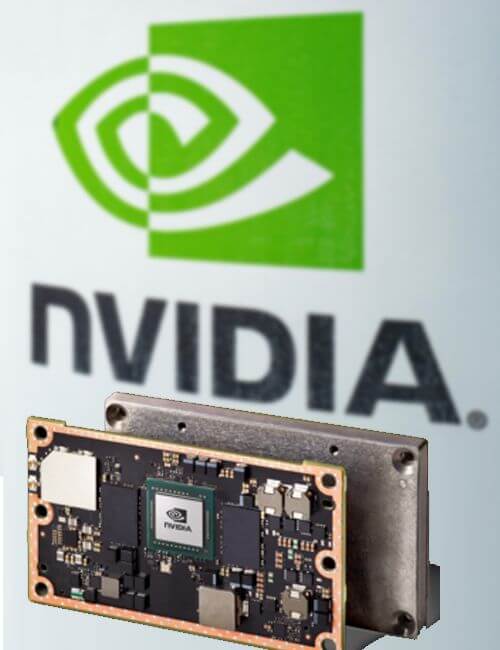
A case study on deploying a dual-camera AI vision system using NVIDIA JetPack on Jetson TX1 — demonstrating GPU acceleration for edge inference on a production embedded platform.