
When engineers select a processor for an embedded system, the decision is rarely just about raw clock speed. It is about the complete package, the peripheral set, the memory architecture, the software ecosystem, the safety certifications, the long-term supply commitment, and critically, whether the silicon vendor's roadmap aligns with the product's lifetime requirements.
Renesas Electronics is one of the world's largest semiconductor companies and the dominant supplier of microcontrollers and microprocessors to the automotive industry. Their RZ family of microprocessors (MPUs), distinct from their well-known RA and RH850 microcontroller families, targets applications that need the processing horsepower of a Linux-capable application processor while remaining within the power, cost, and qualification envelope of an embedded product.
The RZ family is not a single device. It is a carefully segmented portfolio of MPU subfamilies, each optimised for a specific class of application, from small real-time HMI panels and industrial network controllers through to AI-accelerated vision systems and full automotive infotainment platforms. Understanding the landscape of the RZ family, which subfamily does what, why, and with what trade-offs, is the first step to making the right silicon selection for any embedded system that needs more compute than an MCU can provide.
This article is the first in Embien's Silicon Vendor Series, providing deep technical context on processor families that our engineering teams work with daily.
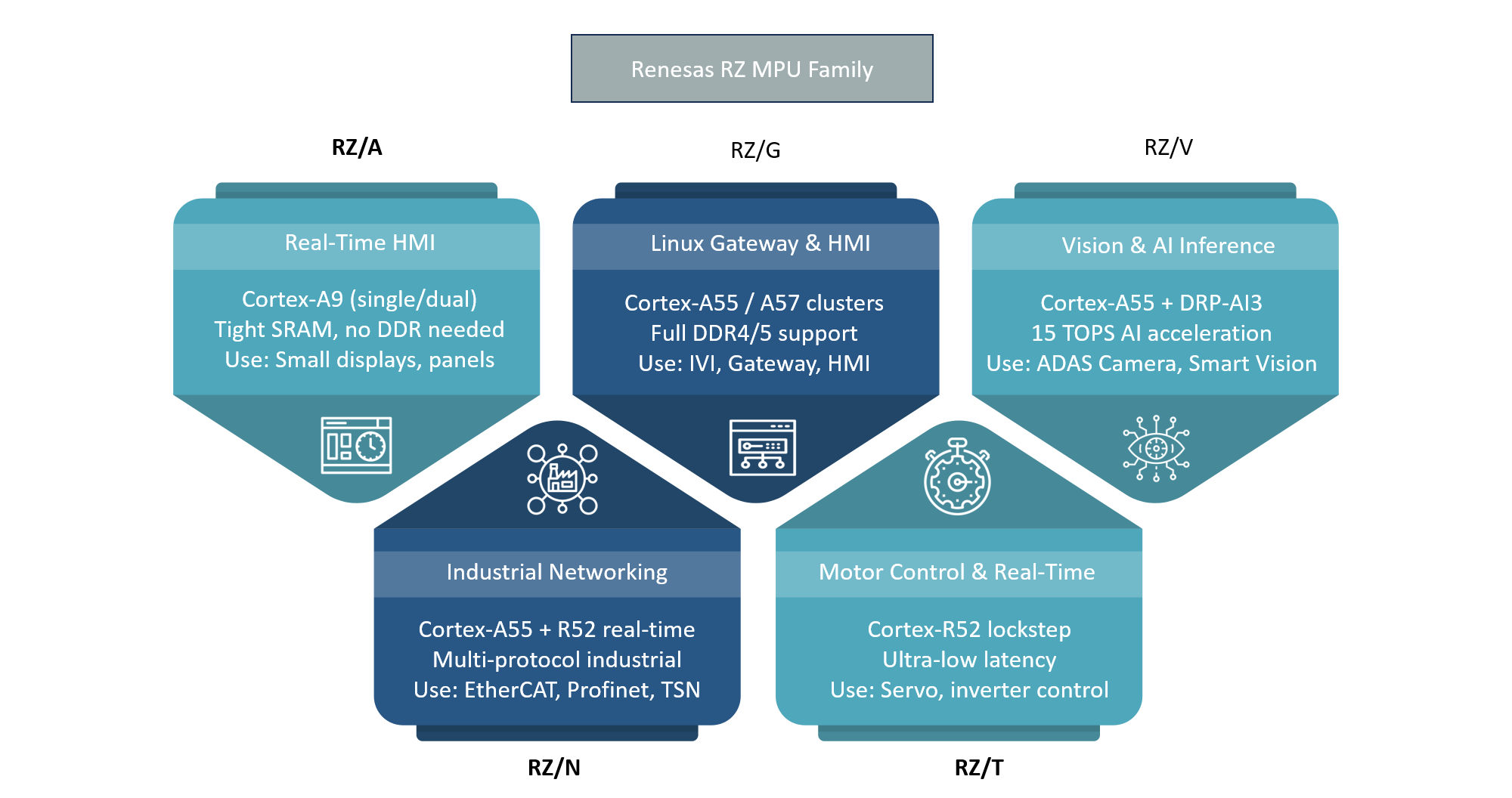
The RZ family shares a common architectural philosophy: ARM Cortex-A application processor cores, paired with specialised hardware accelerators and peripherals for the target application domain, built on Renesas's mature embedded process technology.
Unlike general-purpose application processors, where the silicon vendor optimises for peak benchmark performance, the RZ family optimises for the complete embedded system: deterministic performance, low idle power, wide operating temperature range, long-term availability (typically 10–15 year production commitments), and a software ecosystem built around embedded Linux and real-time operating systems rather than Android or Windows.
This philosophy makes the RZ family particularly well-suited to the space between MCUs and high-performance automotive SoCs, applications that need Linux but do not need the power consumption, cost, or complexity of a Qualcomm Snapdragon or NVIDIA Tegra platform.
The RZ/A subfamily is the most compact in the RZ portfolio and occupies a distinctive niche: it provides an ARM Cortex-A9 application processor with a large on-chip SRAM, up to 10 MB in some variants, allowing the device to run a full HMI application directly from internal memory without requiring external DDR DRAM.
This matters enormously in cost-sensitive and space-constrained applications. External DDR memory adds component cost, PCB area, routing complexity, EMI challenges, and a source of potential field failures. Eliminating it entirely simplifies the hardware design significantly.
Key characteristics:
Typical applicationsIndustrial HMI panels, home appliance control interfaces, medical device displays, small automotive body control displays, white goods interfaces.
The RZ/A is the silicon beneath several of Embien's Sparklet-powered HMI deployments, where the combination of on-chip SRAM, hardware graphics acceleration, and the absence of external DDR delivers a reliable, cost-effective TFT display platform.
The RZ/G subfamily steps up to ARM Cortex-A55 and Cortex-A57 application processor clusters with full external DDR4/LPDDR4 memory interfaces, targeting applications that need a capable Linux platform for complex HMI, connectivity gateway functions, or multi-application environments.
Key characteristics:
Typical applications: In-vehicle infotainment head units, automotive gateway ECUs, industrial gateway controllers, smart camera systems, digital cockpit display controllers.
The RZ/G2L and RZ/G2E are particularly popular in cost-conscious automotive and industrial designs where a capable Linux platform is needed but the application does not justify the power consumption or cost of a full automotive-grade SoC like the R-Car series.
The RZ/V subfamily is the most technically distinctive member of the RZ family and the one generating the most engineering interest in the ADAS and industrial vision space. It combines an ARM Cortex-A55 application processor cluster with Renesas's proprietary DRP-AI (Dynamically Reconfigurable Processor for AI) hardware accelerator.
The DRP-AI is not a conventional NPU or fixed-function accelerator. It is a dynamically reconfigurable dataflow processor, its internal connection topology can be reconfigured at runtime to match the specific computational pattern of each layer in a neural network. This allows it to achieve very high energy efficiency for inference workloads, the RZ/V2N delivers 15 TOPS of AI inference at approximately 1.5 TOPS/W, competitive with dedicated NPU products at significantly lower power and cost.
The DRP-AI supports the major neural network frameworks, ONNX, TensorFlow Lite, PyTorch, through Renesas's DRP-AI Translator tool, which converts trained models into optimised DRP-AI execution graphs. This makes it practical to train a model on a GPU cluster using standard frameworks and then deploy it to the RZ/V with a well-defined optimisation workflow.
RZ/V key variants:
| Variant | Cores | DRP-AI | Key Feature |
|---|---|---|---|
| RZ/V2L | Cortex-A55 dual + M33 | DRP-AI (1 TOPS) | Entry AI vision |
| RZ/V2H | Cortex-A55 quad + R52 | DRP-AI3 (10 TOPS) | Mid-range ADAS |
| RZ/V2N | Cortex-A55 quad + R52 | DRP-AI3 (15 TOPS) | High-performance vision |
Typical applications: ADAS camera ECUs, smart traffic cameras, industrial visual inspection systems, agricultural vision systems, access control with face recognition, drone vision platforms.
The RZ/V2H and RZ/V2N are directly relevant to the ADAS Sensor Fusion ECU architecture discussed in ECU Insights Series Part 3 - the DRP-AI3 is capable of running the camera-based object detection neural network at 30 fps with the thermal and cost envelope of an embedded automotive design, unlike the much more expensive and power-hungry automotive SoCs typically used for this function.
The RZ/N subfamily targets industrial communication gateway applications, devices that need to simultaneously support multiple industrial fieldbus protocols (EtherCAT, PROFINET, EtherNet/IP, Modbus TCP) with deterministic real-time performance.
Key characteristics:
Typical applications: Industrial IoT gateways, PLCs, motor drive networks, building automation controllers, EtherCAT master controllers.
The RZ/N family is the natural platform for multi-protocol industrial gateways, a device that needs to simultaneously interface EtherCAT to a servo drive network, Modbus TCP to legacy instrumentation, and OPC-UA to a cloud platform, all with deterministic timing.
The RZ/T subfamily breaks from the Cortex-A pattern entirely, using an ARM Cortex-R52 core in lockstep configuration for applications where hard real-time determinism and functional safety are the priority rather than operating system capability.
Key characteristics:
Typical applications: Servo motor controllers, inverter control, robot joint controllers, industrial safety controllers.
The RZ/T positions itself as a bridge between conventional automotive MCUs and the Cortex-A MPU space, providing the real-time performance of an MCU with the peripheral richness and processing capability needed for demanding motor control and safety applications.
A processor family is only as useful as its software support. Renesas invests significantly in the RZ software ecosystem:
Yocto Linux BSP: All RZ/G and RZ/V variants have well-maintained Yocto Project Board Support Packages with long-term support commitments. The BSP includes GPU drivers, display framework, camera framework, and multimedia codecs, the infrastructure that embedded Linux HMI applications depend on.
FreeRTOS and Azure RTOS: For RZ/A and RZ/T variants running without Linux, Renesas provides certified RTOS ports with driver libraries.
DRP-AI Translator and Runtime: The complete toolchain for converting, optimising, and deploying neural network models to the DRP-AI accelerator, covering model conversion, performance profiling, and runtime integration with OpenCV and GStreamer pipelines.
e-AI Translator: For deploying smaller ML models (anomaly detection, keyword spotting) to the Cortex-M33 and R52 cores on RZ/V variants, enabling a heterogeneous AI architecture where the DRP-AI handles heavy inference and the R52 handles lightweight real-time inference.
Renesas Preferred Partner Program: Embien is a member of the Renesas Preferred Partner Program with access to early silicon, reference designs, and technical support across the RZ portfolio, giving our customers an accelerated path from silicon selection to production.
The decision tree for RZ subfamily selection follows application requirements closely:
| Requirement | Recommended Subfamily |
|---|---|
| Small HMI, no external DDR, cost-sensitive | RZ/A |
| Linux HMI, rich graphics, multimedia | RZ/G |
| Camera-based AI inference, ADAS vision | RZ/V |
| Multi-protocol industrial networking | RZ/N |
| Hard real-time motor control, ASIL | RZ/T |
The most common mistake in MPU selection is choosing a subfamily based on peak compute performance rather than the specific peripheral set and software ecosystem the application needs. An RZ/V2H is a poor choice for a pure HMI application, its DRP-AI capability goes unused and its power consumption is higher than an RZ/G2L that would serve the HMI function equally well at lower cost. Modern automotive HMI and vision platforms leveraging Renesas RZ MPUs are powered by robust embedded firmware development for deterministic and efficient system performance.
Embien is a Renesas Preferred Partner and R-Car Consortium member with hands-on production experience across the RZ portfolio. Our engineering teams have deployed RZ/A-based HMI platforms using Sparklet, developed RZ/G-based automotive gateway and IVI systems, and worked with RZ/V platforms for embedded vision and ADAS camera applications using the DRP-AI toolchain. We maintain deep familiarity with the Yocto BSP, Linux device driver development, and DRP-AI model optimisation workflows for this family. Embien’s edge computing services enable low-latency processing and real-time decision-making for advanced automotive HMI systems built on Renesas RZ MPUs.
Whether you are evaluating the RZ family for a new design, migrating from a previous generation Renesas device, or need support optimising a neural network model for DRP-AI deployment, the Embien team can accelerate your path from concept to production.
To discuss your RZ-based design requirements, reach out to the Embien team.

Embien’s product engineering services enable end-to-end development of automotive HMI solutions built on advanced MPU architectures like Renesas RZ.
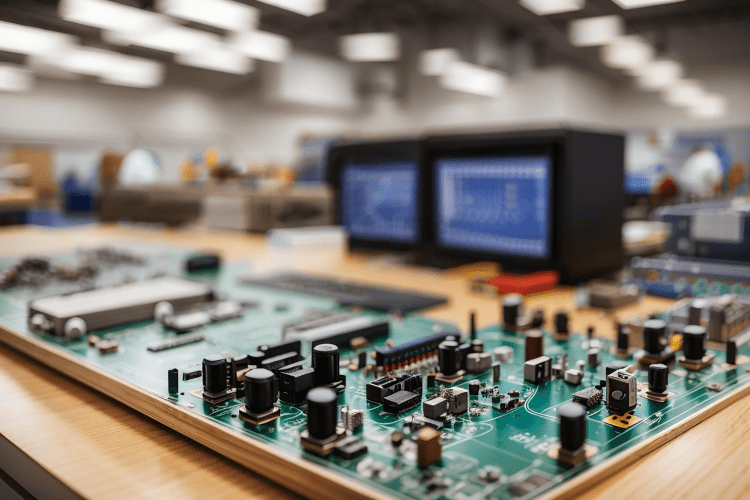
Embien’s Renesas platform expertise enables optimized development of automotive HMI and vision systems built on RZ MPU architectures.
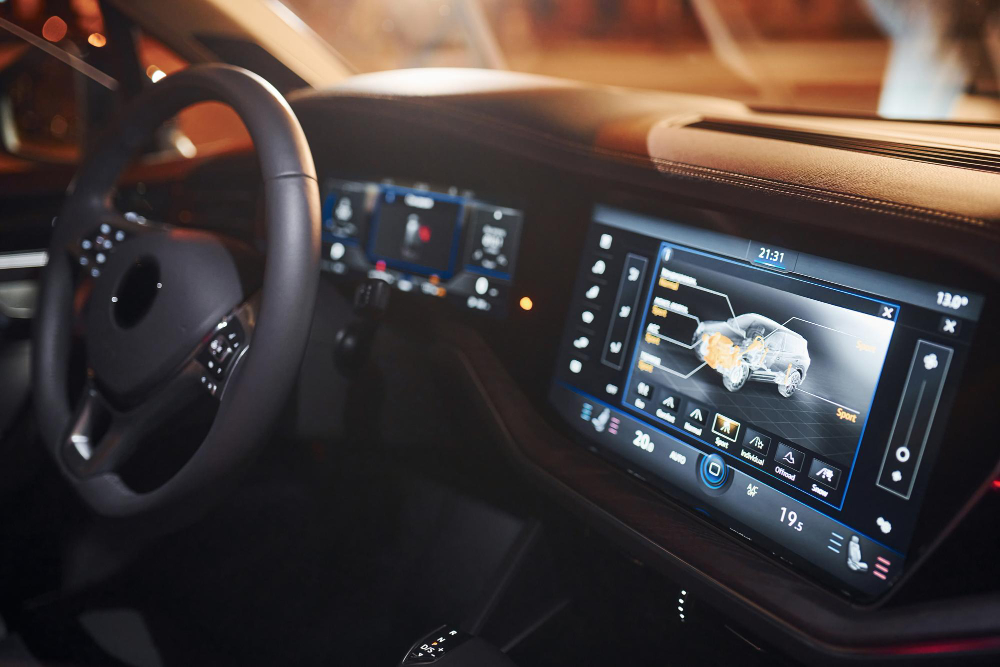
A triple-display automotive ADK on Renesas R-Car M3e was engineered by Embien for advanced in-vehicle infotainment and HMI visualization.