
The Renesas RA family occupies a different position in the Renesas portfolio than the RZ MPUs we covered in the previous article. Where RZ devices run Linux on ARM Cortex-A cores for vision and HMI applications requiring operating system services, the RA family targets the embedded MCU space, deterministic, real-time systems running bare-metal code or an RTOS, controlling peripherals directly, and fitting within tight power and cost envelopes.
What distinguishes the RA family from conventional Cortex-M microcontrollers is its consistent, architecture-level investment in hardware security. Every member of the RA family above the entry tier includes ARM TrustZone for Cortex-M, a dedicated Secure Crypto Engine (SCE), and a True Random Number Generator, making embedded security not an afterthought but a foundational capability present from the silicon level upward.
This matters enormously for the applications the RA family targets: IoT connected devices, industrial edge nodes, smart home controllers, wearables, building automation systems, and automotive-adjacent body control functions. Every one of these applications faces the same pressure, the device is network-connected, long-lived, and increasingly a target for security attacks. Having hardware security roots built into the MCU, rather than bolted on via an external secure element, changes the economics and architecture of secure product design significantly.
This article provides a technical overview of the RA family's architecture, security features, key subfamilies, and the applications where each excels.
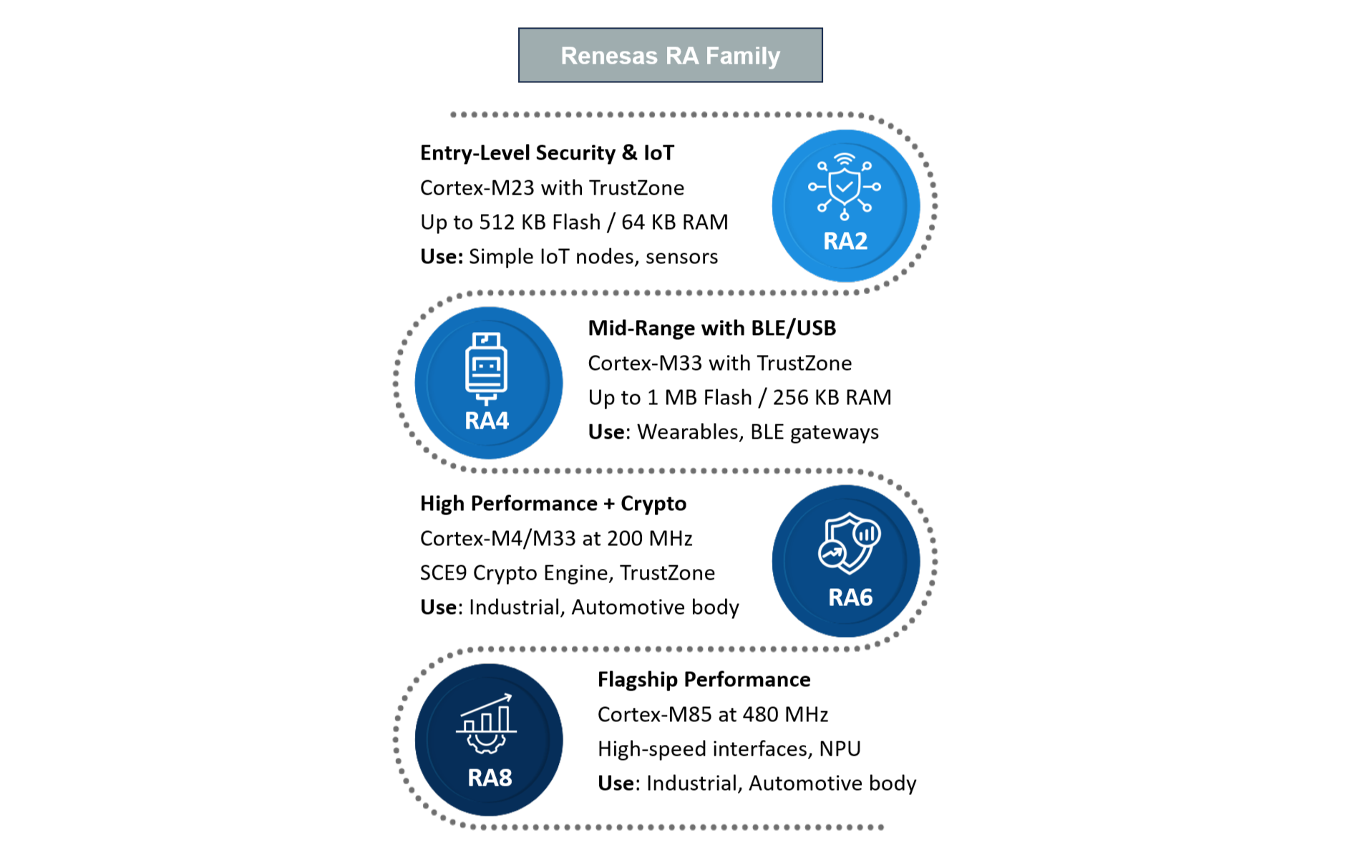
The RA family is built on ARM Cortex-M processor cores - specifically Cortex-M23 (for RA2), Cortex-M33 (for RA4 and RA6), and Cortex-M85 (for RA8). This is a deliberate progression: each step up the family delivers not just more MHz but a more capable security and compute architecture.
The critical security primitive shared across the RA4 and above is ARM TrustZone for Cortex-M. TrustZone partitions the MCU into two execution worlds:
The Secure World runs trusted firmware - cryptographic operations, key storage, secure boot verification, secure communication protocol stacks. Code in the Secure World has access to all MCU resources.
The Non-Secure World runs the main application code - business logic, sensor processing, communication stacks, UI code. Non-Secure code cannot access Secure World memory or peripherals directly. It can only invoke Secure World services through a defined, validated interface called the Non-Secure Callable (NSC) gateway.
This separation means that a vulnerability in the application code - a buffer overflow, a compromised communication stack, cannot directly compromise the cryptographic keys or secure boot logic that live in the Secure World. The attack surface for the most critical security assets is dramatically reduced.
The SCE is Renesas's hardware cryptographic accelerator, present in progressively more capable variants across the RA family. The SCE9, found in the RA6M4 and above, provides hardware-accelerated:
The key wrapping capability deserves particular attention. On a conventional MCU, storing a private key securely means relying on software obfuscation or an external secure element. With the SCE9, keys can be generated inside the SCE, wrapped with a device-unique Hardware Unique Key (HUK), and stored as opaque blobs in flash. The plaintext key material never leaves the SCE, not even to the MCU's application firmware. This provides a meaningful level of key protection without the cost and complexity of an external secure element.
| Subfamily | Core | Max Flash | Key Security Feature | Primary Use Cases |
|---|---|---|---|---|
| RA2 | Cortex-M23 | 512 KB | TrustZone, SCE5 | Simple IoT sensors, entry CE devices |
| RA4 | Cortex-M33 | 1 MB | TrustZone, SCE7, BLE/USB | Wearables, BLE gateways, smart home |
| RA6 | Cortex-M4/M33 | 2 MB | TrustZone, SCE9, Ethernet | Industrial control, automotive body |
| RA8 | Cortex-M85 | 4 MB | TrustZone, SCE9, NPU, MIPI | Edge AI, HMI, high-speed connectivity |
The RA6 subfamily is the most widely deployed in the embedded professional market and the most relevant to Embien's core application domains. The RA6M4 and RA6M5 variants combine a Cortex-M33 core at 200 MHz with the full SCE9 security engine, hardware TrustZone, and a rich peripheral set including Ethernet MAC, USB 2.0 (full-speed and high-speed), CAN FD, multiple SPI/I2C/UART channels, and high-resolution ADC.
The RA6M5 adds a second CAN FD channel and an Octa-SPI interface for high-speed external flash, making it suitable for applications requiring large OTA update buffers alongside CAN connectivity, a combination relevant to automotive body control and gateway applications.
Functionally, the RA6 series targets the space between an entry automotive MCU and a full safety-grade device like the RH850. For ASIL A and B applications where the safety requirements do not demand a lockstep core, building access controllers, smart junction boxes, HVAC controllers, body convenience functions, the RA6 provides a capable, secure, cost-effective platform with a well-supported embedded software ecosystem.
The RA8 subfamily, based on the ARM Cortex-M85 at 480 MHz, represents a significant architectural step up. The Cortex-M85 introduces Helium (ARM M-Profile Vector Extension - MVE), a SIMD instruction set that accelerates DSP and ML inference workloads on an MCU core without requiring a dedicated NPU. For TinyML applications, keyword spotting, anomaly detection, vibration analysis, this is transformative.
The RA8D1 variant adds a MIPI DSI display interface and 2D graphics accelerator, enabling rich TFT display applications directly from an MCU without requiring an MPU. Combined with Embien's Sparklet GUI library, the RA8D1 is a capable platform for HMI applications that need security, a quality display interface, and MCU-class power consumption in a single device.
The RA8T1 targets motor control specifically, adding a dedicated Motor Control Unit (MTU3a) peripheral with high-resolution PWM complementary outputs, dead-time insertion, and encoder interfaces, alongside the Cortex-M85 core and SCE9 security engine. For secure, high-performance motor controllers, an increasingly important category as electrification reaches more application domains, the RA8T1 is a compelling choice.
Renesas supports the RA family with a comprehensive software ecosystem centred on the Flexible Software Package (FSP):
FSP is a modular, layered software framework providing HAL drivers for all RA peripherals, RTOS integration (FreeRTOS, Azure RTOS/ThreadX), middleware stacks (USB, Ethernet, BLE, motor control), and a code generation tool (e2 studio with Smart Configurator) that generates BSP and driver initialization code from a graphical configuration interface.
For security specifically, FSP includes the Crypto FSP modules wrapping the SCE hardware API, a Secure Boot reference implementation, and integration with the TrustZone-based Trusted Firmware-M (TF-M) open-source framework, enabling standards-based PSA Certified secure boot and attestation on RA devices.
The FSP's modular design allows developers to use only the components they need, keeping code size lean for resource-constrained applications while providing a rich starting point for complex connected products. Embien's Product Engineering Services accelerate the development of connected industrial products with integrated hardware, software, and IoT capabilities.
Engineers evaluating the RA family often compare it against the Renesas RH850 (for automotive applications) and STMicroelectronics STM32 (the dominant general-purpose Cortex-M family). The positioning is clear:
RH850 is the choice when ISO 26262 ASIL C or D compliance is required, lockstep cores, automotive qualification, and the safety ecosystem are its primary differentiators. RA does not have lockstep and is not positioned for ASIL C/D.
STM32 dominates industrial and consumer markets with its breadth and ecosystem size, but its security architecture, while improving with the STM32H5 and STM32U5 generations, has historically lagged behind RA's integrated SCE approach. For applications where hardware security is a primary requirement, RA's SCE and TrustZone integration provides a meaningful architectural advantage.
RA occupies the space between these, ASIL A/B capable with appropriate architecture, significantly ahead of conventional MCUs in hardware security, and well supported by Renesas's long-term supply commitment.
Embien works extensively with the Renesas RA family across IoT, industrial, and automotive-adjacent programs. Our engineers are experienced with FSP configuration, SCE-based cryptographic integration, TrustZone partitioning, and OTA update implementation on RA platforms. We have deployed RA-based solutions for building automation, industrial IoT gateway, wearable health monitoring, and automotive body convenience applications. Our Sparklet GUI library is validated and optimised for the RA8D1, enabling rapid HMI development on this platform.
To discuss Renesas RA-based design requirements for your next program, reach out to the Embien team.

Embien's Digital Transformation Services help organizations build secure, connected, and intelligent products for next-generation IoT and industrial ecosystems.

Embien's Embedded System Security Services help build secure connected products with hardware-rooted trust, secure boot, cryptographic key protection, and OTA security.
A case study on an industrial Sub-1GHz wireless sensor network and IoT gateway with long-range connectivity, AES-256 security, and cloud integration.