
In the last few articles of this series, we moved from “what exactly a digital twin is” to real-world deployment challenges, edge-enabled architectures, and the ROI justification frameworks that convince CFOs. Today we are giving you the diagnostic tool most of our clients ask for first: the Digital Twin Maturity Model. If you are wondering whether your current dashboard/BIM model/IoT platform is “just a digital shadow” or already a true digital twin, this five-level framework will tell you exactly where you stand – and, more importantly, what concrete capabilities (and business value) you unlock by climbing to the next level.
Let us explore the Digital Twin Maturity Model – the 5 Levels most industrial companies follow.
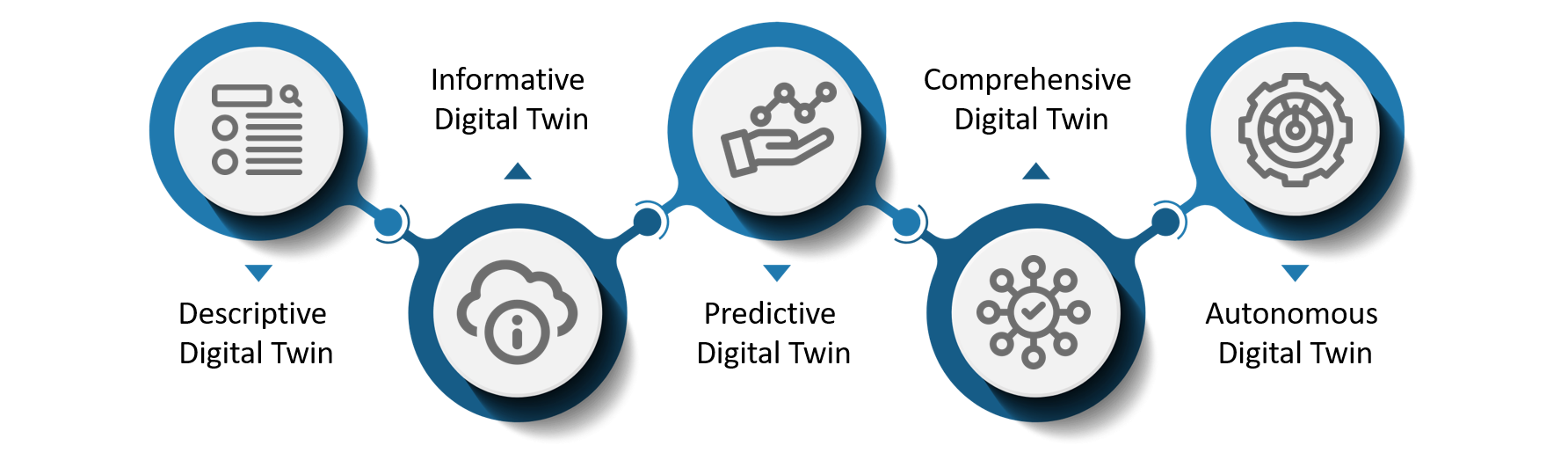
This is where 70 % of companies still pictures of assets live today – beautiful 3D CAD or BIM models used for design reviews, training, or documentation. There is no live data flow. The twin is a perfect visual replica but completely decoupled from reality.
Technical stack typically seen are
Business value: Reduced design errors, better stakeholder communication.
Limitation: The model becomes outdated the moment the physical asset is commissioned or modified. Most companies that call us for “digital twin services” are actually still at Level 1 and don’t realize it.
This is the level where the industry has invested heavily in the last 5–7 years. Sensors push data to the edge to the cloud from where it is shown over dashboards. The twin now reflects the current state of the asset (temperature, pressure, vibration, OEE, etc.).
Typical architecture
Edge gateways (Sparkplug-B/MQTT) → Time-series DB (InfluxDB, Timescale) → Visualization (Grafana, Power BI, ThingsBoard)
Business value: 5–15 % OEE improvement through faster reaction, root-cause analysis after failures.
Limitation: Still reactive. You know the machine failed only after it has failed. If your “digital twin” only shows you what is happening right now and cannot tell you what will happen next week, you are solidly at Level 2. This is where most manufacturing companies currently operate.
This is the jump that delivers the famous “20–40 % maintenance cost reduction” numbers you read in Gartner reports. A Digital Twin with Machine Learning now contains physics models, historical data, and ML models that predict future states — making it the first level of true Digital Twin Sophistication that justifies CFO investment.
Typical technology stack we deploy for clients
Business value: The systems start preparing you for the things that are about to fail giving you time to fix them and mitigate the risks.
Limitation: Still manual intervention is needed as control path is not available.
The twin is no longer just watching or predicting – it is actively controlling the physical asset. Data flows both ways: physical → digital (as before) and digital → physical (set-point changes, automated tuning, model-predictive control).
Critical capabilities
Business value: The twin is intelligent that it will optimize itself and reduce most of your workload.
Limitation: A very small support from humans needed for critical decision making.
The holy grail of Digital Twin Sophistication. At this level, Autonomous Systems make decisions without human approval (within defined constraints) and continuously evolve their own models — representing the ultimate expression of Industrial Automation Digital Twin Services.
Current technology frontier
Only a handful of companies worldwide operate pilot Level 5 twins today (Siemens Energy, Shell, Tesla Gigafactories). But the architecture decisions you make at Level 3 will determine whether you can reach Level 5 in this decade or be stuck forever at Level 2.
Answer these five questions:
Most companies arrive at Level 2 with good IoT infrastructure but no predictive intelligence. Closing that gap quickly requires Digital Twin Development Services that span Embien’s cross-domain embedded services portfolio, and progressing beyond Level 3 is where Embien’s predictive maintenance with digital twin services deliver measurable improvements in asset availability and maintenance cost at every maturity level. Advanced Digital Twin implementations leverage IoT connectivity and edge computing to enable low-latency analytics and closed-loop operations.
Digital Twin Sophistication is not a destination but a journey — understanding your current maturity level is the essential first step. Moving from Level 2 monitoring to Level 3 Digital Twin with Machine Learning and ultimately toward Level 5 Autonomous Systems requires both architectural discipline and the right engineering partner, with Industrial Automation Digital Twin Services delivering measurable ROI at every rung of the ladder.

Discover how Embien's cross-domain embedded services span automotive, medical, industrial, and consumer electronics — giving digital twin projects access to deep domain expertise at every maturity level.

Learn how Embien's predictive maintenance with digital twin services help organisations move from reactive Level 2 monitoring to proactive Level 3 predictive intelligence in months.

Case study: Embien developed an IoT-based remote battery monitoring system that feeds a cloud digital twin with real-time SoC and SoH data, enabling predictive replacement scheduling.