
In the rapidly evolving landscape of Industry 4.0, digital twins represent a pivotal bridge between physical assets and digital intelligence. As part of our series "The Engineering Reality of Digital Twins," this article delves into the intricate technology stack that powers a robust digital twin. Targeted at developers, engineering managers, and companies seeking digital twin implementation services, we'll explore the architecture from edge to cloud, highlighting key components like IoT tech stack, embedded firmware development, and edge computing for digital twins. Whether you're optimizing manufacturing processes or enhancing predictive maintenance, understanding this stack is crucial for seamless integration.
Digital twins are virtual replicas of physical systems, enabling real-time simulation, monitoring, and optimization. A robust implementation requires a layered architecture that ensures data fidelity, low latency, and scalable intelligence. Let's break it down layer by layer, starting with the foundational edge components.
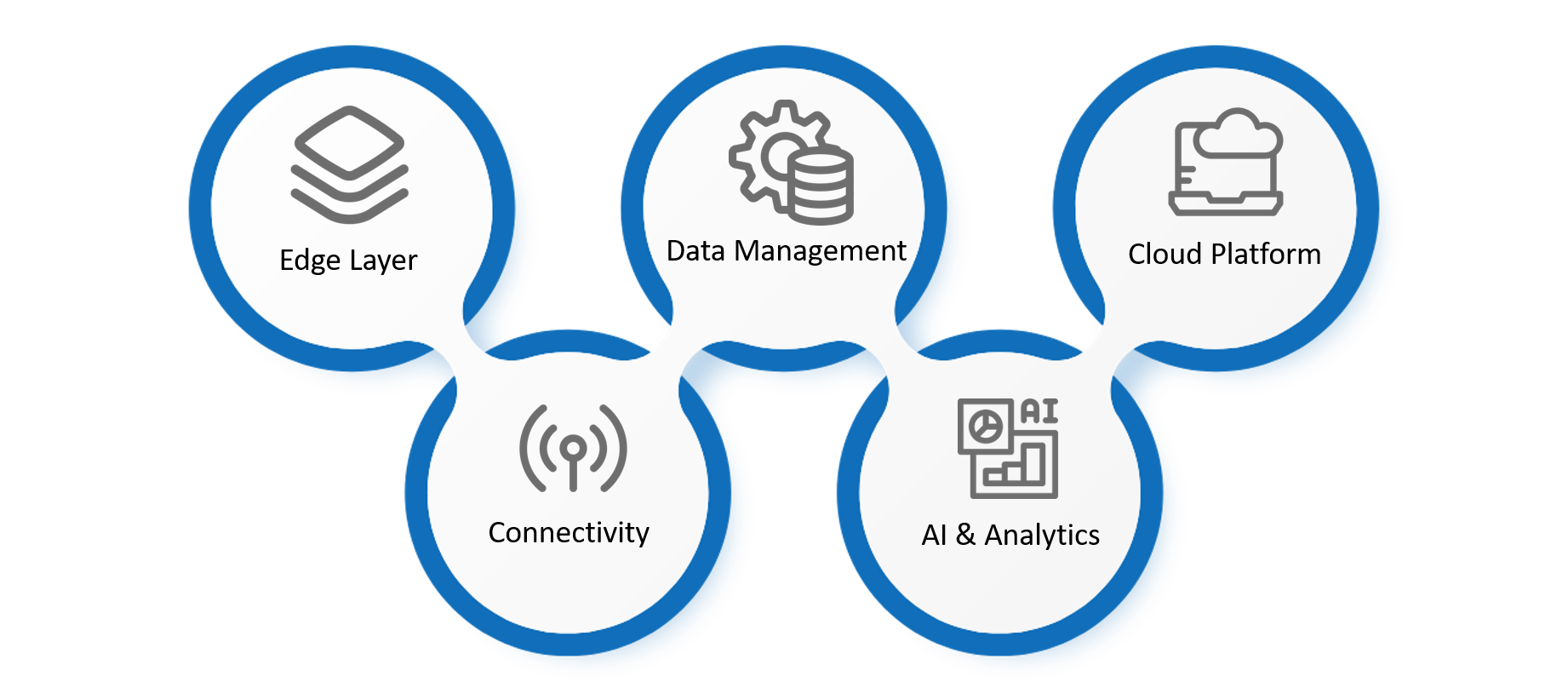
The edge layer forms the bedrock of any digital twin, where physical data is captured and pre-processed. This is where embedded firmware development shines, ensuring reliable data acquisition from diverse assets.
At the core are sensors, devices like accelerometers, thermocouples, and pressure transducers that gather raw data on vibration, temperature, and flow rates. For instance, in an industrial turbine, vibration sensors might sample at 1 kHz to detect early signs of wear. These sensors connect via gateways, which act as intermediaries, aggregating data from multiple sources and performing initial filtering to reduce noise.
Protocol conversion is a critical challenge here. Industrial environments often use legacy protocols like Modbus (for PLCs in factories), CAN (Controller Area Network, common in automotive and machinery), and OPC-UA (Open Platform Communications Unified Architecture, for secure machine-to-machine communication). A robust gateway must translate these into standardized formats for upstream transmission. Embedded firmware, developed on industrial compute platforms, handles this conversion efficiently. For example, using RTOS’es for real-time task management ensures deterministic behavior, preventing data loss in high-stakes scenarios.
Edge computing for digital twins amplifies this layer by enabling on-device analytics. Instead of sending all data to the cloud, edge nodes can run lightweight ML models for anomaly detection, reducing bandwidth needs by up to 90%. Companies looking for digital twin implementation services often overlook firmware optimization, leading to inefficiencies. At Embien Technologies, our expertise in embedded systems ensures gateways are power-efficient and secure, supporting protocols like Modbus TCP/IP over Ethernet for seamless integration.
This edge foundation sets the stage for reliable connectivity, ensuring data flows uninterrupted to higher layers.
Once data is captured at the edge, connectivity becomes the lifeline of the digital twin. A robust IoT tech stack must support low-latency, reliable communication across diverse environments.
MQTT (Message Queuing Telemetry Transport) with Sparkplug extensions is a go-to for publish-subscribe models. Sparkplug adds industrial-grade features like device birth/death certificates and payload optimization, making it ideal for digital twins in manufacturing. For example, a wind farm digital twin might use MQTT Sparkplug to report turbine metrics every second, enabling real-time synchronization.
OPC-UA complements this by providing a secure, platform-independent framework for data exchange. It supports information modeling, where assets are represented as nodes in a semantic address space, facilitating interoperability.
Emerging networks like 5G URLLC (Ultra-Reliable Low-Latency Communication) offer sub-millisecond latencies, crucial for time-sensitive applications such as autonomous vehicles or robotic arms. TSN (Time-Sensitive Networking) enhances Ethernet for deterministic packet delivery, while LoRaWAN suits long-range, low-power scenarios like agricultural digital twins monitoring soil moisture over vast fields.
In practice, a hybrid approach works best. Use LoRaWAN for remote sensors, transition to 5G at gateways, and employ MQTT over TLS for cloud uplink. Security is paramount; implement certificate-based authentication to prevent man-in-the-middle attacks. For developers building IoT architecture for digital twins, tools like Eclipse Mosquitto for MQTT brokers simplify prototyping.
With connectivity secured, the focus shifts to cloud platforms, where the digital twin truly comes alive.
The cloud layer hosts the virtual model, orchestrating data ingestion, simulation, and visualization. Choosing the right platform impacts scalability and cost.
Microsoft Azure Digital Twins excels in modeling complex relationships using Digital Twins Definition Language (DTDL), based on JSON-LD. It integrates seamlessly with Azure IoT Hub for device management and supports spatial intelligence for 3D visualizations. Ideal for enterprises with Microsoft ecosystems, it enables queries like "Find all assets with temperature > 80°C" via its graph-based querying.
AWS IoT TwinMaker, on the other hand, focuses on industrial IoT with built-in 3D modeling via integration with Amazon SageMaker. It uses entity-component architecture for twins, allowing easy attachment of telemetry, alarms, and videos. For asset-heavy industries, its Grafana plugin aids dashboarding.
Custom Kubernetes setups offer flexibility for bespoke needs. Using tools like K3s for lightweight clusters, you can deploy open-source twins with Prometheus for monitoring and InfluxDB for storage. This avoids vendor lock-in but requires expertise in container orchestration, Helm charts, and CI/CD pipelines.
When evaluating for digital twin implementation services, consider factors like data sovereignty (e.g., GDPR compliance) and integration with existing ERP systems. A hybrid cloud-edge model, where sensitive computations stay on-prem, balances performance and security. Effective cloud deployment relies on a solid data layer to handle the influx of information.
Data is the fuel for digital twins, and managing it efficiently is non-negotiable.
Time-series databases (TSDBs) like InfluxDB or TimescaleDB (a PostgreSQL extension) are optimized for high-ingestion rates, storing timestamped data from sensors. They support downsampling for historical analysis and alerting on thresholds. In a digital twin for predictive maintenance, TSDBs enable querying trends like "Average vibration over the last 30 days."
The digital thread concept weaves data across the asset lifecycle, from design (CAD models) to operation (telemetry) and decommissioning. It ensures traceability, using standards like ISO 10303 for data exchange.
Knowledge graphs elevate this by representing entities and relationships semantically. Tools like Neo4j model twins as graphs, where nodes are assets and edges denote dependencies (e.g., "Pump A supplies Fluid to Tank B"). This facilitates advanced queries via Cypher language, uncovering insights like failure propagation.
For optimization, integrate Apache Kafka for streaming data pipelines, ensuring real-time synchronization between physical and digital realms.
To unlock predictive power, AI/ML integration is essential.
AI transforms digital twins from passive mirrors to proactive optimizers.
Physics-informed neural networks (PINNs) blend ML with domain physics, solving differential equations for simulations like fluid dynamics in HVAC systems. Unlike traditional FEM (Finite Element Method), PINNs reduce computation time by orders of magnitude.
Anomaly detection uses algorithms like Isolation Forest or Autoencoders to flag deviations. In TensorFlow or PyTorch, train models on normal data streams to detect outliers, preventing downtime in assets like conveyor belts.
Reinforcement learning (RL) goes further, optimizing control policies. Using libraries like Stable Baselines3, an RL agent can learn to adjust parameters (e.g., valve openings) for energy efficiency, simulating scenarios in the twin before real-world application.
Edge AI, via TensorFlow Lite, pushes inference to devices, while cloud-based training handles heavy lifting. Ethical considerations, like bias in training data, are vital for reliable outcomes. Embien's edge computing services cover firmware development, protocol conversion, and on-device AI inference — ensuring high-fidelity telemetry reaches your Edge Computing for Digital Twins implementation without bandwidth waste or latency risk. Combined with our industrial automation services, we translate twin-generated insights into closed-loop control actions that directly improve asset uptime and process throughput through edge computing for iot applications.
A robust Digital Twin Technology stack is only as reliable as its weakest layer — from embedded firmware converting legacy Modbus signals into MQTT streams, to Physics-informed neural networks that predict equipment failure weeks in advance. Embien’s digital transformation services help integrate data, connectivity, and analytics layers that power robust Digital Twin architectures.The IoT Tech Stack decisions made at the edge determine whether your twin reflects physical reality or a degraded approximation, making deep embedded expertise the essential foundation for every Edge Computing for Digital Twins deployment.

See how Embien's edge computing services provide the firmware, protocol conversion, and on-device inference that make digital twin data pipelines reliable from sensor to cloud.
Explore how Embien's industrial automation services apply digital twin insights to close the control loop — turning predictive intelligence into measurable reductions in asset downtime.
Case study: Embien developed a remote monitoring and control system that streams multi-channel sensor data to a cloud-hosted digital twin for real-time anomaly detection.