
In pursuit of adopting latest technologies companies invest millions into high-fidelity sensors, 5G backhaul, and petabyte-scale data lakes, only to fail at the final yard: the screen.
A Digital Twin is, at its core, a cognitive bridge. If your twin is a perfect mathematical replica of a gas turbine but your operators can’t discern a critical thermal anomaly from a sensor glitch within three seconds, you don’t have a Digital Twin, you have a very expensive screensaver.
In this article, we will peel back the layers of HMI Design Services and the engineering required to turn "Big Data" into "Intuitive Insight."
In the consumer world, UX is about delight and retention. In the industrial Digital Twin world, UX is about situational awareness and cognitive load management.
When we design the UI layer for a Digital Twin, we are essentially trying to represent a "ghost", the digital abstraction of a physical asset, in a way that the human brain can process without fatigue. The reality is that industrial operators are often bombarded with information. A typical refinery might have 50,000 tags updating every second.
The "Engineering Reality" is that visualization must be hierarchical.
If your UI/UX design doesn't follow this flow, you risk "Alarm Fatigue," where the human operator begins to ignore the very intelligence the Digital Twin was built to provide. Embien’s UI/UX design services help transform complex Digital Twin data into intuitive visual experiences across diverse industry domains.
For years, industrial visualization was synonymous with 2D "fla" dashboards think bars, gauges, and line charts. While effective for simple telemetry, they fail to provide spatial context.
We are seeing a massive shift toward integrating game engines like Unity and Unreal Engine into the industrial stack. Why? Because these engines are the world's most optimized platforms for rendering complex geometries in real-time.
When we integrate a high-fidelity 3D model (often derived from original CAD data) with live MQTT or OPC-UA streams, the user experience changes fundamentally. Instead of reading a "High Temp" warning on "Bearing-04," an operator sees a glowing red thermal gradient on the physical 3D representation of that bearing within the machine assembly.
The Engineering Challenge: CAD models are "heavy." They contain every screw thread and internal tolerance. For a Digital Twin, we must perform "Mesh Optimization" stripping the CAD data down to its visual essence so it can be rendered at 60 FPS without needing a liquid-cooled GPU. This is where professional HMI Design Services become a technical necessity rather than a luxury.
The most compelling use case for visualization today is AR/VR in Industry. By decoupling the display from the desk, we bring the Digital Twin to the asset itself.
Imagine a junior technician on a remote offshore wind farm. They encounter a complex pitch-control failure. By wearing an AR headset (like a HoloLens or specialized industrial eyewear), the Digital Twin is "overlaid" onto the physical turbine.
This isn't science fiction; it is the current standard for reducing Mean Time to Repair (MTTR). The "Reality" here, however, is the difficulty of Spatial Anchoring. Ensuring that the digital overlay stays perfectly aligned with the physical asset as the technician moves is a complex feat of computer vision and SLAM (Simultaneous Localization and Mapping) algorithms.
In the Digital Twin ecosystem, latency is the enemy of truth. If the physical sensor detects a pressure spike at t=0, but the visualization layer doesn't render that spike until t=500ms, the "Twin" is out of sync with reality.
In high-speed manufacturing, 500 milliseconds is an eternity. Low-latency rendering involves optimizing the entire data path:
Achieving sub-100ms latency from "Sensor to Eye" requires a deep understanding of the underlying silicon, a core tenet of Embedded GUI Development.
While it's easy to render a beautiful Digital Twin on a high-end workstation with an RTX 4090, the real engineering challenge is doing it on the "Edge." Many industrial assets are monitored via small, sunlight-readable displays embedded directly into the machine or handheld diagnostic tools.
This is where Embien Technologies excels. We understand that you cannot run a 40GB Unreal Engine project on an ARM Cortex-M7 or an i.MX8-based industrial controller.
Sparklet, our proprietary embedded GUI library is designed for exactly this purpose: providing high-performance, fluid, and sophisticated visuals on resource-constrained hardware.
While many "off-the-shelf" libraries are bloated and heavy, Sparklet is lean. It allows us to:
By leveraging Sparklet, our HMI Design Services bridge the gap between "Heavyweight Digital Twins" and "Practical Field Equipment." We ensure that the intelligence of your twin isn’t trapped in the cloud, but is visible, readable, and actionable right where the work happens — a core principle of hmi development for industrial systems. Embien’s product engineering services cover the full visualization stack — from edge-optimised Sparklet GUI rendering on ARM Cortex-M7 platforms to cloud-hosted 3D twin dashboards — underpinned by semiconductor development support that delivers the GPU throughput required for real-time, high-fidelity Digital Twin Technology visualization.
Effective Visualization for Digital Twins transforms overwhelming sensor telemetry into actionable operator insight — using hierarchical UX, 3D context, and sub-100ms rendering to eliminate alarm fatigue. Whether achieved through Embedded GUI Development on resource-constrained edge hardware or cloud-hosted immersive interfaces, robust HMI Design Services are what close the final yard between digital intelligence and human decision-making in any industrial deployment.

Explore how Embien's product engineering services deliver edge-optimised Embedded GUI Development and visualization stacks that make digital twin data immediately actionable for industrial operators.

Learn how Embien's automotive user experience and HMI Design Services expertise translates directly into intuitive digital twin dashboards — applying the same human-centred design discipline to industrial visualization interfaces.
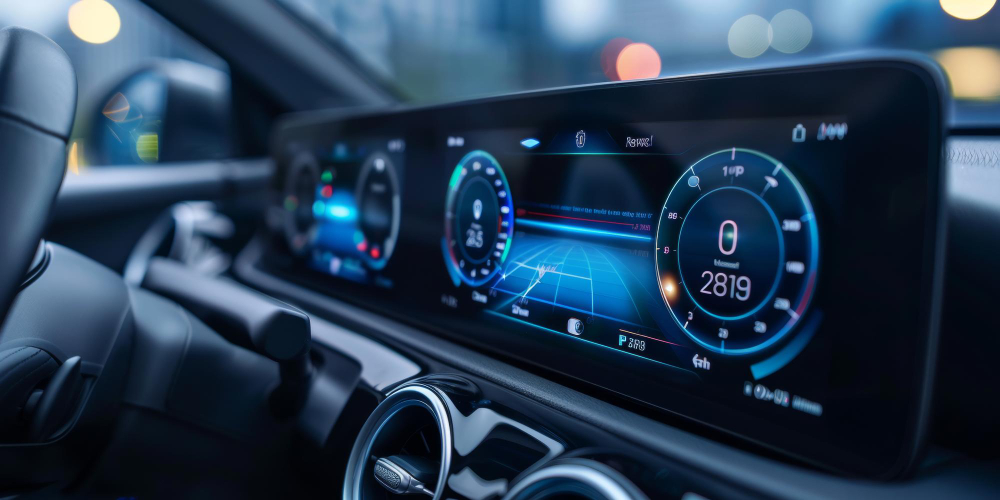
A high-performance HMI case study: Embien developed an Android Automotive smart cluster on i.MX8 — demonstrating the real-time rendering and embedded GUI engineering that underpins digital twin visualization on constrained hardware.