
In the world of high-stakes aerospace and defence (A&D), the cost of a software bug isn’t measured in lost "app engagement" — it’s measured in mission failure, multi-million dollar overruns, and compromised national security.
As software becomes the defining factor of modern warfare, powering everything from the signal processing in Active Electronically Scanned Array (AESA) radars to the real-time decision-making in autonomous loitering munitions, the complexity of Defence Embedded Systems has outpaced traditional development lifecycles.
The industry is currently facing a "Verification Debt" crisis. When verification is treated as a final "gate" rather than a continuous thread woven through the entire programme, teams fall into the trap of Late Verification — a mistake that leads to cascading failures that no amount of late-stage "crunch time" can fix.
Defence Embedded Systems operate under the most unforgiving constraints in engineering. Whether governed by DO-178C (Software Considerations in Airborne Systems) or MIL-STD-498, the standards demand deterministic behavior and absolute reliability.
For a Level A system under DO-178C — where a failure is catastrophic — the rigor required is immense. Every line of code must be traceable to a requirement, and structural coverage (Modified Condition/Decision Coverage — MC/DC) must be 100%. Mission-Critical Embedded Systems of this class leave no margin for defects discovered at integration: a single unresolved requirement gap can invalidate months of certification evidence and restart the compliance clock entirely.
When verification is delayed in Defence Embedded Systems, you aren’t just looking for bugs — you are risking the entire certification body of evidence that regulators and programme managers depend upon.
Historical data from Department of Defense (DoD) programs suggests that major software-intensive projects often experience cost overruns ranging from 30% to 100%. Late Verification is one of the primary drivers of those overruns.
The logic is simple but brutal:
When Late Verification happens via a "Shift-Right" approach, a single architectural flaw discovered during Hardware-in-the-Loop (HIL) testing can trigger a complete redesign of Defence Embedded Systems. In a project with a $50 million budget, a six-month delay due to Late Verification and re-certification can burn over $1.5 million in labor alone — not counting the strategic cost of a delayed deployment. Late Verification is therefore not merely a technical problem; it is a programme management and national security risk that Defense Embedded Systems teams cannot afford to inherit.
Many defense contractors still rely on a traditional waterfall-adjacent model where testing waits for "Golden Hardware." This leads to systemic Late Verification across Defence Embedded Systems programmes:
This approach creates a "bow wave" of risk that crashes during the integration phase. By the time Defence Embedded Systems are finally tested on-target, the "easy" fixes are gone — only the deep-seated, structural issues remain. Defense Embedded Systems programs that fail to escape this trap routinely exceed budget and timeline by factors that dwarf the cost of the Shift-Left Testing infrastructure that would have prevented the problem entirely.
To overcome the pitfalls of Late Verification, CTOs and Program Managers must adopt a Shift-Left Testing philosophy. This means moving verification as far to the left of the development timeline as possible, embedding it into every sprint and milestone of Defence Embedded Systems development.
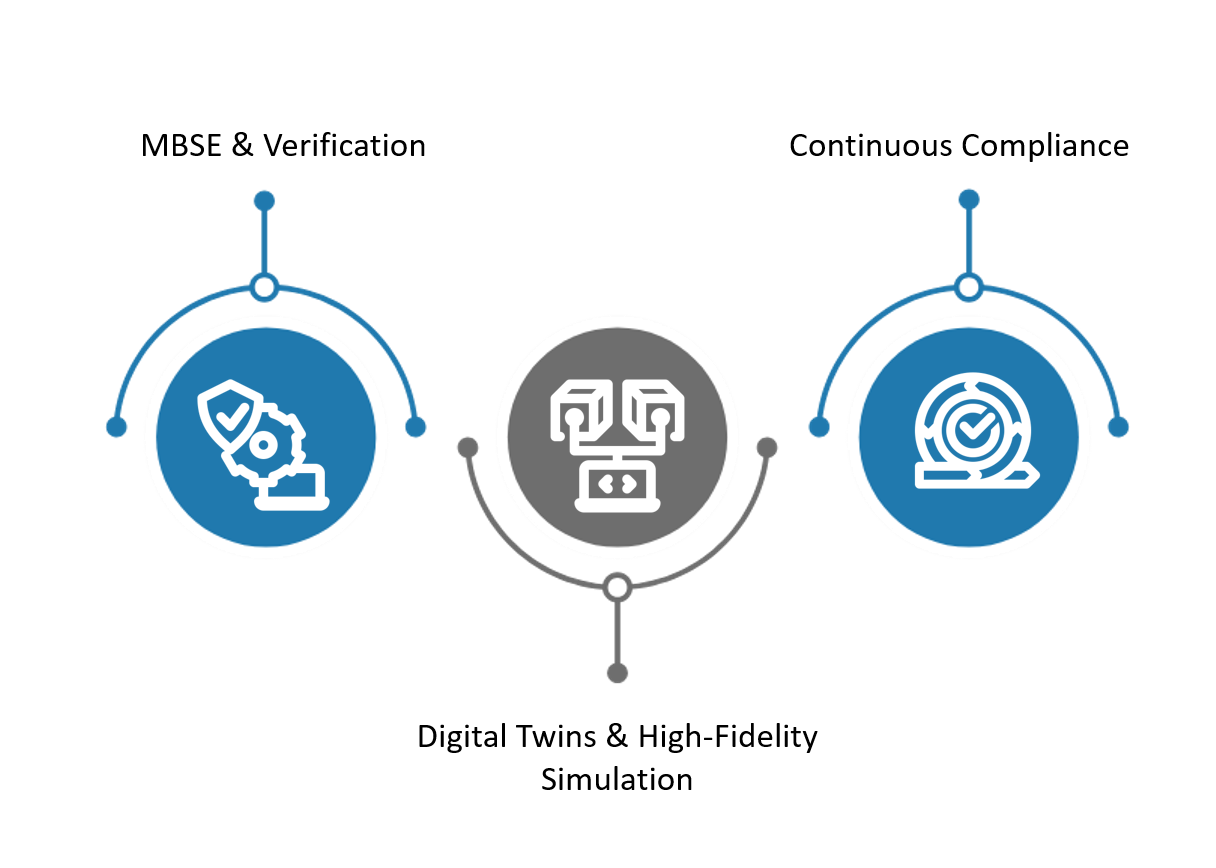
1. Model-Based Systems Engineering (MBSE) and Verification
Instead of 500-page PDF requirement documents, Shift-Left Testing begins with executable models (SysML/Simulink). Model-Based Verification allows teams to simulate system behavior before a single line of C++ or Ada is written. If the guidance logic is flawed, it surfaces in the model — not on the firing range. For Mission-Critical Embedded Systems, this approach is not optional; it is the only path to predictable certification timelines.
2. Digital Twins and High-Fidelity Simulation
Physical hardware is no longer a prerequisite for meaningful Shift-Left Testing. By creating a "Digital Twin" of the embedded environment, developers of Defence Embedded Systems can run thousands of automated regression tests in a virtualized cloud environment. This ensures that when the software finally meets the hardware, 95% of the logic has already been proven — a principle as applicable to Defense Embedded Systems avionics as it is to radar signal-processing firmware.
3. Continuous Compliance
Certification should be "baked in" from the very start of Defence Embedded Systems development. By utilizing automated tools that generate DO-178C or MIL-STD artifacts in real-time, teams eliminate the "documentation panic" at the end of the project. This continuous compliance approach is a cornerstone of mature Shift-Left Testing strategies.
At Embien, we’ve spent years perfecting the tools and processes that prevent the Late Verification trap in Defence Embedded Systems. We understand that in defence, Time-to-Market is Time-to-Mission.
Introducing TestBot: The Future of Automated Validation
One of our flagship offerings, TestBot, was designed specifically to bridge the gap between development and verification in Defence Embedded Systems. TestBot is an end-to-end automated test bench that supports Shift-Left Testing by enabling:
Hardware-in-the-Loop (HIL) Automation: Seamlessly validating firmware against real-world hardware interfaces (CAN, MIL-STD-1553, ARINC 429) without manual intervention — applicable across all Mission-Critical Embedded Systems classes.
No-Code Test Logic: Allowing systems engineers to define complex test scenarios through a graphical interface, accelerating the Shift-Left Testing transition without requiring specialists to write bespoke test harnesses for every Defense Embedded Systems program.
Real-Time Data Processing: Ensuring that timing-critical avionics and radar signals are validated with microsecond precision, meeting the determinism requirements of Defence Embedded Systems standards.
Our expertise isn’t just in the tools, but in the implementation. We help defence contractors navigate the complexities of Secure Boot, Multicore Interference Analysis, and Legacy System Modernization — ensuring that every Defence Embedded Systems project is "Certification-Ready" from Day 1. Embien’s product engineering services embed DO-178C and MIL-STD compliance artifacts into every program from day one, while our semiconductor development support provides the HIL automation, digital twin environments, and hardware bring-up expertise that keep defence programmes on schedule.
Defence Embedded Systems cannot tolerate verification debt — every deferred test compounds into structural risk at integration, certification, and ultimately mission deployment, and organisations that adopt Shift-Left Testing from the very first sprint will consistently deliver Mission-Critical Embedded Systems on time, on budget, and with the full certification body of evidence that regulators demand.

Embien's product engineering services support defence and aerospace programs with shift-left verification strategies — including model-based development, automated HIL test benches, and DO-178C/MIL-STD compliance tooling from day one.

Explore how Embien engineers mission-critical Defence Embedded Systems — applying rigorous shift-left testing, formal verification, and safety-standard compliance to eliminate costly late-stage defects.

A defence-relevant embedded case study: Embien delivered Linux performance tuning and automated deployment on Tegra TK1 — demonstrating the shift-left verification discipline that prevents expensive late-stage failures in Defence Embedded Systems.