
A conventional head-up display projects a fixed, cockpit-relative image, speed, gear, a handful of icons, floating a comfortable distance ahead of the driver. An augmented reality hud is a fundamentally different engineering problem: it has to place graphics that appear anchored to the real world outside the windshield, a turn arrow overlaid on the actual lane, a highlight around the pedestrian the ADAS system has detected, which pulls in optics, real-time graphics, and sensor fusion in ways a conventional combiner HUD never had to address. Our existing coverage of instrument cluster architecture and cluster UX design addresses conventional displays; AR HUD is a genuinely distinct technology this article covers on its own terms.
A conventional combiner-based HUD reflects a fixed image off the windshield or a dedicated combiner glass at a shallow virtual image distance, typically just a couple of meters ahead of the driver, which is sufficient for cockpit information but makes it visually awkward to overlay anything meant to align with objects further down the road. Augmented reality HUD architecture instead targets a much longer virtual image distance, often seven to fifteen meters or more, specifically so overlaid graphics can appear to sit on or near real-world objects like the road surface or a lead vehicle rather than floating obviously in front of the windshield. That longer projection distance changes nearly everything about the optical and mechanical design compared to a conventional HUD, which is why augmented reality HUD is treated as a distinct product category rather than a feature added onto an existing combiner HUD.
Optical engine design for ar hud: picture-generating unit and projection distance starts with the picture-generating unit, typically a TFT-LCD or DLP-based projector, whose image is relayed through a folded mirror path and magnifying optics before reaching the windshield. Achieving the long virtual image distance an AR HUD needs, without an unreasonably large optical package eating into dashboard space, requires careful folded-mirror geometry and often an aspheric or freeform mirror surface to correct the significant image distortion that a curved, raked windshield introduces at that projection distance. Optical engine design for AR HUD: picture-generating unit and projection distance is where the majority of an AR HUD program's hardware engineering effort and bill-of-materials cost actually goes, well before any graphics or sensor fusion software gets involved.
Real-time graphics rendering constraints for world-locked ar hud overlays are unforgiving because a world-locked graphic that lags behind the vehicle's actual motion, even by a couple of frames, becomes visually disorienting rather than helpful; the overlay has to track the driver's perceived view of the real world with very low latency and very high frame consistency. This pushes AR HUD graphics rendering toward dedicated GPU hardware with guaranteed frame timing rather than a best-effort software renderer, and the rendering pipeline has to be tightly synchronized with the vehicle's motion and sensor data rather than treated as an independent display subsystem. Real-time graphics rendering constraints for world-locked AR HUD overlays are, in practice, closer to the demands of a professional flight simulator display than to a typical infotainment graphics pipeline.
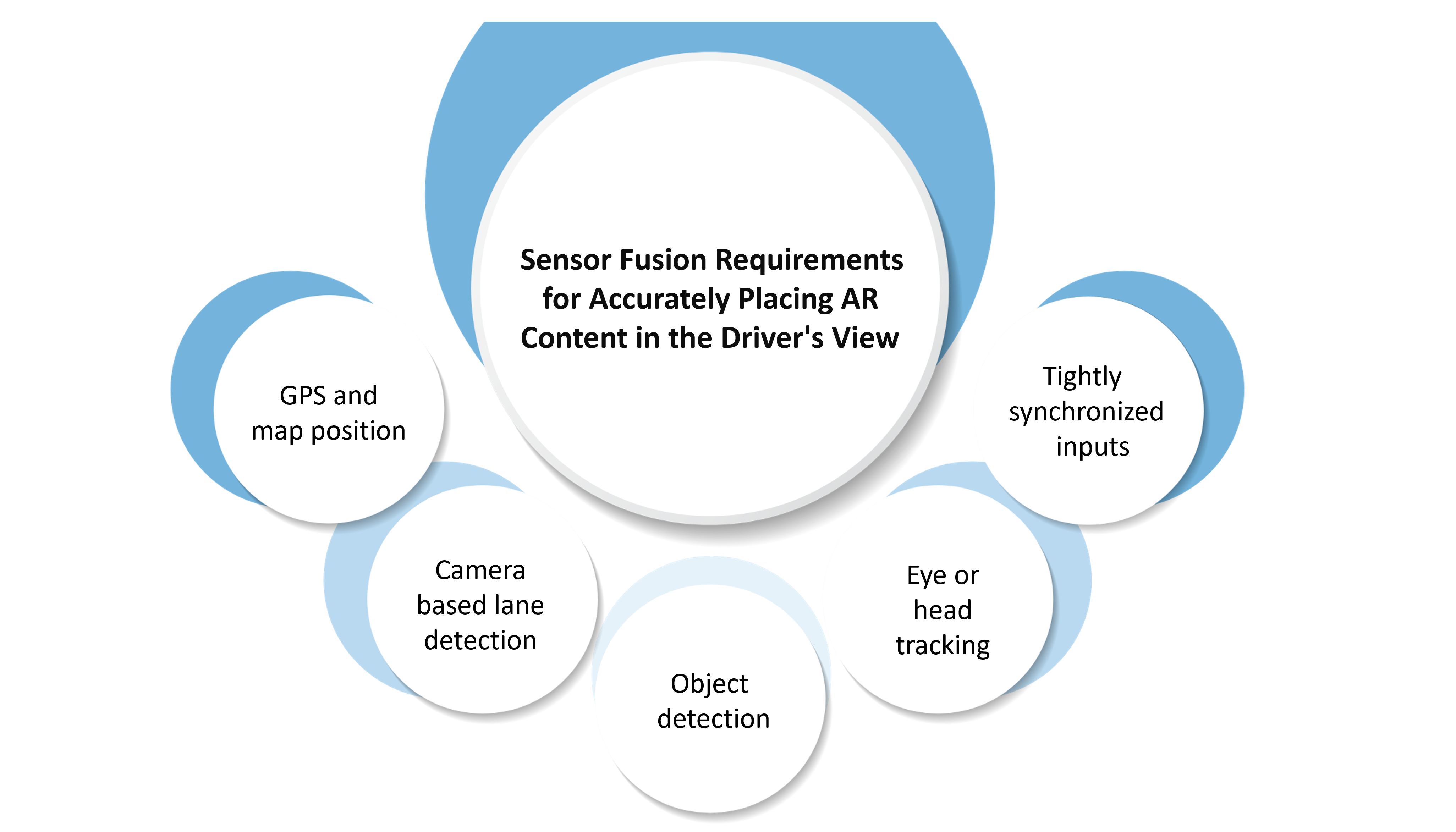
Sensor fusion requirements for placing ar hud content in the driver's view combine several independent inputs that all have to stay tightly synchronized: the vehicle's GPS and map position, camera-based lane and object detection, and, critically, eye or head tracking of the driver's actual viewing position, since a world-locked overlay computed for the wrong assumed eye position will appear visibly misaligned with the real-world object it is meant to highlight. Getting this sensor fusion pipeline accurate and low-latency enough for AR HUD is one of the harder integration problems in the vehicle, because it depends on subsystems, ADAS perception, positioning, and driver monitoring, that were historically engineered independently and now have to feed one tightly time-synchronized display pipeline.
The eye-box, the three-dimensional region within which the driver's eyes can see the full HUD image correctly, has to be large enough to accommodate the real range of driver heights, seating positions, and normal head movement during driving, without making the optical package impractically large. A generous eye-box is even more important for augmented reality HUD than for a conventional HUD, because a world-locked overlay's alignment with real-world objects is far more sensitive to the assumed eye position than a conventional cockpit-relative HUD image is; an overlay that looks correctly placed for one seating position can look visibly offset for another driver of different height, which makes eye-box size and driver position variance a core, not secondary, design constraint.
An AR HUD's most valuable content, lane guidance, pedestrian and hazard highlighting, adaptive cruise following-distance indicators, comes directly from the vehicle's ADAS perception pipeline, which means augmented reality ar embedded systems are not a standalone display feature but a consumer of the same object detection and lane-tracking outputs the ADAS system already produces. Coordinating AR HUD content timing with the underlying perception pipeline's own latency and update rate is essential, since an overlay generated from stale perception data will lag visibly behind the real-world scene it is supposed to be anchored to. This is also where augmented reality ar embedded engineering meets automotive functional safety: an overlay that misrepresents a hazard's position is worse than no overlay at all.
Embien Technologies brings deep instrument cluster and automotive display engineering experience to augmented reality hud programs, including optical-adjacent graphics pipeline design, real-time rendering architecture, and sensor fusion integration for world-locked AR overlays. This work extends naturally into large-format cockpit display engineering, covered in our companion article on pillar-to-pillar and curved automotive displays. To discuss AR HUD engineering for a new or existing vehicle program, reach out to Embien's engineering team.

Embien's Digital Transformation Services accelerate software-defined vehicles, connected cockpits, and next-generation automotive HMI platforms.

Automotive Electronics expertise spans AR HUDs, instrument clusters, cockpit displays, ADAS integration, and sensor fusion.
A case study on developing a triple-display automotive platform with a digital cluster, infotainment system, and dedicated head-up display.