
Rear parking assist and similar driver-supervised parking aids are, architecturally, a vehicle-side problem: the car senses its own surroundings and helps a driver who is still in the loop complete a maneuver. Automated valet parking systems: sensor and infrastructure architecture is a different engineering problem entirely. In an automated valet parking (AVP) deployment, the vehicle drives itself to a parking space with no driver aboard at all, and it does so by depending on sensing, communication, and control infrastructure the vehicle itself does not own or carry. Understanding automated valet parking systems: sensor and infrastructure architecture means understanding where responsibility for perception, decision-making, and safety shifts from the vehicle to the facility, and what that shift demands of both sides of the system.
How does automated valet parking differ architecturally from driver-assisted parking? it differs in where the safety-relevant intelligence actually lives. A driver-assisted system like rear parking assist uses onboard ultrasonic or camera sensing to warn or gently intervene while a human retains full authority over the maneuver and can override at any moment. Automated valet parking removes the driver from the loop entirely once the vehicle is dropped at a designated zone, so the system needs a complete, continuously updated model of a parking structure that no single vehicle's sensor suite was ever designed to build alone. That model has to account for other AVP vehicles moving simultaneously, pedestrians who may enter a nominally vehicle-only zone, and structural features -- ramps, low clearances, blind corners -- that a facility's own infrastructure is far better positioned to track than a vehicle passing through it once.
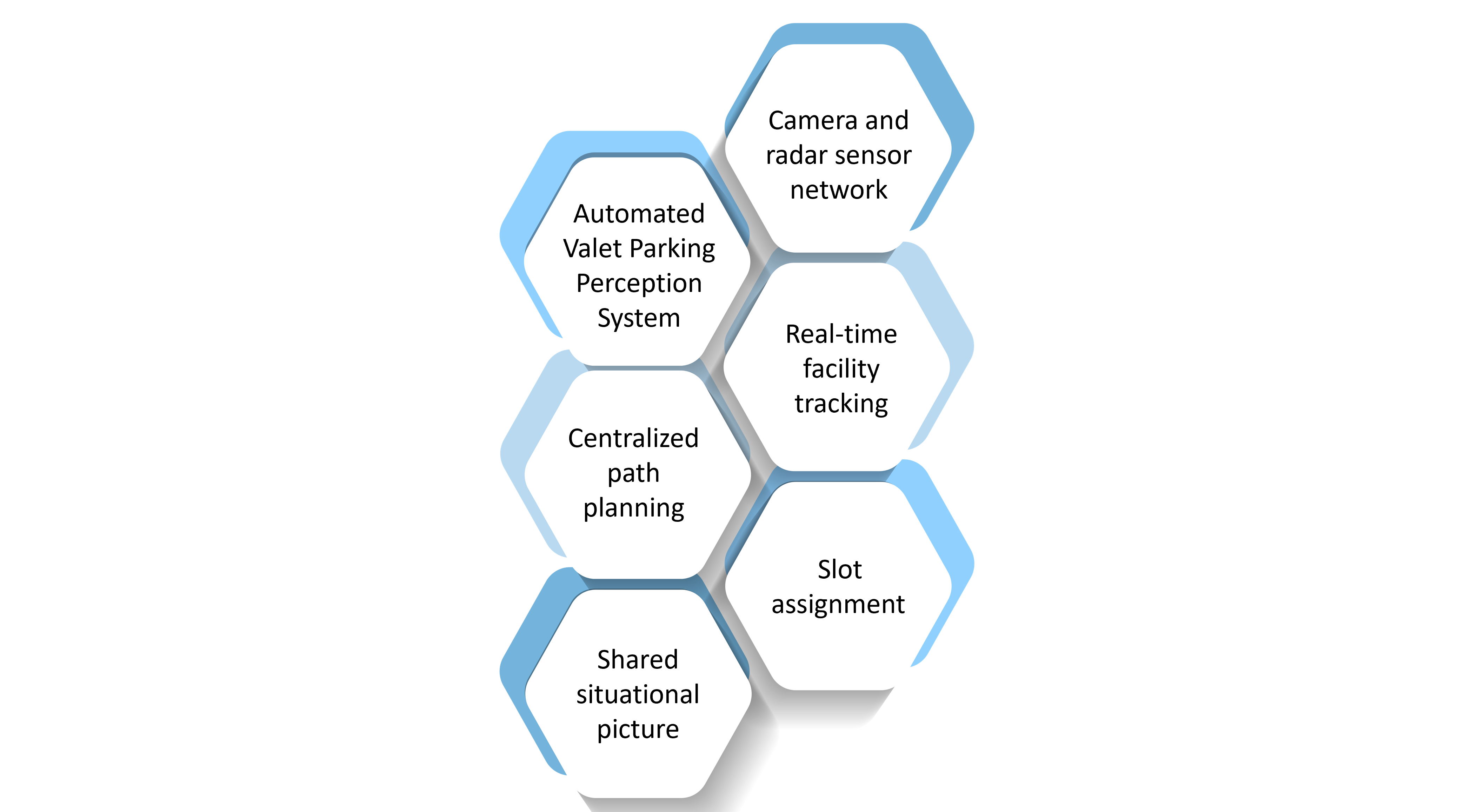
Infrastructure-side sensing and communication for automated valet parkingis what actually makes the AVP concept possible at scale. A production AVP facility deploys its own camera and radar sensor network covering the full parking structure, feeding a central perception and orchestration system that tracks every vehicle, pedestrian, and obstacle in the facility in real time. Rather than expecting a single vehicle's sensors to see around a blind corner or through a support pillar, the infrastructure sees the whole space continuously and pushes that shared situational picture out to every AVP-capable vehicle currently maneuvering. Infrastructure-side sensing and communication for automated valet parking also typically includes centralized path planning and slot assignment, so vehicles aren't independently negotiating right-of-way the way a human driver would in a conventional lot; the facility's system tells each vehicle where to go and when it is safe to go there.
V2i communication requirements for coordinating with parking infrastructure sit at the center of the whole AVP architecture, because the vehicle-side automation is only as good as the low-latency, high-reliability link carrying instructions and situational updates from the facility system. That link needs guaranteed message delivery within tight time budgets -- a stale infrastructure update is worse than none, because a vehicle acting on outdated positional data can make a maneuver decision that infrastructure sensing would have flagged as unsafe moments later. V2I communication requirements for coordinating with parking infrastructure typically build on the same connectivity foundation used for broader V2X deployments, and a facility rolling out AVP benefits from the same underlying V2X and C-V2X communication architecture already being engineered for wider vehicle-to-everything connectivity rather than a bespoke, facility-only protocol.
Because the vehicle depends on infrastructure it doesn't control, fail-safe design when parking infrastructure communication is lost mid-maneuver is not an edge case an AVP architecture can defer -- it is one of the first requirements that has to be designed in from the start. A vehicle that loses its link to the facility system mid-maneuver has to default to a conservative, self-contained behavior: stop in place if stopping is safe, or complete a bounded, low-risk motion using only onboard sensing if stopping where it is would itself create a hazard, such as blocking a lane other vehicles depend on. Fail-safe design when parking infrastructure communication is lost mid-maneuver also has to specify how long a vehicle waits before escalating to a remote operator or an audible/visual alert, and how the facility recovers a stranded vehicle without putting a person on foot into an active AVP zone.
AVP raises liability questions that driver-assisted parking systems never had to answer, because responsibility for a safe outcome is now genuinely split between the vehicle manufacturer and the facility operator running the infrastructure the vehicle depends on. If a collision happens because the facility's sensor network had a coverage gap versus because the vehicle mis-executed a valid instruction, those are different fault chains with different regulatory and insurance implications, and most jurisdictions are still working out how AVP deployments should be certified, audited, and insured as a joint vehicle-infrastructure system rather than as a vehicle feature alone. This is one of the reasons AVP rollouts to date have stayed largely limited to controlled pilot deployments rather than broad public availability.
It's useful to think of AVP as the next rung on a ladder that starts with driver-supervised systems like the one covered in Embien's rear parking assist (RPAS) engineering guide. RPAS establishes the vehicle-side sensing, actuator control, and warning logic for a driver who stays engaged throughout the maneuver. Automated valet parking keeps much of that vehicle-side control stack but removes the assumption that a human is present to catch what the vehicle's own sensors miss, replacing that assumption with dependency on facility infrastructure instead. Engineering teams building toward AVP capability are, in a real sense, building on top of the same actuator and low-speed maneuvering competence RPAS already proved out, then adding the infrastructure-dependent layer on top.
Embien Technologies works across both sides of the automated valet parking systems: sensor and infrastructure architecture problem: vehicle-side perception and low-speed maneuver control, and the V2I connectivity layer that ties a vehicle to facility infrastructure in real time. For teams evaluating an AVP pilot, that means engineering support that spans sensor fusion, fail-safe maneuver logic, and the communication architecture the whole system depends on -- not just a single piece of the stack in isolation.

Embien's Digital Transformation Services support connected automotive platforms by integrating embedded systems, connectivity, cloud, and intelligent digital technologies.

Embien's Automotive Electronics expertise covers ADAS, sensor integration, vehicle electronics, and connected automotive systems for advanced mobility applications.
A case study on developing an electric power steering technology demonstrator with ASIL-D functional safety requirements for automotive applications.