
The automotive Ethernet content already on the site focuses on the established point-to-point standards used for high-bandwidth backbone and sensor links, but a newer standard addresses a different problem entirely: connecting many low-bandwidth sensors economically. 10base-t1s automotive ethernet: multidrop networking for zonal sensor architectures covers exactly that gap, a multidrop Ethernet physical layer purpose-built for zonal sensor networking rather than point-to-point high-bandwidth links.
A zonal architecture concentrates dozens of low-bandwidth sensors and simple actuators, window switches, door sensors, seat position sensors, wheel speed sensors, within a single vehicle zone, and wiring each of those individually back to a zonal controller over a dedicated point-to-point link adds harness cost and connector count that doesn't scale well as sensor counts climb. Multidrop Ethernet lets many nodes share a single unshielded twisted-pair bus segment, closer in spirit to how CAN or LIN nodes share a bus than to how traditional point-to-point automotive Ethernet links work, which is exactly the topology zonal sensor networking with many low-bandwidth nodes actually needs.
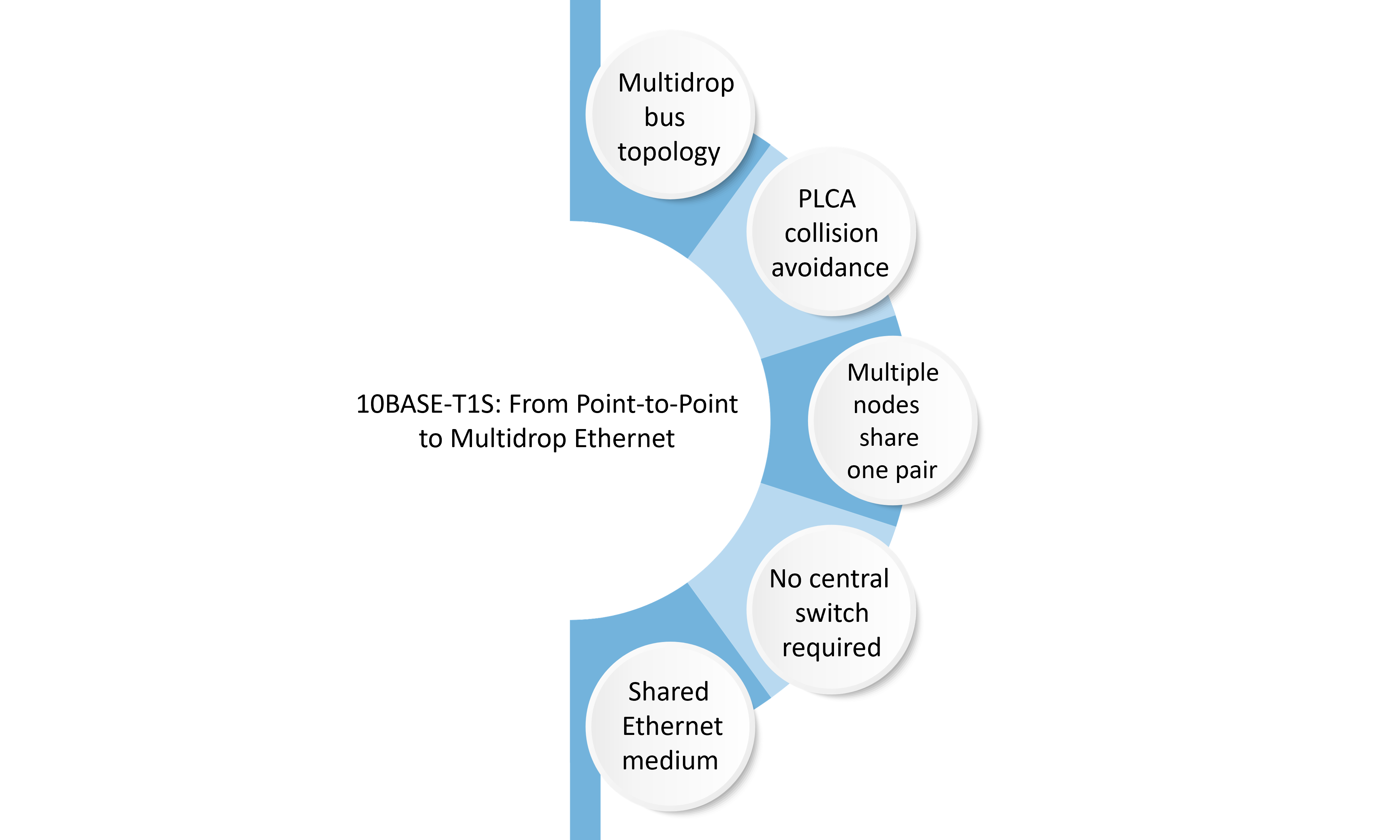
How 10base-t1s differs architecturally from point-to-point automotive ethernet comes down to topology and medium access. Standard automotive Ethernet variants like 100BASE-T1 and 1000BASE-T1 are point-to-point links, one cable, one pair of endpoints, requiring a switch to connect more than two devices; 10BASE-T1S instead supports a genuine multidrop bus topology where multiple nodes physically share the same pair of wires, using a collision-avoidance scheme called PLCA, Physical Layer Collision Avoidance, to let many nodes transmit on the shared medium without a central switch. How 10BASE-T1S differs architecturally from point-to-point automotive Ethernet is, in effect, the difference between Ethernet built for a handful of high-bandwidth links and Ethernet reengineered to behave like a shared bus.
Where does 10base-t1s fit relative to can fd for sensor-network use cases? is a natural question since both target similar cost-sensitive, multidrop sensor networking use cases. 10BASE-T1S offers meaningfully higher raw bandwidth, 10 Mbit/s, than CAN FD's data-phase rate, and it natively speaks Ethernet and IP, simplifying integration with Ethernet-based zonal and central compute architectures without a protocol translation gateway. CAN FD, in turn, retains stronger real-time determinism and a more mature, widely deployed tooling and diagnostic ecosystem. Where 10BASE-T1S fits relative to CAN FD for sensor-network use cases in most current zonal architectures is as a complement rather than a replacement, handling sensor nodes that benefit from native Ethernet connectivity while CAN FD continues to handle latency-critical control traffic.
Physical layer and topology considerations for multidrop automotive networks shape how a 10BASE-T1S segment actually gets designed in a vehicle. The standard supports both a bus topology, with nodes tapping into a shared trunk cable, and a mixed topology using multidrop segments off a switched Ethernet backbone, and segment length, node count, and stub length all have defined limits that a network designer has to respect to keep signal integrity and PLCA timing within spec. Physical layer and topology considerations for multidrop automotive networks also include EMC performance over unshielded twisted pair, a design constraint 10BASE-T1S was specifically engineered to meet given the automotive environment it targets.
10BASE-T1S segments typically terminate at a zonal gateway or zonal controller, which aggregates sensor data from the multidrop segment and forwards it onto the vehicle's higher-bandwidth Ethernet backbone toward central compute. Product Engineering Services for zonal E/E architectures include 10BASE-T1S integration, gateway ECU development, and scalable automotive Ethernet network design. That role fits directly into the broader shift toward zonal E/E architecture described in our zonal E/E architecture and domain controllers article, where 10BASE-T1S is one of the physical-layer building blocks that main controllers centralizing vehicle comput make dense, low-cost sensor connectivity practical within a single vehicle zone.
Current oem adoption status for 10base-t1s automotive ethernet is still relatively early compared to established point-to-point automotive Ethernet standards, with several major OEMs and Tier 1 suppliers publicly committed to 10BASE-T1S for next-generation zonal architectures and early production designs beginning to appear, but it has not yet reached the broad deployment maturity of 100BASE-T1. Current OEM adoption status for 10BASE-T1S automotive Ethernet is expected to accelerate as more vehicle platforms move to zonal architectures that specifically benefit from multidrop sensor connectivity, following a similar early-adoption curve to what other newer automotive networking standards have gone through.
10BASE-T1S doesn't replace the point-to-point automotive Ethernet standards covered in our physical layer of automotive Ethernet and Layer 2 protocols article; it extends automotive Ethernet's reach into a topology those point-to-point standards were never designed to serve. Alongside CAN FD, covered in our CAN FD and CAN XL article, 10BASE-T1S rounds out a vehicle network architecture that increasingly mixes multiple physical layers, each chosen for the specific traffic pattern it serves best.
Embien Technologies designs multidrop and point-to-point automotive Ethernet networks, including 10base-t1s automotive ethernet: multidrop networking for zonal sensor architectures deployments, as part of broader zonal E/E architecture and network integration engineering. To discuss 10BASE-T1S integration, zonal sensor network design, or mixed CAN FD and automotive Ethernet architecture, reach out to Embien's engineering team.

Embien's Domains Served include automotive electronics, software-defined vehicles, industrial automation, and connected mobility platforms.

Automotive Electronics expertise spans zonal ECUs, body electronics, gateway controllers, and in-vehicle Ethernet communication.

A case study on developing an i.MX8-based Android Automotive smart cluster with high-performance HMI, vehicle networking, and production-grade embedded software.