
Every major failure mode in an EV battery pack traces back to heat, whether it shows up as accelerated capacity fade over years of use or as a rapid, dangerous event over minutes. Automotive battery pack thermal management: bms engineering for ev safety is the discipline that sits between those two outcomes, and it is arguably the single hardest problem in EV battery engineering precisely because it has to be solved simultaneously at the cell level, the pack level, and the software level inside the BMS. Our broader guide to automotive BMS ECU architecture covers battery management generally; this article goes deep on the thermal side specifically.
A battery pack has to stay within a narrow temperature band to charge and discharge safely, and that band is difficult to hold across a real vehicle's operating envelope: fast charging that dumps heat into cells in minutes, cold-climate operation where the pack barely reaches efficient operating temperature, and a physical form factor where cells at the center of a large pack are inherently harder to cool than cells at the edge. Unlike most other embedded systems for electric vehicles, a thermal management failure does not just degrade performance, it can cascade into a safety event, which is why automotive battery pack thermal management: bms engineering for ev safety gets a level of validation rigor that few other vehicle subsystems receive.
The active vs passive cooling architecture tradeoffs for ev battery packs decision shapes nearly every other choice in the thermal design. Passive cooling, relying on the pack's thermal mass and conduction to the vehicle body, is lower cost and mechanically simpler, but it caps the charging and discharging rates a pack can sustain without exceeding safe cell temperatures, which makes it a poor fit for fast-charging-capable platforms. Active liquid cooling, circulating coolant through channels or plates in thermal contact with the cells, adds pumps, a cooling loop, and real software complexity to the BMS, but it is what makes aggressive fast-charging and high sustained discharge rates possible without derating. Most mainstream EV platforms today land on active liquid cooling specifically because the active vs. passive cooling architecture tradeoffs for EV battery packs increasingly favor active systems as charging speed becomes a competitive differentiator, even though the added cost and complexity are real.
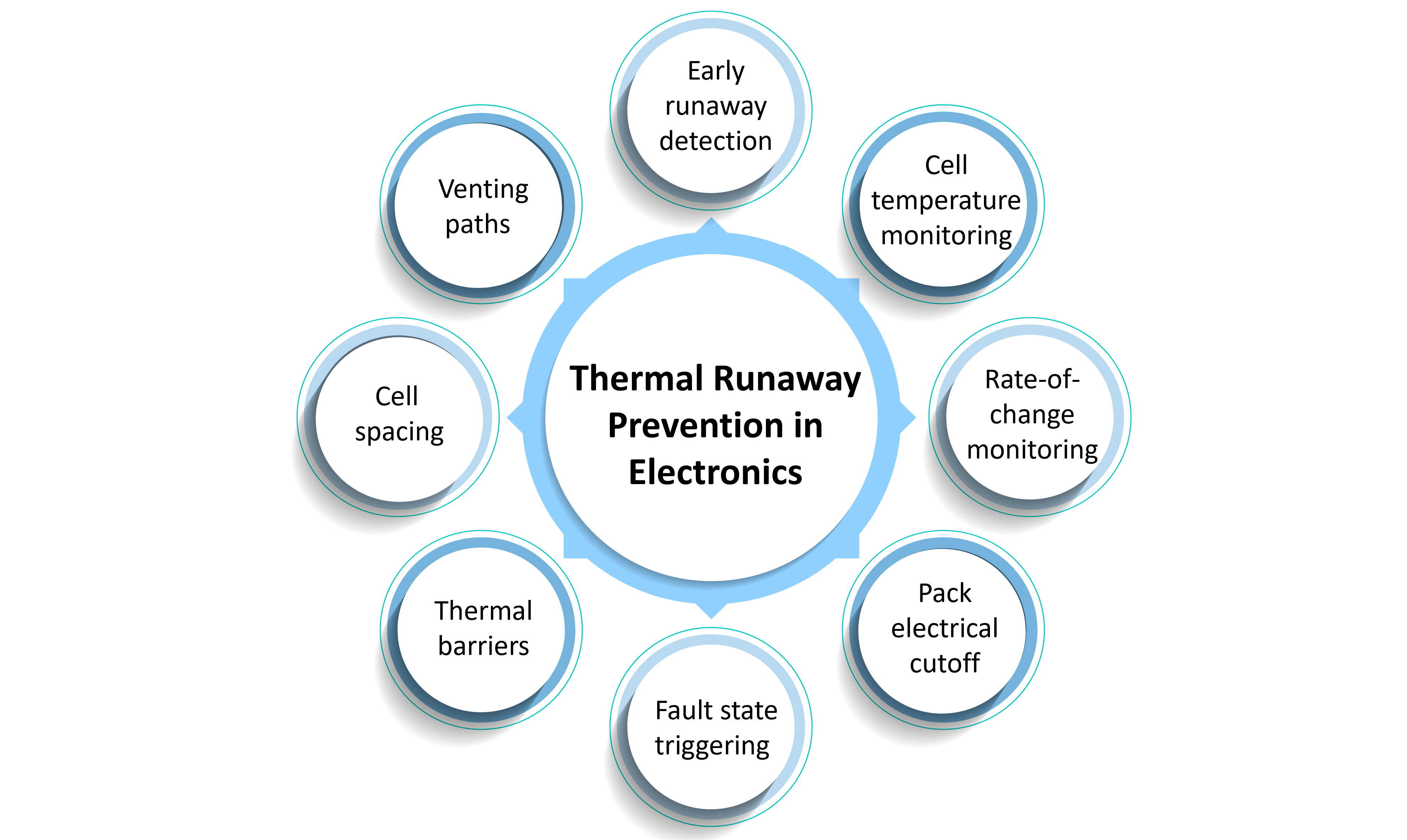
Thermal runaway prevention in electronics for an EV battery pack operates on two separate timescales: detecting the early signature of an individual cell going into thermal runaway, a rapid, self-sustaining temperature rise driven by internal short-circuit or cell damage, and preventing that event from propagating to neighboring cells once it starts. Detection relies on monitoring rate-of-change in cell temperature and voltage rather than absolute thresholds alone, since a runaway event's defining characteristic is how fast it accelerates, not just how hot it eventually gets. Propagation prevention is largely a mechanical and materials problem, cell spacing, thermal barriers, and venting paths designed so a single cell failure does not ignite its neighbors, but the BMS plays a critical role by cutting off the pack electrically and triggering a fault state the instant runaway is detected. Thermal runaway prevention in electronics at this scale is one of the clearest cases where hardware design and embedded software have to be co-engineered rather than treated as separate disciplines.
Cell balancing and its relationship to ev battery thermal behavior is easy to underweight because balancing is usually framed as a capacity and state-of-charge accuracy problem, not a thermal one. But an imbalanced pack, where some cells sit at a higher state of charge than others, concentrates stress and heat generation unevenly across the pack during high-current events, and cells that run consistently hotter than their neighbors degrade faster in a feedback loop that widens the imbalance further over time. Active balancing architectures that redistribute charge between cells, rather than passive balancing that simply bleeds excess charge as heat, actually help the thermal picture as well as the capacity picture, because they avoid adding balancing-driven heat into cells that are often already running warmer than average.
A thermal management system is only as good as the temperature data the BMS actually receives, and sensor placement strategy determines whether that data reflects real pack conditions or a misleading average. A small number of sensors placed only at easily accessible locations, near the pack's edge or cooling inlet, will systematically underreport the temperature of cells buried deeper in the pack, which are typically the hottest and most at risk. A well-designed sensor placement strategy distributes temperature sensing across representative hot-spot locations identified during thermal characterization testing, weighted toward the geometric center of large modules and toward cells nearest the highest-current busbars, so the BMS's thermal model reflects worst-case cell temperature rather than a comfortable average that masks a developing problem.
Every degree of sustained excess temperature accelerates the chemical degradation processes that reduce a battery pack's usable capacity over its service life, which means thermal design decisions made at the start of a program directly determine the warranty and long-term reliability exposure a manufacturer carries years later. A pack that runs consistently a few degrees hotter than a well-cooled comparable design will show measurably faster capacity fade, and in a market where EV buyers increasingly compare battery warranty terms as a purchase factor, that difference has real commercial consequences. Embedded systems for electric vehicles that treat thermal management as a safety-only concern, rather than also a longevity and cost-of-ownership concern, are solving only half the problem the BMS actually needs to address.
Embien Technologies designs battery management systems with thermal behavior treated as a first-class design input, not an afterthought layered onto a capacity-focused BMS. Our automotive battery pack thermal management: bms engineering for ev safety work spans sensor placement strategy, active and passive cooling control software, thermal runaway detection logic, and cell balancing architecture, informed by real EV and two-wheeler EV program experience as well as adjacent work on battery junction box ECU architecture. To discuss battery pack thermal management for a new or existing EV platform, reach out to Embien's engineering team.

Embien's Product Engineering Services support EV battery and BMS development through embedded hardware, firmware, system integration, validation, and product engineering.

Embien's Connected Vehicle Development services integrate embedded systems, vehicle connectivity, diagnostics, and data-driven capabilities for connected automotive platforms.
A case study on developing a standalone CAN programming tool for battery management system development, diagnostics, and ECU programming.