
A raw automotive camera sensor does not produce anything a perception model can use directly, it produces a grid of noisy, badly-lit, Bayer-patterned voltage readings that has to be turned into a clean, correctly-exposed image before any detection or classification network ever sees a frame. That conversion is the job of the image signal processor, and image processing embedded at this stage of the vision pipeline shapes everything downstream of it: a perception model can only be as good as the image it is handed, and a badly-tuned ISP quietly caps a system's real-world accuracy no matter how well the neural network behind it is trained. This article covers what an automotive-grade ISP pipeline actually does between the sensor and the perception stack.
Why do automotive isp requirements differ from consumer camera isp? because a consumer camera ISP is tuned to produce an image a human finds pleasing, while an automotive ISP is tuned to produce an image a detection or segmentation model can extract accurate, repeatable features from, and those two goals diverge more than people expect. A consumer ISP can afford to smooth away fine detail for a cleaner-looking photo; an automotive ISP that does the same thing can blur exactly the edge information a perception model needs to resolve a pedestrian at range. Automotive ISP tuning also has to hold up across a functional safety argument, produce deterministic, repeatable output frame to frame, and run within a fixed real-time budget on embedded silicon rather than a phone's power-generous image pipeline.
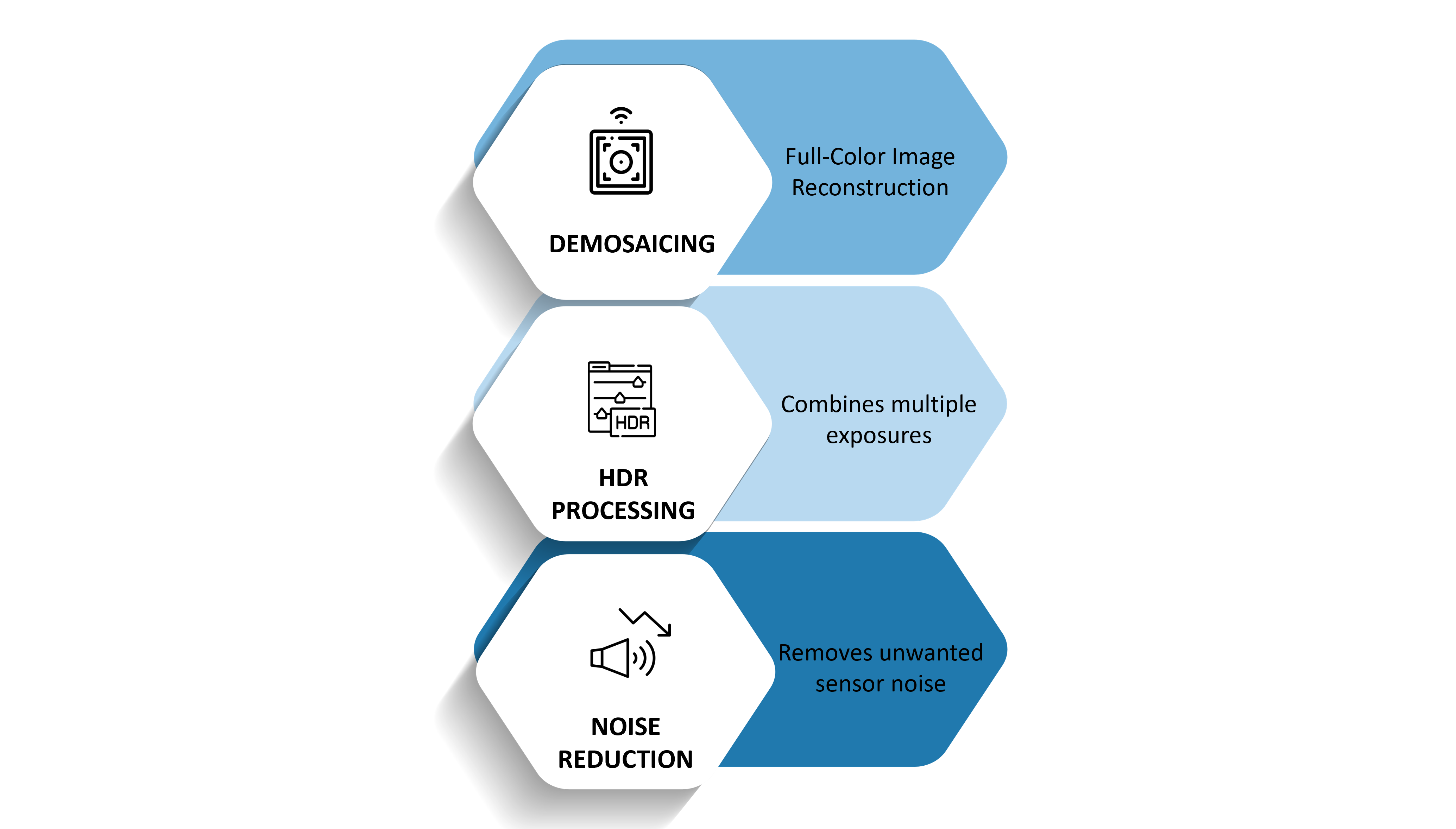
Automotive isp pipeline: demosaicing hdr and noise reduction for adas cameras describes the core processing chain most automotive ISPs run in sequence. Demosaicing reconstructs a full-color image from the Bayer-filtered sensor array, interpolating red, green, and blue values for every pixel from the single color channel that pixel actually measured. High dynamic range processing merges multiple exposures, or reads a sensor's native wide dynamic range output, to hold detail in both a bright sky and a shadowed underpass in the same frame, a condition ordinary driving produces constantly. Noise reduction removes sensor noise that would otherwise be mistaken for texture or edges by a downstream perception model, and it has to do this without erasing the genuine low-contrast detail — a partially-occluded pedestrian, a faded lane marking — that the model actually needs to detect.
Automotive image processing embedded on ADAS hardware runs against a hard real-time deadline, not a best-effort one: a frame that arrives late at the perception stage is a frame the system effectively never processes at the speed the vehicle is moving. Every stage of the ISP pipeline — demosaicing, HDR merge, noise reduction, lens correction — has to complete within a fixed, predictable latency budget on every frame, not on average, because a functional safety argument for an ADAS vision system depends on worst-case timing, not typical-case timing. That constraint shapes ISP hardware and algorithm choices from the ground up, favoring deterministic, pipeline-friendly implementations over the more adaptive, iterative techniques a consumer camera ISP can use when it has an entire second to process a still photo.
Handling glare low light and dynamic range in adas vision systems is where automotive ISP tuning earns its keep, because these are exactly the conditions ordinary driving produces and a perception model cannot compensate for a badly-processed input. Direct sun low on the horizon, oncoming headlight glare at night, and the transition into and out of a tunnel all stress an ISP's dynamic-range handling and its ability to suppress lens flare and blooming without losing the surrounding scene detail. An ISP tuned only against a lab test set of well-lit daytime frames will pass validation and then degrade badly in exactly the edge-case lighting conditions where a perception system's accuracy matters most, which is why glare, low light, and rapid dynamic-range transitions get dedicated tuning and test coverage rather than being treated as an extension of normal daytime tuning.
Isp tuning tradeoffs between image quality and perception model accuracy exist because the settings that make an image look best to a human reviewer are not always the settings that maximize a downstream model's detection accuracy. Aggressive noise reduction produces a visually cleaner frame but can strip the fine texture a classification model relies on; sharpening that improves perceived clarity can introduce artifacts a model has never seen in training and reacts to unpredictably. Getting this tradeoff right requires tuning the ISP against the perception model's actual accuracy metrics on a validation set, not against a human's subjective judgment of image quality, and re-validating that tuning whenever the perception model itself is retrained, since a model trained on one ISP's output characteristics does not automatically generalize to another's.
The ISP's output is the perception pipeline's input, and the handoff between the two is a deliberate engineering interface, not an incidental one. Getting the ISP's color, exposure, and noise characteristics matched to what the perception model was actually trained on is as important as any single processing stage inside the ISP itself, because a mismatch here silently degrades accuracy in a way that is hard to diagnose after the fact. Our companion piece on training and validating perception models for automotive ADAS covers the other side of that handoff — how a perception model is trained and validated against the kind of image data an automotive ISP actually produces, edge cases included. The ISP pipeline discussed here also feeds the same sensor fusion layer covered in our piece on ADAS sensor fusion ECU architecture, alongside the radar processing chain described in automotive radar signal processing.
Embien Technologies designs and tunes image processing embedded vision pipelines for automotive ADAS programs — demosaicing, HDR, noise reduction, and lens correction tuned against real perception-model accuracy rather than subjective image quality, delivered within the hard real-time budgets safety-relevant vision systems require. To discuss an automotive camera ISP pipeline for an ADAS or autonomous driving program, reach out to Embien's engineering team.

Embien's Edge Computing Services enable real-time AI, computer vision, and image processing on embedded automotive platforms for latency-sensitive applications.

Embien's Automotive Electronics expertise covers camera systems, ADAS, embedded vision, sensor integration, and advanced automotive display platforms.
A case study on integrating a rear-view camera with Qt and implementing dynamic image loading for an embedded automotive display system.