
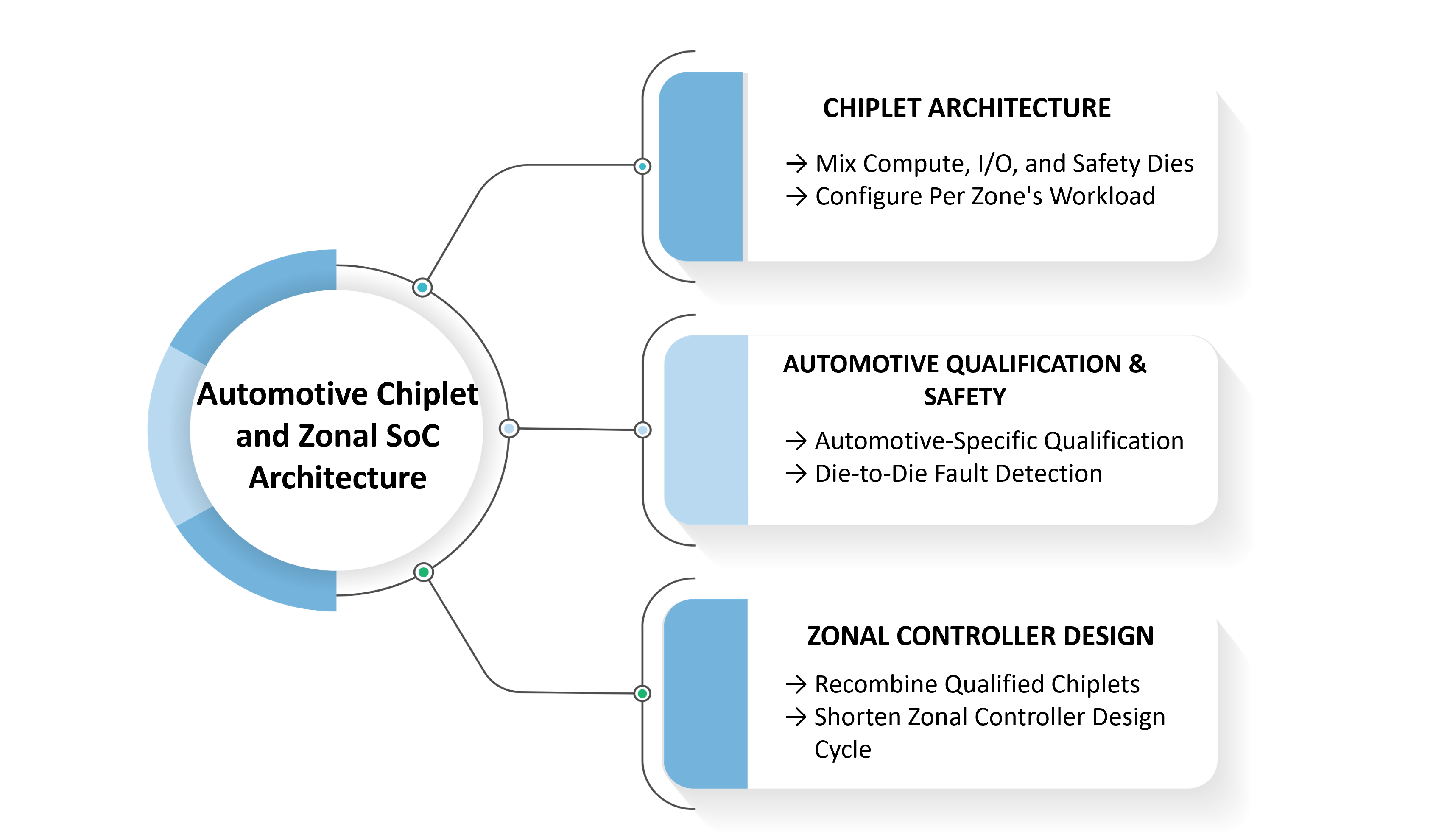
Zonal E/E architecture consolidates dozens of distributed ECUs into a small number of powerful zonal and central compute domains, and that consolidation is putting a kind of demand on automotive silicon that monolithic SoC design struggles to meet economically at the pace the industry now needs. Automotive chiplet and zonal SoC architecture: silicon behind centralized compute is the emerging answer: building a zonal or central compute SoC from multiple smaller dies, chiplets, integrated into a single package rather than fabricated as one large monolithic chip, so that compute, I/O, and safety-relevant functions can be mixed, matched, and reused across a vehicle program's different domain controllers without redesigning silicon from scratch for each one.
Why is zonal architecture driving automotive chiplet interest? Zonal architecture concentrates the compute workload of what used to be many separate, simpler ECUs into a small number of zonal controllers and a central compute unit, each of which now needs a mix of general-purpose processing, specialized AI/ML acceleration, and safety-relevant microcontroller functions that a single monolithic SoC design struggles to serve efficiently across every zone and every vehicle program variant. Chiplet-based design lets a silicon vendor mix proven compute, I/O, and safety dies in different combinations for different zonal roles, reusing qualified building blocks instead of taping out a new monolithic die for every zonal controller variant, which is exactly the flexibility zonal architecture's compute consolidation is creating demand for.
Automotive-specific qualification requirements for multi-die chiplet packages go well beyond what chiplet architecture needs to satisfy in data center or consumer applications, where the technology has matured fastest. A multi-die automotive package has to survive the same AEC-Q100 temperature cycling, vibration, and humidity qualification as a monolithic automotive SoC, but now across multiple dies and the interconnect fabric joining them, where die-to-die interfaces, thermal interaction between dies operating at different power densities, and package-level reliability under automotive thermal cycling introduce failure modes a monolithic die simply doesn't have. Automotive-specific qualification requirements for multi-die chiplet packages are a major reason chiplet-based automotive silicon has lagged behind the pace of chiplet adoption in less demanding markets.
Functional safety implications of chiplet-based automotive socs add another layer of complexity on top of qualification: an ISO 26262 safety case built around a monolithic SoC treats the chip as a single unit of analysis with a known failure mode distribution, while a chiplet-based SoC introduces additional failure modes at the die-to-die interconnect and package level that the safety case has to explicitly account for. Functional safety implications of chiplet-based automotive SoCs mean an ASIL-D-capable zonal or central compute chiplet package needs interconnect-level fault detection and diagnostic coverage designed in from the start, not assumed to inherit automatically from each individual die's own safety qualification, since the composed system's failure behavior isn't simply the sum of its parts.
If automotive-grade chiplet packages mature as the roadmap suggests, zonal domain controller design could shift meaningfully: instead of each zonal controller variant requiring its own monolithic SoC design cycle, a controller could be assembled from a smaller catalog of qualified compute, safety, and I/O chiplets, configured differently per zone's actual workload. That shift would let silicon vendors and Tier 1 suppliers respond to changing zonal architecture requirements, new sensor types, new AI workloads, new safety requirements, by recombining qualified chiplets rather than committing to a new monolithic tape-out, meaningfully shortening the design cycle for each new zonal controller generation.
Realistic timeline for chiplet-based parts reaching automotive-grade maturity extends well beyond how quickly chiplet architecture matured in less safety- and reliability-demanding markets, because automotive qualification, functional safety certification, and the multi-year design-in cycles OEMs run before a new architecture reaches production all add time a consumer or data-center part doesn't have to absorb. Realistic timeline for chiplet-based parts reaching automotive-grade maturity is best measured in vehicle-program generations rather than product-cycle years, meaning zonal architecture programs planning today should treat automotive-grade chiplet silicon as a mid-decade-and-beyond option, not something to design the current generation of zonal controllers around.
The underlying chiplet architecture concept, disaggregating a monolithic SoC into smaller, mix-and-match dies connected through a standardized package-level interconnect, isn't automotive-specific at all, and understanding it in its general form makes the automotive-specific qualification and safety questions in this article easier to reason about. Our chiplet architecture explained article in the Technology Insights folder covers why monolithic SoC design is giving way to modular chiplet approaches across the semiconductor industry generally, of which the automotive use case this article describes is one demanding, safety-critical application.
Automotive chiplet interest doesn't exist independent of the architectural shift that's creating demand for it. Our zonal E/E architecture and domain controllers article covers the compute consolidation trend driving this silicon-level shift in the first place, and the two are best read together: zonal architecture explains the demand, automotive chiplet and zonal soc architecture: silicon behind centralized compute explains the silicon industry's emerging answer to it.
Embien Technologies helps automotive programs evaluate automotive chiplet and zonal SoC architecture: silicon behind centralized compute against real zonal domain controller requirements, including functional safety case implications and realistic qualification timelines for emerging multi-die silicon options. See our companion DFM/DFT for ECU production article for how manufacturability considerations extend to next-generation compute packages as well.
To discuss zonal compute silicon strategy for an upcoming vehicle program, reach out to Embien's engineering team.

Embien's Product Engineering Services support automotive compute platforms through embedded hardware, software, system architecture, prototyping, validation, and production engineering.

Embien's Automotive User Experience expertise supports connected cockpit, HMI, display, and software-defined vehicle platforms across next-generation automotive architectures.

A case study on developing an SoC FPGA-based embedded system using Microsemi SmartFusion2 and uClinux for integrated processing and programmable logic applications.