
Automotive cybersecurity incident forensics: post-breach ECU analysis is the technical work that starts once an incident response process has already flagged something worth investigating: an anomalous diagnostic session, an unexpected reflash event, or a fleet-wide pattern of ECU resets that doesn't match any known malfunction signature. Where the organizational side of incident response decides who gets notified and when, automotive cybersecurity incident forensics: post-breach ECU analysis is about determining, with evidence a court or a regulator would accept, what actually happened inside the vehicle's electronics: which ECU was affected, what changed, when it changed, and whether the change was consistent with an attack rather than a fault.
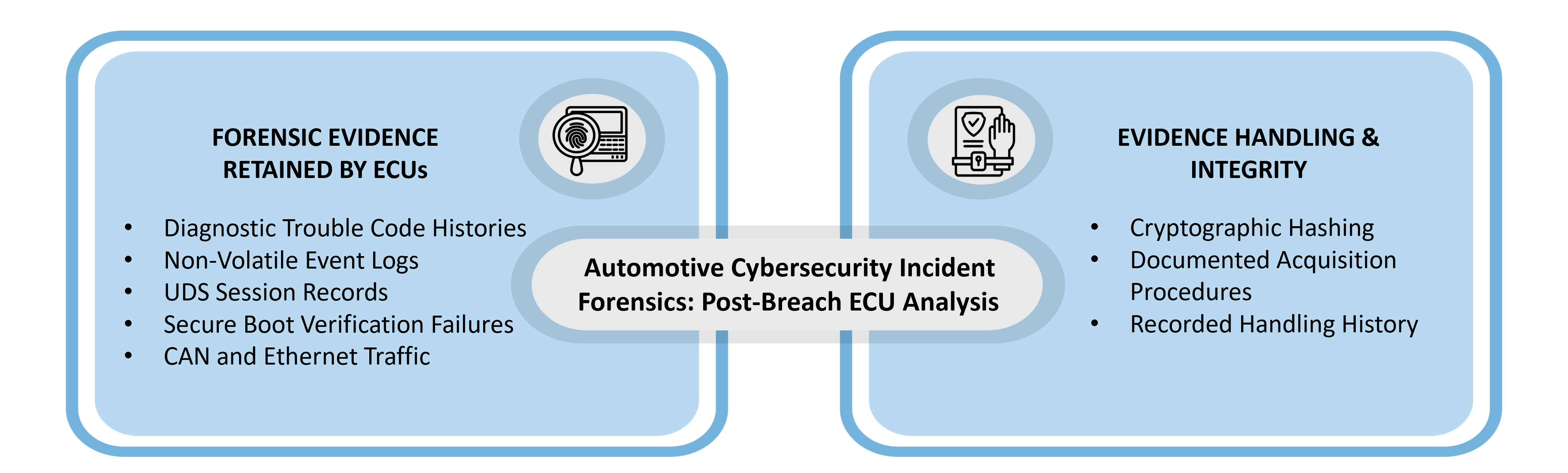
Modern ECUs and central gateways retain more forensic material than most incident responders expect going in: diagnostic trouble code histories, non-volatile event logs, UDS session records, secure boot verification failures, and, on gateway and telematics units with enough storage budget, rolling buffers of bus traffic. The quality of automotive cybersecurity incident forensics: post-breach ECU analysis an investigator can actually perform is bounded by what was retained before the incident occurred; an ECU that overwrites its event log every few ignition cycles gives a forensic team almost nothing to work with no matter how skilled the analysis afterward.
CAN and Ethernet traffic log analysis for vehicle intrusion detection after the fact means reconstructing a timeline from whatever bus traffic was captured, looking for the signatures a live intrusion detection system would also flag: unexpected arbitration IDs, message frequencies that deviate from a known-good baseline, replayed diagnostic frames, or Ethernet traffic to addresses that have no legitimate reason to be active. CAN and Ethernet traffic log analysis for vehicle intrusion detection is materially easier when the vehicle already ran a runtime monitoring layer before the incident, since a post-breach investigation can then correlate a specific alert timestamp against the raw traffic around it rather than searching an unstructured capture blind.
Chain-of-custody considerations for automotive forensic evidence matter as much for a vehicle cybersecurity incident as they do in any other digital forensics discipline, and arguably more, because automotive incidents can carry safety, liability, and regulatory consequences that turn an internal investigation into evidence in litigation or a regulatory inquiry. Extracted ECU logs, bus captures, and flash memory images need documented acquisition procedures, cryptographic hashing to prove the extracted data wasn't altered, and a recorded handling history from the moment evidence leaves the vehicle. Chain-of-custody considerations for automotive forensic evidence are frequently the weak point in an otherwise technically sound investigation: the forensic conclusion can be correct and still carry no evidentiary weight if the acquisition process that produced it wasn't documented properly.
How to distinguish a genuine vehicle cyberattack from a malfunction in log data? is the question every automotive forensic investigation has to answer before it can call an event an incident at all, because CAN bus errors, sensor glitches, and intermittent wiring faults can all produce log signatures that superficially resemble an attack. The distinguishing factors an investigator looks for are intent-shaped: message injection that follows a pattern no legitimate ECU would produce, timing that correlates with a known attack technique rather than a random fault distribution, or a sequence of events, unauthorized diagnostic access followed immediately by an unexpected reflash, that a hardware fault simply cannot produce on its own. Getting this distinction wrong in either direction is costly: treating a real intrusion as a routine fault leaves a vulnerability unaddressed, while treating every anomaly as an attack burns investigative resources that should go toward genuine incidents.
Designing ECUs with forensic readiness in mind is a decision that has to be made at the architecture stage, not retrofitted after the first incident makes the gap obvious. That means sizing non-volatile event log storage for a meaningful retention window rather than the minimum needed for warranty diagnostics, timestamping log entries against a synchronized clock so events across multiple ECUs can be correlated, and protecting the log itself with the same secure-boot-anchored integrity guarantees that protect application firmware, so an attacker who compromises an ECU cannot also erase the evidence. Designing ECUs with forensic readiness in mind up front is consistently cheaper than the alternative: an incident where the vehicle simply didn't keep the evidence a forensic team needed.
Automotive cybersecurity incident forensics: post-breach ECU analysis is the technical engine behind the organizational incident-response process our blog post Vehicle Cybersecurity Incident Response: What Happens When a Car Gets Hacked walks through: triage, containment, notification, and remediation decisions all depend on forensic findings arriving in a timely, defensible form. It also depends on a runtime monitoring layer having been in place before the incident; readers building that layer should see our companion article on automotive cybersecurity monitoring and intrusion detection systems, which covers the detection process that produces the alerts a forensic investigation like this one follows up on.
A vulnerability management process capable of supporting real post-breach investigation is itself part of what ISO 21434 expects an organization's cybersecurity management system to sustain across a vehicle's production life, covered in our ISO 21434 explainer. A TARA that identifies a credible attack scenario but stops short of asking whether the resulting incident could actually be investigated afterward has left forensic readiness out of the risk picture entirely.
Embien Technologies supports automotive cybersecurity incident forensics: post-breach ECU analysis and the forensic-readiness design work that makes it possible, from event log architecture and CAN and Ethernet traffic log analysis for vehicle intrusion detection to chain-of-custody-aware evidence handling for post-incident investigations. To discuss forensic readiness for an upcoming ECU or gateway program, reach out to Embien's automotive cybersecurity engineering team.

Embien's Digital Transformation Services help connected automotive platforms strengthen cybersecurity, data integrity, and lifecycle resilience across embedded and cloud-connected systems.

Embien's Automotive Cybersecurity Services cover secure ECU architecture, threat analysis, secure boot, intrusion detection, cryptography, and cybersecurity engineering across the vehicle lifecycle.

A case study on implementing production-grade secure boot and hardware security module capabilities for an automotive telematics control unit.