
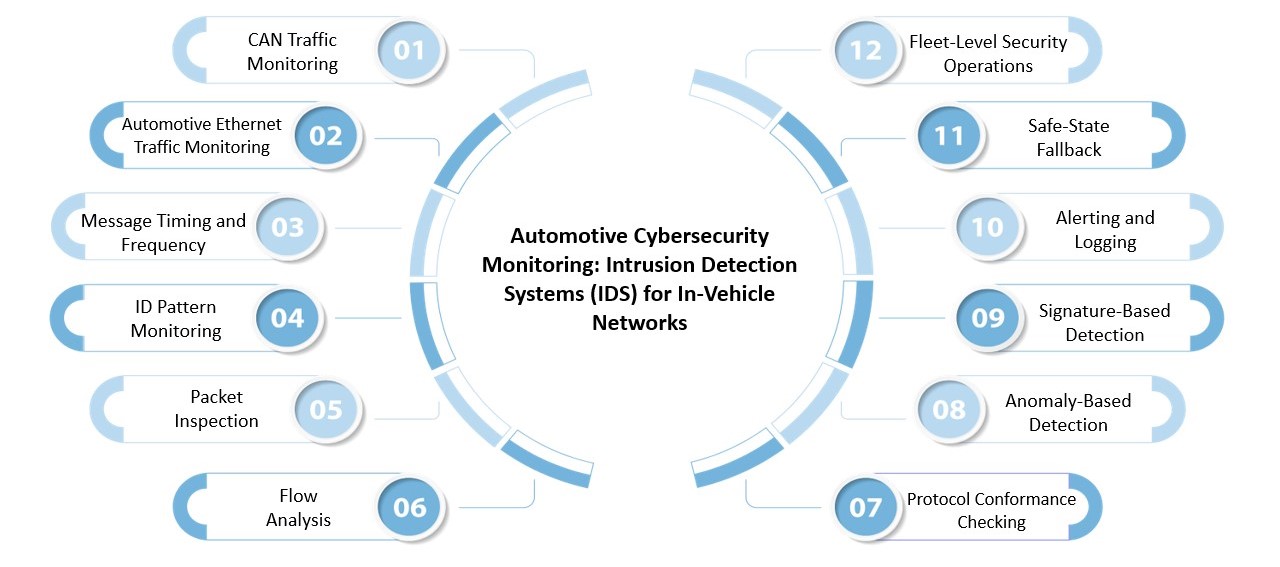
Building security into a vehicle's design, threat analysis, secure boot, hardened interfaces, reduces attack surface, but it does not tell a vehicle when an attack is actually underway. Automotive cybersecurity monitoring: intrusion detection systems (ids) for in-vehicle networks is the operational complement to that design-time work: software that watches CAN and automotive Ethernet traffic in real time, looking for the patterns a compromised ECU or an active attack produces, so that an intrusion gets detected, logged, and responded to while the vehicle is operating rather than discovered only after the fact.
A vehicle's cybersecurity design represents the best threat analysis available at development time, but new attack techniques, undiscovered vulnerabilities, and supply-chain compromises can all surface long after a vehicle is in the field, at which point no amount of design-time hardening detects them happening. Runtime intrusion detection exists precisely to cover that gap, providing visibility into what's actually occurring on the vehicle's networks during operation, rather than relying entirely on the assumption that design-time security controls will hold for the vehicle's full operational life without any need for ongoing verification.
Ids architecture for can and automotive ethernet networks differs meaningfully between the two bus types: a CAN-based IDS typically monitors message timing, frequency, and ID patterns against an expected baseline, since CAN has no native source authentication and anomalies often show up as unexpected message rates or IDs appearing from the wrong ECU. IDS architecture for CAN and automotive Ethernet networks on the Ethernet side can draw on more conventional network intrusion detection techniques, packet inspection, flow analysis, protocol conformance checking, adapted for automotive Ethernet's specific protocols and real-time constraints, and a comprehensive in-vehicle IDS deployment typically runs both approaches together across a modern vehicle's mixed CAN-and-Ethernet network topology.
Anomaly-based vs signature-based detection for in-vehicle traffic represents the central design tradeoff in any automotive IDS: signature-based detection matches network traffic against known attack patterns, fast and low false-positive when the signature library is current, but blind to novel attacks it hasn't seen before, while anomaly-based detection builds a baseline of normal vehicle network behavior and flags deviations from it, capable of catching genuinely new attack techniques but prone to false positives when legitimate but unusual vehicle behavior looks statistically anomalous. Anomaly-based vs signature-based detection for in-vehicle traffic isn't really an either-or choice in a mature IDS deployment, most production automotive IDS architectures run both in combination, using signatures for known threats and anomaly detection as a backstop for what signatures can't yet describe.
How should a vehicle handle a detected intrusion: alerting, logging, and safe-state fallback? Detection alone doesn't protect a vehicle, the response architecture matters just as much: a confirmed intrusion needs to be logged with enough detail to support later forensic analysis, an alert needs to reach the right destination, an in-vehicle warning, a backend security operations system, or both, and for intrusions affecting safety-relevant functions, the vehicle's response needs to include a defined safe-state fallback rather than simply continuing to operate on a network it now knows is compromised. Getting this response chain wrong in either direction, alerting on too much noise or failing to act on a genuine intrusion, undermines the value of detection in the first place.
Fleet-level security operations for aggregating ids data across vehicles extends intrusion detection beyond any single vehicle's own response, aggregating IDS alerts and telemetry across an entire fleet lets a manufacturer's security operations team spot coordinated or campaign-level attacks that would look like an isolated anomaly from inside any one vehicle, and prioritize investigation based on patterns visible only at fleet scale. Fleet-level security operations for aggregating IDS data across vehicles also feeds directly back into the vehicle's own defenses, patterns confirmed as genuine attacks at the fleet level can inform updated detection signatures pushed back out to the vehicle population, closing the loop between individual-vehicle detection and organization-wide security response.
An IDS alert is the starting point for an investigation, not the end of one, and a genuinely useful automotive IDS deployment assumes downstream forensic capability will need to pick up wherever detection leaves off. Our cybersecurity incident forensics article covers how ECU and network log analysis reconstructs what happened after a breach is confirmed, and the two disciplines are designed to work together, IDS surfaces the alert, forensics establishes the full picture of scope and impact.
Runtime intrusion detection is best understood as one output of the broader cybersecurity engineering lifecycle our ISO 21434 cybersecurity lifecycle article describes, TARA identifies where monitoring is actually needed, and it also builds directly on the network-level security foundation covered in our automotive Ethernet security architectures article. Automotive cybersecurity monitoring: intrusion detection systems (ids) for in-vehicle networks is the runtime layer that sits on top of both, turning design-time security analysis and network architecture into an operational capability.
Embien Technologies designs automotive cybersecurity monitoring: intrusion detection systems (IDS) for in-vehicle networks, covering CAN and automotive Ethernet IDS architecture, anomaly and signature detection tuning, and fleet-level security operations integration. See our companion incident forensics article for how a detected intrusion gets investigated once flagged.
To discuss in-vehicle intrusion detection architecture for an upcoming program, reach out to Embien's engineering team.

Embien's Digital Transformation Services support connected systems with secure embedded platforms, data integration, cybersecurity, and lifecycle engineering.

Embien's Automotive Cybersecurity Services cover secure ECU architecture, threat analysis, secure boot, intrusion detection, cryptography, and cybersecurity engineering across the vehicle lifecycle.

Implementation of a secure bootloader for ArduPilot on STM32H7, strengthening firmware authenticity and secure startup for connected embedded systems.