
Every diagnostic protocol on the site so far — UDS, OBD-II, DoIP — is described from the vantage point of a single vehicle at a time: a technician plugged into one ECU, reading one set of codes. Automotive diagnostic trouble code (dtc) management at fleet scale: from ecu to cloud is a different discipline built on top of those same protocols, one where the interesting engineering problem isn't reading a code from an ECU, it's what happens after thousands of vehicles are doing that continuously and reporting the results somewhere a fleet operator can actually act on them.
How does fleet-scale dtc management differ from per-vehicle diagnostics? per-vehicle diagnostics is fundamentally a point-in-time, single-session activity: a technician connects, reads active and stored codes, clears what's been addressed, and disconnects. Fleet-scale DTC management has to be continuous, automated, and comparative — not just reading what codes exist on one vehicle right now, but tracking how DTC patterns are trending across a whole fleet over time, flagging vehicles whose diagnostic profile is drifting away from the fleet norm before a fault becomes a breakdown, and doing all of that without a technician ever physically connecting to most of the vehicles involved. That shift, from a single diagnostic session to a continuously ingested data stream across an entire fleet, is what turns DTC management from a service-bay activity into a data-architecture problem.
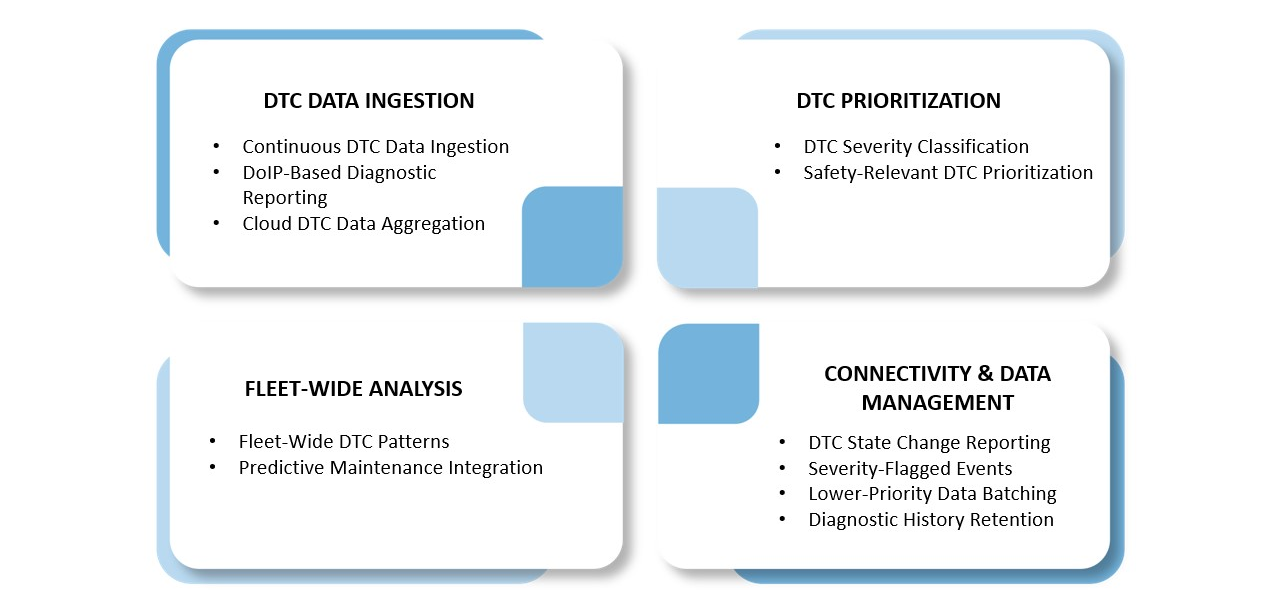
Aggregating dtc data from doip-connected vehicles into a cloud platform is the foundation the rest of fleet-scale DTC management depends on. DoIP (ISO 13400), covered in Embien's guide to ISO 13400 and UDS on DoIP, gives a vehicle an IP-based diagnostic transport that maps naturally onto cloud connectivity in a way older diagnostic transports never did, since the same UDS service structure a technician would use locally over DoIP can be extended over a telematics link to report DTC data back to a cloud platform without waiting for a physical connection. Aggregating DTC data from DoIP-connected vehicles into a cloud platform means the fleet operator's backend ends up holding a continuously updated, structured view of every reporting vehicle's diagnostic state, rather than a fragmented record built only from whatever service visits happened to occur.
Prioritizing urgent safety-relevant dtc codes at fleet scale is what makes an aggregated DTC data stream actually useful rather than overwhelming. A fleet reporting continuously generates a genuinely large volume of codes, and the overwhelming majority of them are low-severity, informational, or already-known issues that don't need immediate attention. Prioritizing urgent safety-relevant DTC codes at fleet scale means the backend platform has to classify incoming codes by severity and safety relevance automatically, surfacing a brake-system or powertrain-relevant code for immediate fleet-operator attention while routing a minor sensor-drift code into a lower-priority maintenance queue, because a fleet operator who has to manually triage every incoming code from every vehicle effectively has no prioritization system at all.
Aggregated, prioritized DTC data becomes considerably more valuable once it feeds into a predictive maintenance program rather than sitting as a passive alert log. Recurring DTC patterns across similar vehicles in a fleet — the same code appearing at a similar mileage or duty-cycle point across multiple units — are exactly the kind of signal a predictive maintenance system, covered in Embien's guide to predictive maintenance and automotive data logging, is built to catch and act on before individual vehicles actually fail in service. Fleet-scale DTC aggregation and predictive maintenance are, in practice, two halves of the same data pipeline: one collects and prioritizes the signal, the other turns that signal into a scheduled intervention.
Data volume and connectivity constraints for fleet-wide diagnostic reporting shape almost every design decision in a fleet DTC platform, because not every vehicle in a fleet has continuous, high-bandwidth connectivity, and reporting every diagnostic parameter from every vehicle continuously would be both unnecessary and, in constrained connectivity environments, simply impractical. A workable architecture reports DTC state changes and severity-flagged events promptly while batching lower-priority, high-volume diagnostic data for opportunistic upload when connectivity allows, and it has to be resilient to a vehicle going offline for extended periods without losing the diagnostic history that accumulated while it was disconnected.
Fleet-scale DTC management isn't a replacement for the vehicle-level diagnostic protocols the rest of the site covers — it's the layer built on top of them. The same UDS and DoIP foundations, and the remote diagnostic access patterns covered in Embien's remote diagnostics architecture guide, extend directly into fleet operations once a fleet operator needs visibility across many vehicles rather than one. Understanding automotive diagnostic trouble code (dtc) management at fleet scale: from ecu to cloud means understanding that continuity: the protocol doesn't change moving from a service bay to a cloud platform, but the scale, prioritization, and connectivity constraints around it change substantially.
Embien Technologies builds the full pipeline automotive diagnostic trouble code (dtc) management at fleet scale: from ecu to cloud depends on: DoIP-based vehicle-side diagnostic reporting, cloud aggregation and severity classification, and integration into predictive maintenance programs that turn fleet-wide DTC patterns into scheduled action.

Embien's Digital Transformation Services connect embedded systems, cloud platforms, data pipelines, and connected products to support scalable digital operations.

Embien's Software-Defined Vehicle engineering supports connected vehicle architectures with centralized software, remote diagnostics, OTA updates, and lifecycle data management.
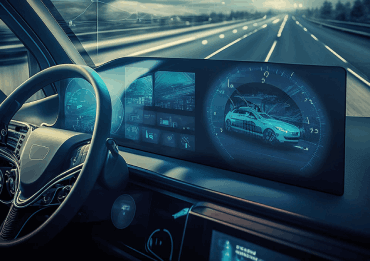
An Android-based UDS client enabling remote diagnostics and FOTA update capabilities for an automotive cluster platform.