
The ABS and ESC content already on the site assumes a hydraulic brake system with electronic control layered on top, an architecture where, even if every control unit failed, the driver could still generate hydraulic brake pressure by pressing the pedal. Brake-by-wire systems: engineering redundancy without a mechanical backup covers a fundamentally different architecture, one where that hydraulic connection between pedal and brakes doesn't exist at all, and every gram of stopping force has to be commanded, actuated, and verified electronically from end to end.
In a conventional or even a hydraulically-boosted electronic brake system, the pedal is mechanically or hydraulically coupled to the brake calipers as a last-resort fallback; in a true brake-by-wire system, the pedal is a sensor, nothing more. Pressing it generates an electronic signal that a control unit interprets and translates into a commanded actuator force at each wheel, with no physical path left for brake pressure to reach the calipers if the electronics fail. That single architectural change is what makes brake-by-wire a fundamentally different functional-safety problem than adding electronic control on top of an existing hydraulic system, because every failure mode that used to degrade gracefully to "the driver can still generate some hydraulic pressure" now has to be handled entirely within the electrical and software domain.
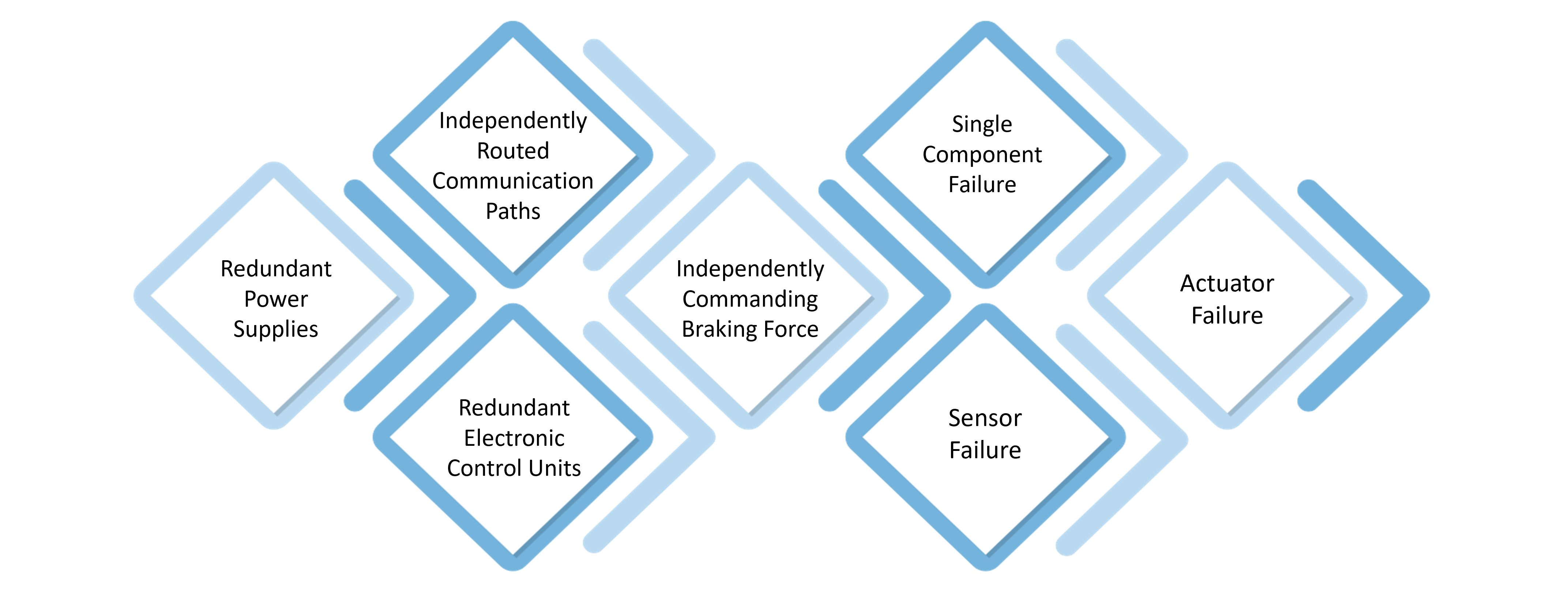
The redundancy architecture required to meet asil d without a mechanical fallback typically means duplicating the systems that matter most: redundant power supplies so a single electrical fault can't take down braking entirely, redundant and independently routed communication paths between the pedal sensor and the brake actuators, and in many designs redundant electronic control units capable of independently commanding braking force if the primary controller fails. Because brake-by-wire removes the mechanical backup that used to be the implicit fallback for almost every other ASIL D automotive system, the redundancy architecture required to meet ASIL D without a mechanical fallback has to assume that any single component, sensor, controller, or actuator, can fail, and still deliver braking force through a surviving redundant path.
Sensor and actuator diversity for fault detection in brake-by-wire systems is what makes that redundancy architecture actually trustworthy rather than just duplicated. Using two identical pedal position sensors catches a sensor that fails to zero or fails open, but it doesn't catch a systematic design or manufacturing defect that affects both sensors the same way; using sensors built on different sensing principles, or actuators from different suppliers with different failure characteristics, protects against exactly that class of common-cause fault. Sensor and actuator diversity for fault detection in brake-by-wire systems is a deliberate design choice, not an accident of sourcing, and it's specifically aimed at the failure modes that plain duplication can't catch.
How does pedal feel simulation work in a fully electronic brake system? is a question that has no equivalent in a hydraulic system, where pedal feel comes naturally from the resistance of pushing fluid through the brake circuit. With no hydraulic path to push against, a brake-by-wire pedal needs a dedicated pedal feel simulator, typically a spring-and-damper mechanism paired with the same force sensor that measures the driver's input, tuned to reproduce the resistance curve drivers expect from a conventional brake pedal. Getting that simulated feel right, consistent, predictable, and free of any perceptible lag between pedal movement and simulated resistance, is a significant part of brake-by-wire calibration work, since any mismatch from expected pedal feel reads to a driver as something being wrong with the brakes.
The certification challenges unique to removing the mechanical brake backup stem from the fact that regulators and certification bodies have decades of established practice for hydraulic and hydraulically-boosted electronic brake systems, but comparatively little precedent for a system with no mechanical fallback path at all. A brake-by-wire program has to build a safety case that demonstrates, through redundancy, diversity, and extensive fault-injection testing, that the electronic system as a whole meets or exceeds the reliability that a mechanical backup used to provide implicitly. Certification challenges unique to removing the mechanical brake backup also extend to defining exactly what a minimal risk condition looks like when there's no physical fallback to fall back to, an open engineering and regulatory question that brake-by-wire and steer-by-wire programs are actively working through together.
Brake-by-wire doesn't replace the wheel-slip control or vehicle stability logic described in our ABS control module and electronic stability control (ESC) articles; those control algorithms still run, just against electronically actuated brakes with no hydraulic circuit underneath them. What changes is the redundancy and fault-tolerance envelope those algorithms operate within, since a brake-by-wire ABS or ESC controller failure now has to be caught and compensated by a redundant path rather than degrading to unassisted hydraulic braking. The same redundancy-without-a-mechanical-fallback problem shows up on the steering side too, which is exactly what our steer-by-wire functional safety and redundancy design article covers.
Embien Technologies designs the redundant control architectures, sensor and actuator diversity strategies, and fault-tolerant software that brake-by-wire systems: engineering redundancy without a mechanical backup require to reach ASIL D without a mechanical fallback. To discuss brake-by-wire redundancy architecture, pedal feel simulation, or functional safety certification support, reach out to Embien's engineering team.

Embien integrates embedded systems, software, connectivity, and intelligent technologies to support digital transformation across automotive and other industrial applications.

Embien's automotive electronics expertise covers ECU development, embedded control systems, vehicle connectivity, and electronic solutions for advanced automotive applications.

A case study on developing an ASIL D electric power steering technology demonstrator, focusing on functional safety, redundant control architecture, and reliable steering system operation.