
Zonal E/E architecture is almost always justified in compute terms: fewer, more powerful domain controllers instead of dozens of distributed ECUs, simpler software integration, cleaner OTA update paths. That's a real and important argument, but it's not the only one, and arguably not even the one that has pushed OEMs hardest toward zonal consolidation. Automotive wiring harness complexity: the physical cost behind zonal architecture is the other half of the case — a genuinely physical, manufacturing-floor argument that exists independently of anything happening in software.
How does wiring harness complexity scale with distributed ecu architecture? it scales roughly with the number of point-to-point connections a distributed architecture requires, and that number grows faster than the ECU count itself. Every distributed ECU added to a traditional domain-based or fully distributed architecture, detailed in Embien's guide to major electronic control units in vehicle systems, typically needs its own dedicated power, ground, and signal runs back to a central point or to whatever ECUs it directly communicates with. As ECU count climbs into the hundreds on a modern premium vehicle, the harness carrying all of that wiring becomes one of the heaviest, most labor-intensive, and most failure-prone single components in the entire vehicle — often the third-heaviest component after the engine and chassis, and among the most expensive to assemble.
Weight cost and assembly-time implications of wiring harness complexity at volume compound in ways that matter enormously once a vehicle program is producing at real scale. A complex harness can weigh 50 kilograms or more on a heavily equipped vehicle, directly working against fuel efficiency and EV range targets. Weight, cost, and assembly-time implications of wiring harness complexity at volume also show up on the assembly line itself: harness installation remains one of the most manual, least automatable steps in vehicle assembly, since routing and connecting thousands of individual wires through a body structure resists the kind of robotic automation that has transformed most other assembly stations, which means harness complexity translates almost directly into labor cost and assembly time at every unit produced.
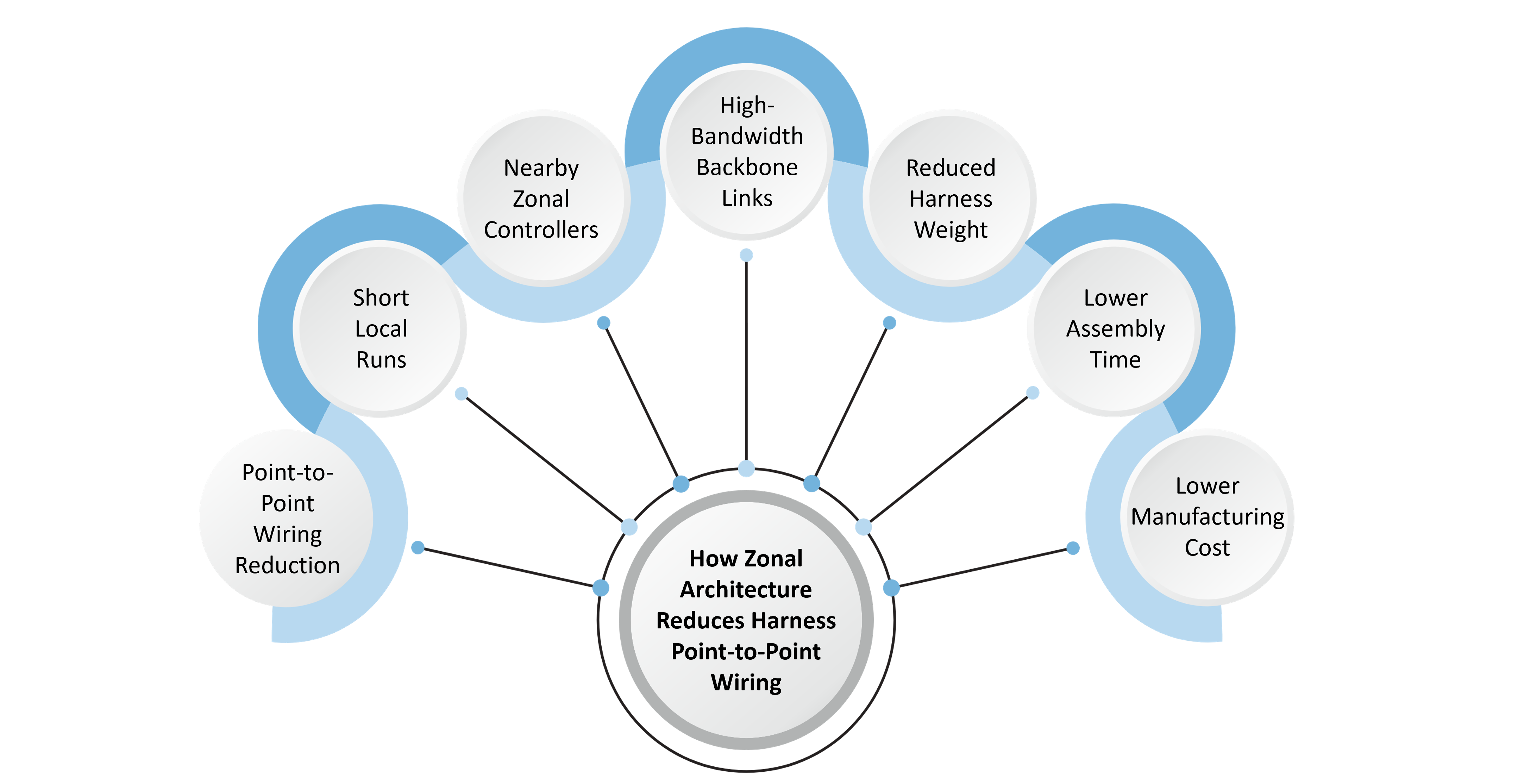
How zonal architecture reduces harness point-to-point wiring comes down to a simple topological change: instead of wiring every distributed ECU back to a central point or to every ECU it needs to talk to, a zonal architecture, covered in Embien's guide to zonal E/E architecture and domain controllers, groups ECUs and sensors by physical location and connects each zone to a single nearby zonal controller over a short local run. That zonal controller then carries the aggregated data back over a much smaller number of high-bandwidth backbone links, rather than every peripheral device needing its own long point-to-point run across the vehicle. How zonal architecture reduces harness point-to-point wiring is, in a real sense, the physical mirror of what it does computationally: consolidating distributed connections into a smaller number of shared, higher-capacity ones.
Connector and harness design tradeoffs specific to zonal topology aren't free, though. Concentrating more devices onto a single zonal controller means each zonal connector now carries more current and more signal lines than any single connector in a fully distributed design would have, which raises its own thermal, connector-pin-count, and single-point-of-failure design questions. Connector and harness design tradeoffs specific to zonal topology also include where exactly to place each zonal controller physically, since the harness savings a zonal architecture promises only materialize if controllers are actually positioned close to the sensor and actuator clusters they serve, not simply relocated versions of the same long-run problem under a new name.
The harness-weight and assembly-cost argument for zonal architecture isn't equally strong across every vehicle segment. It's strongest on EVs and premium vehicles carrying the largest sensor and actuator counts, where a heavily equipped vehicle's harness complexity — and the resulting weight, cost, and assembly burden — is largest to begin with, making the potential savings from zonal consolidation largest in absolute terms too. The case is comparatively weaker on lower-complexity, lower-equipment vehicle segments, where a simpler distributed harness was never that heavy or expensive to begin with, and the cost of redesigning around a zonal topology may take longer to pay back relative to the smaller harness savings available.
Put together, the compute-consolidation argument and the harness-complexity argument for zonal architecture reinforce each other rather than compete. A program evaluating zonal consolidation purely on compute and software integration terms is only seeing half the business case; automotive wiring harness complexity: the physical cost behind zonal architecture is the physical-engineering half that shows up directly in vehicle weight, manufacturing cost, and assembly-line labor — often in dollar terms a program's finance function will find just as persuasive as the software architecture argument alone.
Embien Technologies works across both sides of this problem: ECU and zonal E/E architecture design, and the practical wiring and connector implications that architecture carries onto the manufacturing floor, helping OEMs make automotive wiring harness complexity: the physical cost behind zonal architecture part of a real, quantified business case rather than a secondary talking point.

Embien provides end-to-end product engineering services spanning hardware design, embedded software, system integration, and product development for complex electronic systems.

Embien supports automotive development with embedded systems engineering, ECU software, vehicle connectivity, diagnostics, and electronic system integration for next-generation vehicles.

A case study on developing an AIS 140-compliant 4G data logger for vehicle tracking, CAN data acquisition, and connected automotive monitoring applications.