
Classic CAN is covered in depth elsewhere on the site, but classic CAN's bandwidth and payload limits have been constraining modern E/E architectures for years, and the protocols engineered to address that, CAN FD and the newer CAN XL, deserve their own dedicated coverage rather than a footnote on the classic CAN content. Can fd development and the further step CAN XL represents are both extensions of the same underlying CAN protocol family, not replacements for it, built specifically to carry more data, faster, without abandoning CAN's proven arbitration and fault-tolerance model.
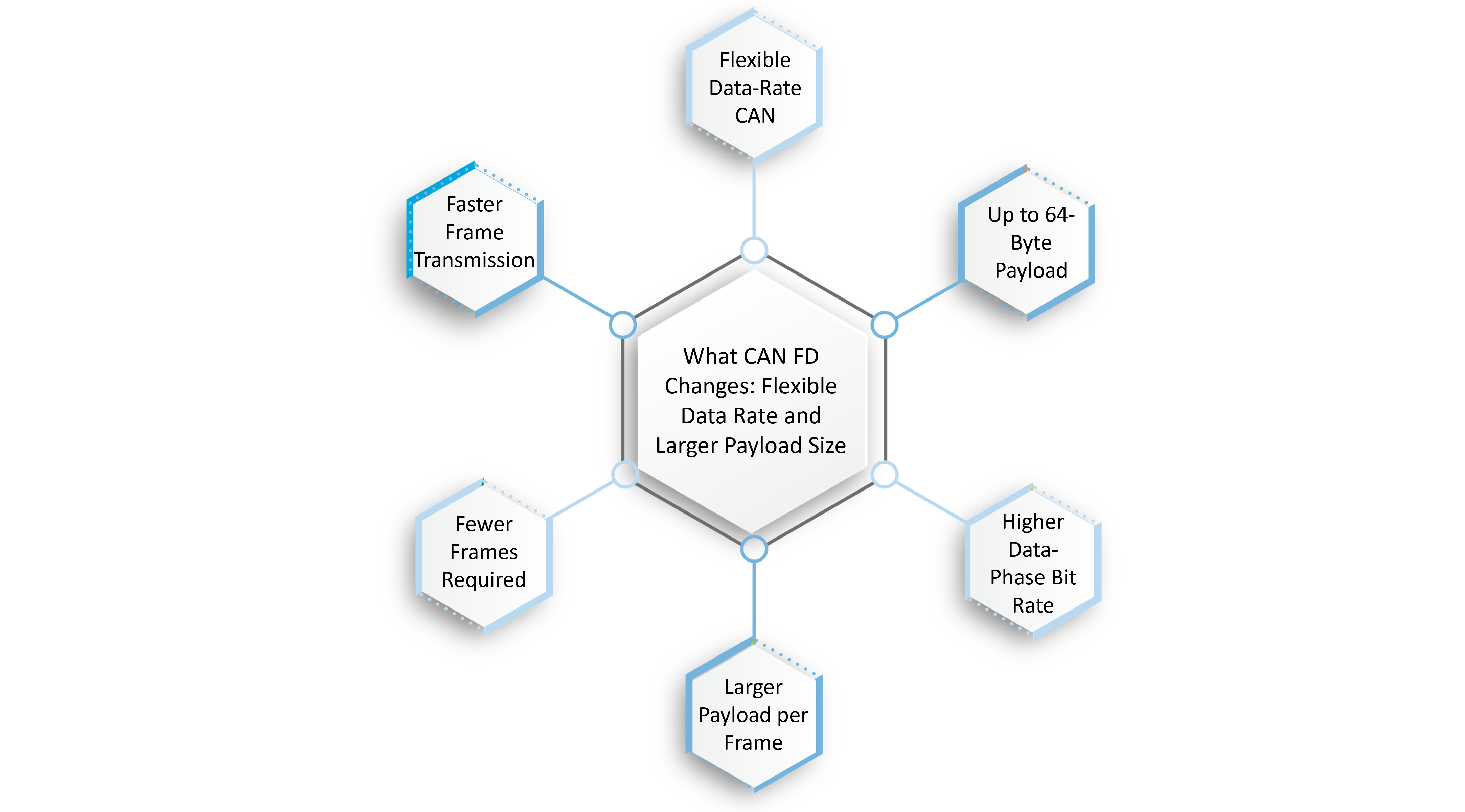
CAN FD, Flexible Data-rate CAN, changes two things classic CAN fixed from the start: it increases the data payload per frame from 8 bytes to up to 64 bytes, and it allows the data phase of a frame to transmit at a higher bit rate than the arbitration phase, typically several times faster. Both changes directly address the two biggest practical limits of classic CAN as vehicle networks have grown more data-hungry, since a larger payload means fewer frames are needed to carry the same signal set, and a faster data phase means each of those frames takes less bus time to transmit.
Classic CAN's 8-byte payload and 1 Mbit/s maximum bit rate were more than sufficient for the vehicle networks of the era it was designed for, but modern E/E architectures with dozens of ECUs, high-resolution sensor data, and increasingly centralized zonal or domain controller designs started running into classic CAN's ceiling well before CAN FD became mainstream. Message sets that used to fit comfortably within classic CAN's frame and bandwidth limits began requiring message splitting across multiple frames or competing more aggressively for limited bus bandwidth, both of which can fd development was specifically engineered to relieve.
Can fd integration in automotive systems is now largely mainstream rather than emerging, with CAN FD transceivers and controllers standard on most new vehicle platforms, but integration still requires care: a CAN FD network mixing FD-capable and classic-CAN-only nodes has to manage that heterogeneity carefully, since a classic CAN node can't parse an FD frame's larger payload or faster data-phase bit rate. CAN FD integration in automotive systems typically segments a vehicle's networks so FD-capable domains run at FD's higher performance while any remaining classic-CAN-only nodes stay isolated on their own segment or behind a gateway that translates between the two.
The question of can-fd vs ethernet for in-vehicle networking comes up constantly as vehicle architectures add more automotive Ethernet, and the honest answer is that they serve different roles rather than directly competing. CAN FD remains the better fit for real-time control-loop and body-electronics traffic where deterministic, low-latency, event-driven messaging matters more than raw throughput, while automotive Ethernet is the better fit for high-bandwidth, non-deterministic traffic like sensor video streams or large software update payloads. Can-fd vs ethernet for in-vehicle networking: which is better is, in practice, the wrong framing for most vehicle architectures, which use CAN FD and automotive Ethernet together, each carrying the traffic it's actually suited for rather than one displacing the other.
CAN xl bandwidth increase and its relationship to automotive ethernet represents the next step past CAN FD, pushing payload size up to 2048 bytes per frame and data-phase bit rates toward 10 Mbit/s or higher, closing much of the practical gap between CAN's traditional strengths, deterministic arbitration and lower per-node cost, and the raw bandwidth that used to be automotive Ethernet's exclusive territory. CAN XL is explicitly positioned as complementary to automotive Ethernet rather than a competitor to it, aimed at use cases that need more bandwidth than CAN FD provides but still want CAN's arbitration and fault-confinement behavior rather than a full Ethernet stack.
A vehicle network migrating toward CAN FD or CAN XL rarely does so in one step across the whole architecture; most real migrations run classic CAN, CAN FD, and eventually CAN XL nodes side by side for years, segmented by domain or bridged through gateway ECUs that translate between protocol generations. That mixed-generation reality shapes tooling, diagnostic, and DBC file requirements just as much as it shapes the network topology itself, since a diagnostic or logging tool has to correctly interpret whichever CAN generation a given bus segment is actually running.
CAN FD and CAN XL's larger payloads change how signals get packed and documented in a network's DBC file, since a signal database built around classic CAN's 8-byte frame assumption has to be extended to describe FD and XL's much larger payload layouts without breaking backward compatibility for tools and ECUs still reading the classic CAN portion of the same database. Our DBC file format article covers the file format fundamentals that this extension builds on, and getting DBC tooling to correctly handle mixed classic CAN, CAN FD, and CAN XL signal definitions in one project is a real, practical part of adopting the newer protocols.
Embien Technologies supports can fd development, CAN XL migration planning, and mixed-protocol network architecture across automotive E/E programs, building on the CAN bus fundamentals covered in our automotive CAN bus article and extending into CAN FD, CAN XL, and automotive Ethernet integration, including the multidrop Ethernet approaches covered in our 10BASE-T1S automotive Ethernet article. To discuss CAN FD integration, CAN XL migration, or mixed-protocol vehicle network architecture, reach out to Embien's engineering team.

Embien integrates embedded software, connected systems, and intelligent technologies to support digital transformation across automotive and industrial applications.

Embien supports Software-Defined Vehicle development through automotive software, ECU integration, vehicle connectivity, diagnostics, and software-driven vehicle functionality.
A case study on developing an Android-based automotive smart cluster using the i.MX8 platform, focusing on embedded software integration and in-vehicle display functionality.