
While practically similar cars from all vendors offer little differentiation today, in the near future emotionally intelligent cars will personalize themselves to each user's needs. Central to this is the AI accelerator architecture — the hardware and software foundation that powers every decision the EI car makes. Let us explore how the AI accelerator architecture of an emotionally intelligent car is structured.
The AI system in emotionally intelligent cars has two components — the AI core configured by the OEM and a personalization layer that adapts based on the human associate. The AI core runs on a purpose-built AI accelerator architecture comprising CPUs, GPUs, NPUs and TPUs working in concert. This AI accelerator architecture controls the vehicle, interacts directly with automotive subsystems and is responsible for overall operation and safety. Think of it as a super-ECU that manages all other ECUs in the vehicle.
Being tightly coupled with the underlying hardware, the AI accelerator architecture is pre-configured in a static manner for most of its core settings. Fine-tuned for every vehicle SKU, this configuration is the intellectual property of the OEM or the software vendor who designed it. Emotionally intelligent cars rely on this static layer to deliver consistent, predictable behaviour across the entire vehicle range.
Some of the static configurations include:
These static configurations could be loaded at the end of the production line or updated over-the-air as software upgrades are released. The AI accelerator architecture makes both possible without requiring hardware changes.
Apart from static configurations, emotionally intelligent cars support dynamic configurations applicable over a certain duration or course of a trip. This is where hybrid AI becomes essential — combining rule-based logic with machine learning to allow the AI accelerator architecture to adapt in real time while staying within predefined safety boundaries.
Major dynamic configurations driven by hybrid AI include local rules and regulations, for example:
Dynamic configuration via hybrid AI can also be dictated by the company that rents the car:
The hybrid AI configuration can also be derived by the EI car itself based on the state of the driver, especially at lower autonomous levels:
These dynamic configurations of the AI core can be set via the HMI or from V2X infrastructure as the car drives into a new territory. The hybrid AI layer ensures emotionally intelligent cars remain responsive to context without compromising safety.
Designing the AI accelerator architecture for emotionally intelligent cars requires deep expertise in AI for embedded systems — from selecting the right NPU/GPU accelerator chips to optimizing inference pipelines for real-time vehicle control. AI for embedded systems disciplines such as quantization, pruning and hardware-aware neural architecture search are critical to making the AI core both powerful and power-efficient. Embien's cross-domain embedded services bring together automotive hardware and AI expertise to help OEMs build this foundation.
A core principle of the AI accelerator architecture in emotionally intelligent cars is on-device AI — running all safety-critical inference locally, without dependency on cloud connectivity. On-device AI ensures that driver monitoring, hazard detection and vehicle control continue to function reliably even in areas with no network coverage. Embedded ML development services from Embien help OEMs deploy optimized on-device AI models that meet the stringent latency and safety requirements of automotive systems.

Embien's edge computing services enable the on-device AI and AI accelerator architecture powering emotionally intelligent cars — from sensor fusion to real-time vehicle control.

Explore how Embien's UI/UX design services build the human-facing layer of emotionally intelligent cars, leveraging hybrid AI to deliver an intuitive, personalized in-cabin experience.
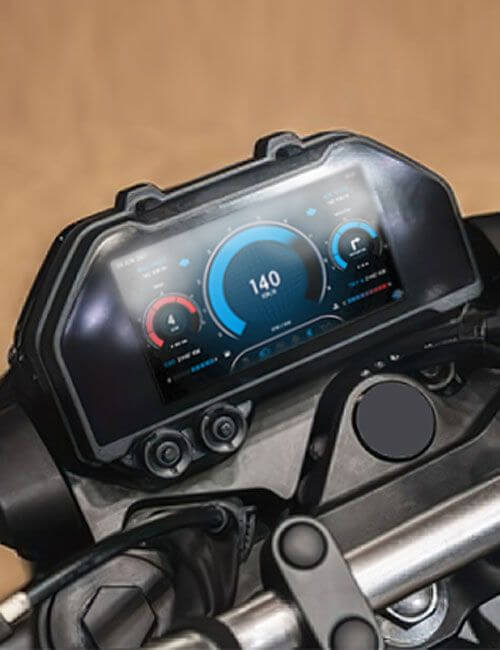
A case study on Embien's NXP i.MX RT1170 digital cluster solution — a showcase of embedded AI accelerator architecture and on-device AI in an automotive instrument cluster.