
Zonal E/E architecture and domain controllers for centralized vehicle compute represent the biggest structural shift in vehicle electronics since the CAN bus itself became standard. Our earlier overview, Automotive E/E Architecture: The Backbone of Vehicle Electronics, covers the general 2024-era landscape; zonal E/E architecture and domain controllers for centralized vehicle compute is the specific, dominant direction that landscape has moved in through 2025 and 2026, and it deserves treatment on its own terms rather than as one bullet point in a broader overview.
Why are distributed per-function ECUs giving way to zonal domain controllers? The traditional model, one dedicated ECU per function, one for the window lift, one for the seat controller, one for each headlamp module, scaled reasonably well when vehicles had a few dozen electronic functions. It scales badly at 100-plus ECUs: wiring harness weight and cost balloon, each additional ECU adds its own bill of materials, supply chain, and software update surface, and the sheer number of point-to-point connections becomes a packaging and reliability problem in its own right. Zonal domain controllers replace that model by grouping ECUs geographically, front-left, rear-right, and so on, rather than functionally, and consolidating the compute for everything in that physical zone onto one more powerful controller connected back to the rest of the vehicle over a much simpler high-bandwidth backbone.
Zonal architecture topology and compute consolidation in vehicles starts with dividing the vehicle into physical zones, commonly front, rear, and left/right splits depending on the platform, each served by a zonal controller that aggregates the sensors and actuators physically near it. Zonal architecture topology and compute consolidation in vehicles moves the intelligence that used to live in dozens of small function-specific ECUs into a much smaller number of zonal controllers and a handful of central domain or vehicle computers handling ADAS, infotainment, and body/comfort domains at a higher level. What consolidates into a domain controller varies by program, but window and seat control, lighting logic, and low-level sensor signal conditioning are common candidates for absorption into the zonal layer, while safety-critical actuation often stays closer to the physical actuator for latency and isolation reasons.
Networking implications of zonal gateways and automotive Ethernet follow directly from the topology change: a small number of zonal controllers exchanging aggregated data with central compute needs far more bandwidth per link than the CAN-based point-to-point wiring it replaces, which is why zonal architectures and the shift to automotive Ethernet as a backbone are effectively the same trend viewed from two angles. Zonal gateways now carry mixed traffic, safety-critical control data alongside camera and sensor streams and infotainment traffic, over the same physical links, which raises the networking implications of zonal gateways and automotive Ethernet from a simple bandwidth question into a traffic-prioritization one. Readers wanting the physical-layer detail behind this shift can see our Automotive Ethernet Bus article for how that backbone is actually built.
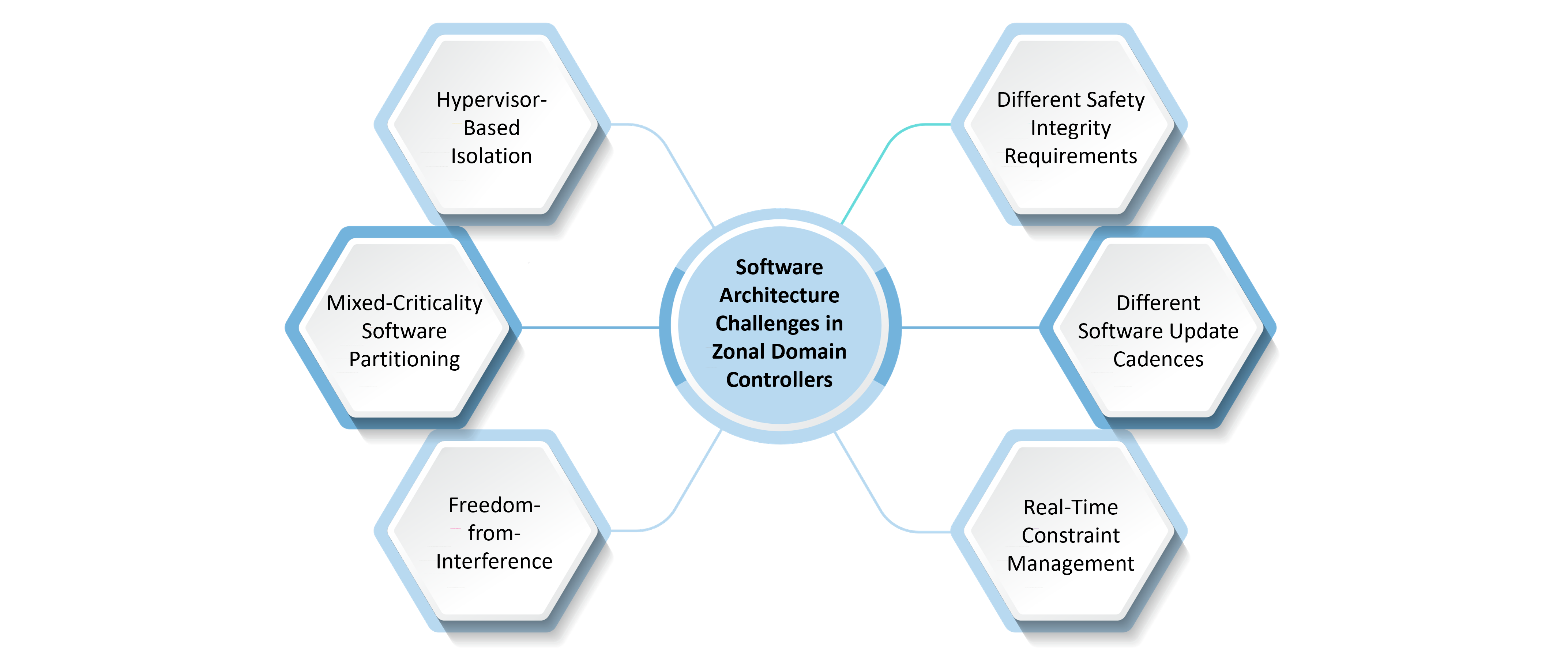
Consolidating functions that used to run on isolated, single-purpose ECUs onto one zonal domain controller creates a software architecture problem that didn't exist under the distributed model: functions with different safety integrity requirements, different update cadences, and different real-time constraints now have to coexist on shared hardware without one function's software fault or update affecting another's certified behavior. Hypervisor-based partitioning, mixed-criticality scheduling, and rigorous freedom-from-interference arguments become load-bearing architecture decisions rather than academic concerns once a zonal controller is running body comfort logic and a safety-relevant actuator interface side by side.
Very few OEMs can or do move from a fully distributed architecture to a fully zonal one in a single vehicle generation; the realistic migration path from distributed to zonal vehicle architecture is incremental. A common first step consolidates a single zone, often the body/comfort domain, onto a zonal controller while leaving powertrain and chassis ECUs distributed, validating the software partitioning and networking approach on lower-risk functions before extending it further. The migration path from distributed to zonal vehicle architecture also has to account for legacy supplier ECUs that won't be redesigned for a new platform generation, which usually means a zonal controller has to speak both a modern Ethernet-based backbone and legacy CAN or LIN to the ECUs it hasn't yet absorbed.
Zonal E/E architecture and domain controllers for centralized vehicle compute is as much an enabler of software-defined vehicle development as it is a hardware and networking trend on its own. Consolidating compute onto fewer, more powerful controllers is what makes decoupling software release cycles from hardware release cycles practical in the first place, since there are far fewer independent ECU software targets to update and validate. Our companion article, Software-Defined Vehicle Architecture: Core Technical Building Blocks, covers that software side directly, and the two trends are best read together rather than as separate architecture decisions.
Embien Technologies supports OEMs and Tier 1 suppliers through zonal E/E architecture and domain controllers for centralized vehicle compute: zonal topology definition, function consolidation and mixed-criticality software partitioning, zonal gateway and automotive Ethernet networking, and staged migration planning from an existing distributed architecture. To discuss a zonal architecture migration for an upcoming vehicle platform, reach out to Embien's automotive E/E architecture team.

Embien supports automotive OEMs and Tier 1 suppliers with embedded engineering across vehicle electronics, ECU development, hardware and firmware integration, automotive communication protocols, and system-level engineering for evolving vehicle E/E architectures.

Embien's software-defined vehicle engineering capabilities support centralized vehicle compute, domain controllers, zonal architecture, ECU software consolidation, automotive Ethernet integration, and software architecture development for scalable and update-ready vehicle platforms.

A case study on developing an i.MX8-based Android automotive smart cluster, highlighting embedded computing, Android software integration, and automotive system development relevant to centralized vehicle computing and next-generation E/E architectures.