
The obd ii protocol has been the backbone of US emissions diagnostics for decades, and it remains deeply entrenched in how OEMs think about diagnostic access in North America. But an OEM building and certifying a vehicle platform for sale across multiple regulatory regions runs into a real limitation of the OBD II protocol fairly quickly: it was written around US emissions requirements, and other major markets - the EU, Japan, and a growing list of others - have converged instead on WWH-OBD, the World-Wide Harmonized On-Board Diagnostics standard, as their emissions diagnostic baseline. Understanding where WWH-OBD extends beyond OBD-II, and why it was built the way it was, matters for any team designing one ECU diagnostic stack that has to satisfy more than one region's regulators.
OBD-II defines a fixed, relatively small set of standardized diagnostic services (Modes 01 through 0A) built around the specific data US regulators wanted visibility into at the time the standard was written. That works well inside the regulatory scope it was designed for, but it doesn't scale cleanly to the broader and more granular emissions diagnostic requirements other regions have since adopted - richer freeze-frame data, more detailed monitor status reporting, and diagnostic access patterns that map more naturally onto a general-purpose diagnostic protocol than onto OBD-II's fixed service list. An OEM relying solely on the obd ii protocol for a globally sold platform ends up needing a second, parallel diagnostic implementation for every market that doesn't accept OBD-II as sufficient on its own.
How does wwh-obd build on uds rather than obd-ii's service structure? it does so by discarding OBD-II's small, fixed Mode-based service set and instead layering emissions-specific diagnostic services on top of UDS (ISO 14229), the same general-purpose diagnostic protocol used for the rest of a vehicle's non-emissions diagnostics. That's a meaningfully different architecture: instead of a narrow, emissions-only protocol living alongside a separate general diagnostic protocol, WWH-OBD gives an ECU one underlying diagnostic transport and service framework - the one already covered in Embien's UDS protocol guide - extended with the specific service IDs and data identifiers emissions regulators need. That consolidation is a large part of why WWH-OBD has become the preferred baseline for OEMs building diagnostic stacks meant to serve more than the US market alone.
Regional emissions diagnostic requirement differences wwh-obd bridges go well beyond simple naming differences between markets. The EU, for instance, requires more granular reporting on monitor completion status and readiness than the baseline OBD-II Mode 01/09 data set typically surfaces, while other regions have their own specific data identifier and DTC-format expectations layered on top of the shared WWH-OBD foundation. Regional emissions diagnostic requirement differences WWH-OBD bridges are handled through a combination of the shared UDS-based service structure plus region-specific configuration and data identifier sets, which is exactly the design that lets WWH-OBD serve as one diagnostic architecture across genuinely different regulatory regimes rather than forcing a separate protocol stack per market.
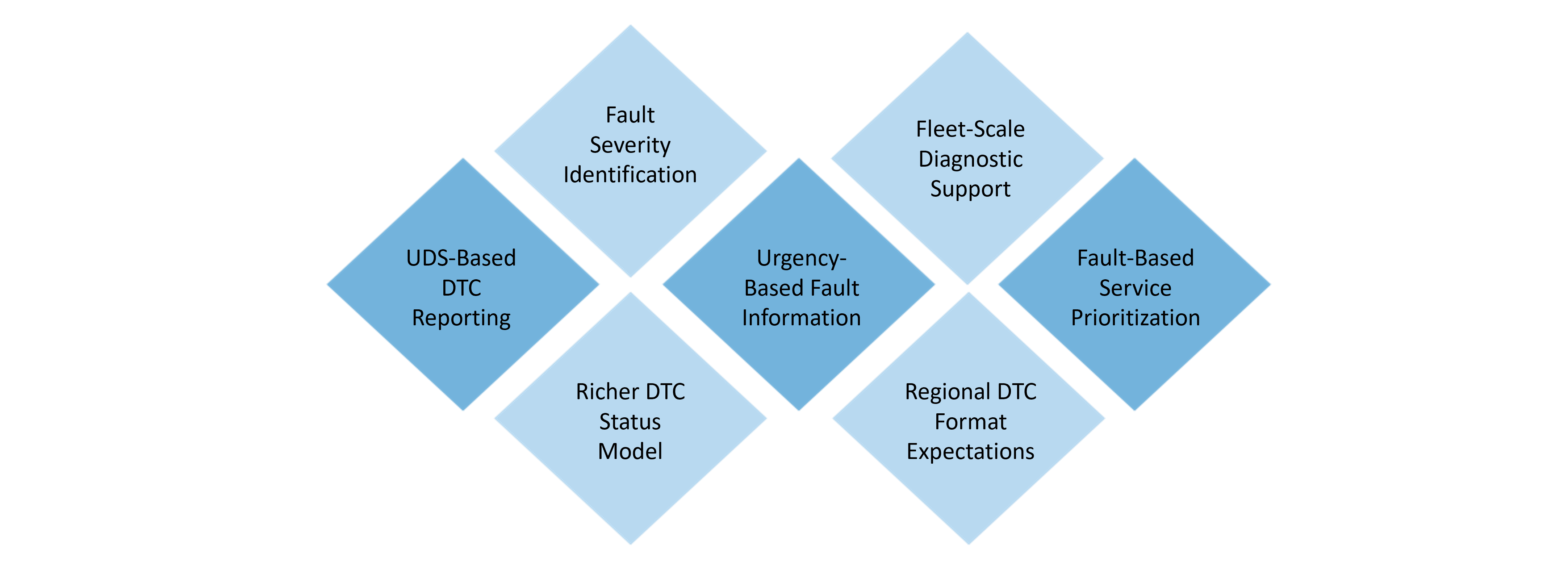
DTC harmonization is one of the more visible practical benefits WWH-OBD brings to a multi-market platform. Legacy OBD-II DTC reporting was constrained by a relatively narrow code format and a limited status byte, while WWH-OBD's UDS-based DTC reporting structure carries a considerably richer status and severity model - enough to express not just that a fault exists, but how severe it is and how urgently it needs attention, information that varies in importance from one region's regulatory framework to the next. That richer DTC model is also what makes WWH-OBD data genuinely useful downstream, in fleet-scale diagnostic and service tooling that needs more than a bare pass/fail code to prioritize its work.
For an OEM building a single ECU diagnostic software platform intended to ship into multiple regulatory regions, adopting WWH-OBD as the shared baseline - rather than maintaining separate OBD-II and region-specific diagnostic stacks - is usually the more sustainable long-term architecture, even though it means an upfront investment in UDS-based diagnostic infrastructure that a US-only, OBD-II-focused team might not otherwise need. The payoff is a single diagnostic service implementation configured per-market rather than reimplemented per-market, which materially reduces the certification and maintenance burden as a platform's addressable market list grows.
WWH-OBD isn't a replacement for understanding either OBD-II or UDS on their own - it sits directly on top of both. Embien's guide to the OBD-2 protocol covers the US-centric baseline WWH-OBD was built to extend beyond, and the UDS protocol guide covers the general-purpose diagnostic foundation WWH-OBD's service structure is actually built on. A team that already understands the obd ii communication protocol and the broader obd2 protocol stack has most of the conceptual groundwork needed to understand where and why WWH-OBD diverges from it.
Embien Technologies builds diagnostic software stacks spanning the obd ii protocol, UDS, and WWH-OBD for OEMs designing one ECU platform to satisfy multiple regulatory regions - from the underlying obd ii communication protocol and general obd2 protocol stack implementation through WWH-OBD's emissions-specific service and DTC extensions.

Embien's product engineering services support the development of automotive embedded products, covering ECU software development, diagnostic protocol integration, firmware engineering, system integration, and validation for globally compliant vehicle platforms.

Embien's automotive electronics engineering capabilities support vehicle diagnostic systems through ECU development, UDS and OBD protocol integration, embedded firmware, diagnostic communication, and automotive software solutions for multi-market emissions compliance.

A case study on developing a UDS client for an Android-based vehicle instrument cluster, highlighting remote vehicle diagnostics, diagnostic communication, ECU integration, and Firmware Over-The-Air (FOTA) update capabilities relevant to automotive diagnostic systems.