
The automotive industry is moving into a new software era. Vehicles are no longer engineered as static products with capabilities fixed at launch. They are increasingly designed as Software-Defined Vehicles (SDVs), where features, diagnostics, connectivity, and user experience can evolve continuously through software updates, cloud services, and intelligent orchestration across the vehicle stack.
That shift is creating space for the next major layer of in-vehicle innovation: Automotive AI Copilots.
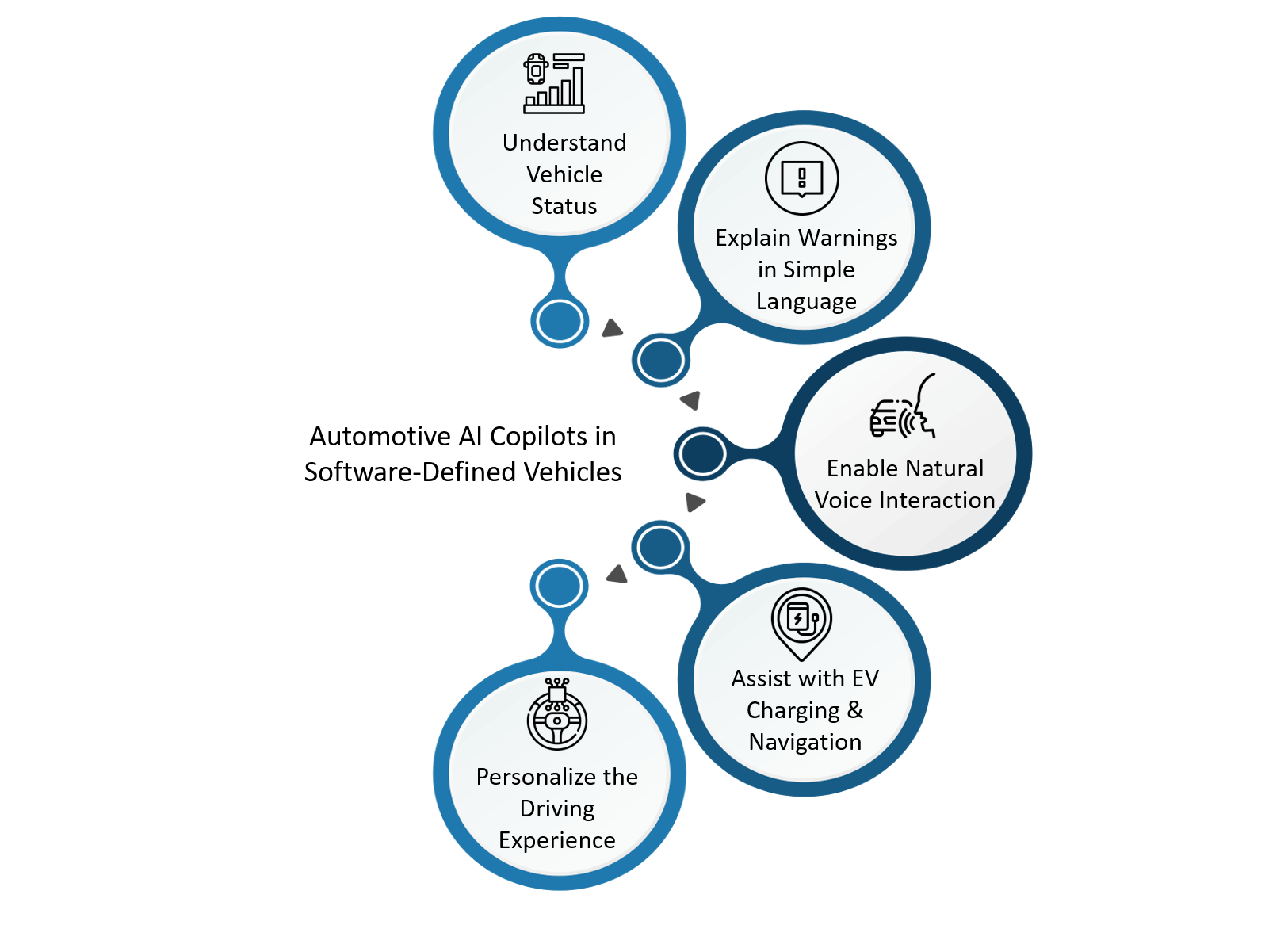
An Automotive AI Copilot is not just a better voice assistant or a chatbot inside the dashboard. In an SDV environment, it becomes a contextual intelligence layer that can understand vehicle state, personalize the cockpit, explain warnings in natural language, support EV charging and route decisions, surface diagnostics, and connect in-cabin experiences with cloud-enabled vehicle services. As digital cockpits become the most visible software touchpoint in the vehicle, AI copilots are also emerging as a key differentiator for OEMs looking to elevate user experience, strengthen brand value, and extend engagement long after the vehicle leaves the factory.
Why Automotive AI Copilots Are Gaining Momentum
Three major shifts are driving the rise of Automotive AI Copilots.
The first is the move toward SDV architectures. Vehicles are shifting from fragmented ECU-based designs to domain, zonal, and centralized compute architectures that can support richer software layers and continuous feature delivery. This is what makes AI copilots practical at scale. A copilot cannot provide meaningful assistance if cockpit software, diagnostics, telematics, personalization, and cloud services remain isolated. It needs a software-defined platform that can expose and update vehicle functions across the lifecycle.
The second shift is changing user expectations. Drivers increasingly expect the same level of personalization, natural interaction, and contextual assistance they get from digital platforms elsewhere. In premium EVs and next-generation connected vehicles, the benchmark is no longer just a responsive infotainment display. It is a cockpit that can adapt, converse, recommend, and proactively support the user based on intent, context, and vehicle state.
The third is the business value of software-defined mobility. As vehicles become software platforms, OEMs gain new ways to monetize premium features, after-sales services, and branded digital experiences. In that model, the cockpit is no longer just a display layer; it becomes the visible surface of a broader software business. Automotive AI Copilots fit directly into that shift because they turn software complexity into a more usable and differentiated customer experience.
A Global Shift Toward AI-Enabled SDVs
The move toward intelligent, software-led mobility is happening globally. In Japan, OEM strategies increasingly treat vehicles as long-lifecycle software platforms, with initiatives such as Honda’s ASIMO OS and Toyota’s Arene reflecting a platform-led approach to evolving vehicle software. In Europe, SDV programs are being shaped not only by digital cockpit innovation but also by strong requirements around cybersecurity, software-update governance, and functional safety. In the United States, OTA-led product thinking and EV-first software strategies have accelerated the expectation that vehicles should improve after purchase, making the digital cockpit a more strategic space for AI-led differentiation. South Korea and India add further momentum through investments in SDV platforms, connected vehicle software, and automotive engineering services. Across these markets, the direction is clear: the next competitive battleground is not connectivity alone, but secure, intelligent, and updateable vehicle software.
What an Automotive AI Copilot Actually Requires
The most common mistake in AI-copilot discussions is to treat the copilot as a standalone interface feature. In reality, a production-grade Automotive AI Copilot sits on top of a much deeper software stack.
At the front end is the digital cockpit—the instrument cluster, infotainment system, touch HMI, voice interface, and the broader in-cabin interaction layer. This is where the user experiences the copilot. But the copilot itself needs access to systems behind that interface. It needs vehicle context such as diagnostics, charging status, navigation state, cabin settings, user preferences, and service information. It also needs connectivity to telematics systems, OTA services, cloud APIs, and remote diagnostics.
This is where Retrieval-Augmented Generation (RAG) becomes highly relevant. Instead of answering only from a general-purpose language model, an automotive copilot can retrieve information from owner manuals, fault-code libraries, service procedures, charging logic, or OEM knowledge repositories before generating a response. That makes it more useful in real-world scenarios such as explaining a dashboard warning or guiding a driver through a charging issue.
The execution model matters too. Not every AI function belongs in the cloud. Edge AI is increasingly important for low-latency, privacy-sensitive, and always available in-cabin experiences. Personalization selected contextual prompts, and some local inference tasks are often better handled close to the vehicle. Cloud AI still plays a major role in fleet learning, analytics, and model updates, but the long-term reality of Automotive AI Copilots is likely to be hybrid intelligence, with capabilities distributed across edge and cloud.
Why OTA, Validation, and Cybersecurity Matter
Once an Automotive AI Copilot becomes part of the vehicle software experience, it also becomes part of the SDV lifecycle. That changes how it must be built and maintained.
First, AI copilots are not “ship once” software. Their behavior will evolve through feature updates, model changes, service integrations, bug fixes, and cybersecurity patches. That makes over-the-air updates foundational. In an SDV environment, OTA is the mechanism that keeps software-defined experiences relevant, secure, and competitive over time.
Second, the validation burden becomes much heavier. A copilot update can affect HMI behavior, API interactions, diagnostics, telematics integrations, and contextual responses. Validation therefore must move beyond one-time feature testing toward continuous regression, software integration testing, SIL/HIL-based verification, and release confidence across the stack. For AI-enabled cockpit experiences, testing must also consider latency, fallback behavior, contextual relevance, and resilience to software changes.
Cybersecurity is equally critical. Automotive AI Copilots sit inside a highly connected environment that can include user profiles, diagnostics, telematics pathways, cloud services, and OTA-enabled functions. Weak authentication, poorly secured APIs, unsafe update paths, or exposed diagnostics can create unacceptable risks. That is why automotive cybersecurity can no longer be added later. It has to be built into the SDV architecture from the start.
Compliance, Zero Trust, and the Road Ahead
For OEMs and Tier-1 suppliers, compliance now has to shape architecture, development, and validation from the beginning. Standards such as ISO 26262 for functional safety, ISO/SAE 21434 for automotive cybersecurity, UNECE R155 for cybersecurity management, UNECE R156 for software update management, and ASPICE for software process maturity all influence how software-defined vehicles are designed and maintained. An Automotive AI Copilot that can access diagnostics, interact with cloud services, or personalize vehicle behavior cannot be treated as an isolated UX feature. It sits inside a regulated software ecosystem where trust, update integrity, and secure communication are essential.
This is also where Zero Trust becomes relevant as a design principle. In an SDV environment, cockpit systems, telematics units, mobile apps, cloud services, OTA pipelines, and AI services are all connected. Automotive AI Copilots amplify that complexity because they often span multiple software domains. Applying Zero Trust means enforcing strong identity, least-privilege access, authenticated update paths, encrypted communications, and continuous verification across the vehicle software stack.
Looking ahead, technologies such as 6G, digital twins, and richer edge-cloud orchestration could further expand what AI-enabled mobility platforms can do. But for current AI-copilot programs, the near-term challenge is much more grounded: building SDV platforms that can securely support intelligent cockpit experiences today.
How Embien Supports AI-Enabled SDV Programs
Embien helps OEMs and Tier-1s build the software foundation required for Automotive AI Copilots in Software-Defined Vehicles. Through Sparklet, Embien supports digital cockpit experiences such as instrument clusters, infotainment, and HMI development.
With RAPIDSEA, it enables connected vehicle software, communication stacks, diagnostics, and middleware essential for OTA-ready and software-defined architectures.
Backed by Testbot and Embien’s broader embedded engineering expertise—including embedded software development, BSP and device-driver development, RTOS/Linux/Android platforms, telematics integration, cloud connectivity, and automotive cybersecurity, these capabilities come together to help OEMs turn AI-enabled cockpit concepts into secure, scalable, and production-ready vehicle software platforms. Enabling AI-powered, connected, and software-defined products across diverse industries and mobility ecosystems.
Conclusion
Automotive AI Copilots are becoming one of the most visible outcomes of the Software-Defined Vehicle transition. But their success will not be determined by the conversational layer alone. They depend on a robust SDV foundation that can connect the digital cockpit to vehicle data, diagnostics, OTA infrastructure, cloud services, and validation workflows while maintaining security, trust, and compliance across the lifecycle. In that sense, the future of Automotive AI Copilots is not just about AI—it is about engineering the software-defined vehicle stack that makes intelligent in-vehicle experiences usable, secure, and production-ready on the road.