
The Component That Looked Fine - Until It Did Not
A startup developing a vehicle fleet telematics unit selected a microcontroller for their TCU design. The device came from a reputable vendor, it met all functional specifications, and it was readily available in distribution. The product passed bench testing, passed environmental testing in their own lab, and shipped to customers.
Eighteen months later, field returns began accumulating from customers in the Middle East and South Asia. Devices were resetting intermittently during summer afternoons. Investigation revealed the MCU was a commercial-grade device rated to +70°C junction temperature. In a sealed TCU mounted in a vehicle cabin without active cooling, junction temperatures were routinely exceeding +80°C on hot afternoons. The device was operating outside its qualified envelope, and eventually, consistently failing.
The fix required a board redesign, a component change, and a field recall. The root cause was a component grade decision made early in the program without adequate analysis of the actual operating environment. This is one of the most preventable categories of product failure in embedded electronics, and it is prevented by understanding component grades from the start. Across domains, component grade selection depends on application-specific reliability, environmental, and lifecycle requirements.
Why Component Grades Exist
Semiconductor manufacturers build the same functional circuit, an MCU, a power management IC, a CAN transceiver, in multiple variants optimised for different markets. These variants differ in three fundamental ways:
Temperature Range: The operating and storage temperature range the component is qualified to survive without performance degradation or permanent damage. This is the most visible grade differentiator.
Qualification Standard: The stress test regime the component has been subjected to, and passed, to demonstrate long-term reliability in its target environment. Commercial components may have minimal formal qualification. Military components undergo the most rigorous testing. Automotive occupies a specific, well-defined qualification regime.
Documentation and Traceability: The evidence package, qualification test reports, failure rate data, change notification commitments, that comes with the component. This matters enormously for regulated industries and long-lifecycle products.
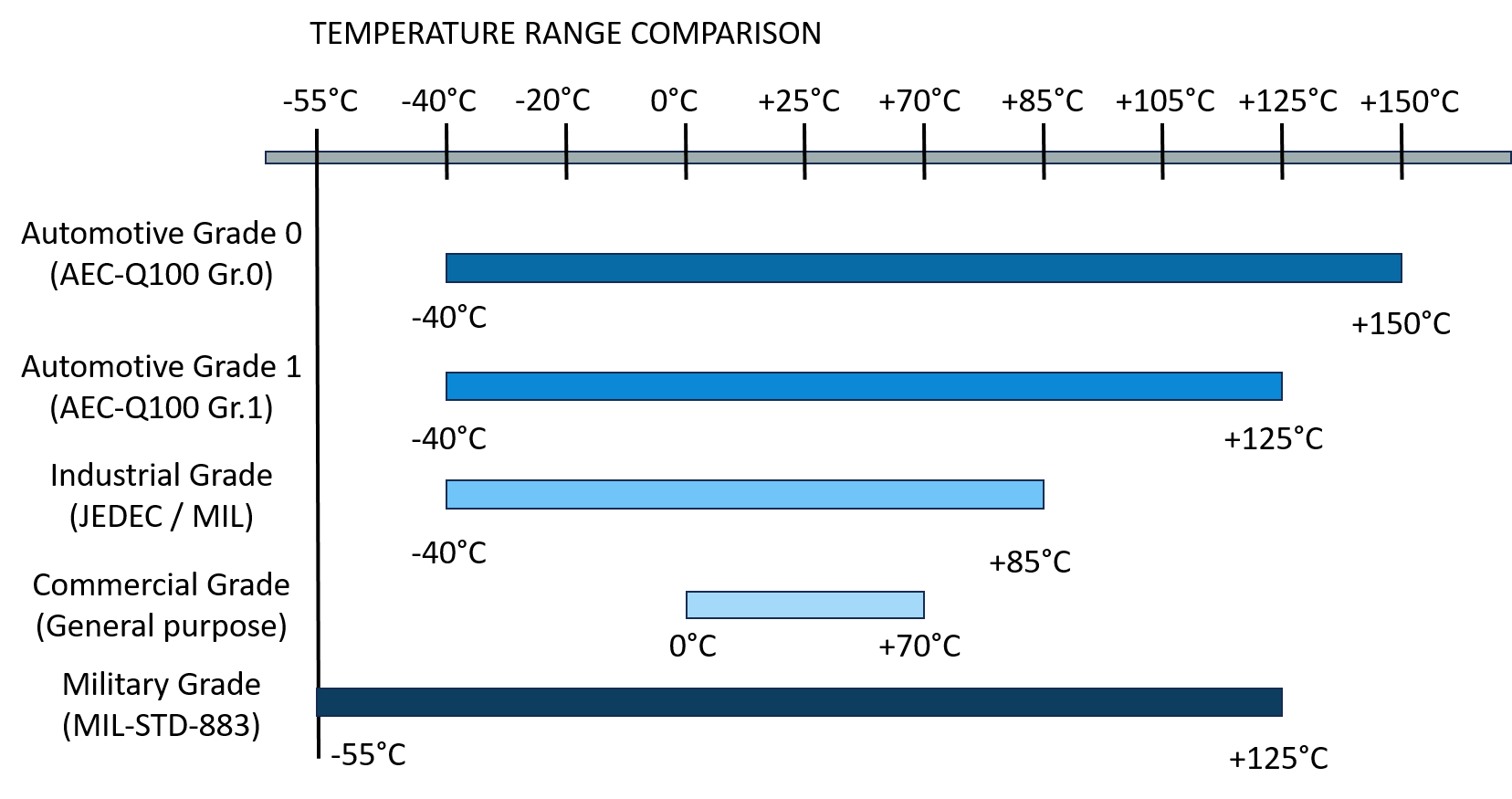
Commercial Grade - The Default and Its Limits
Commercial grade components are designed for consumer electronics, computing, and general-purpose applications. They are optimised for cost, availability, and time-to-market rather than longevity or environmental robustness.
Temperature Range: Typically 0°C to +70°C junction temperature. This reflects the assumption that the product operates in a climate-controlled indoor environment.
Qualification: Minimal formal qualification. JEDEC standards provide baseline reliability guidance but do not mandate the stress test sample sizes or durations that automotive qualification requires. Process changes by the manufacturer may not be communicated to customers.
Supply Commitment: Commercial components are typically available for 2–5 years before being discontinued or revised. For a consumer product with a 2-year lifecycle this is acceptable. For an industrial product expected to be in the field for 10 years, or an automotive component supporting a 15-year vehicle lifetime, it is a serious supply chain risk.
When commercial grade is appropriate: Short-lifecycle consumer products, office equipment, products operating only in climate-controlled indoor environments, non-critical functions in systems with robust thermal management keeping all component junction temperatures well below +65°C.
Industrial Grade - The Middle Ground
Industrial grade components extend the commercial specification for the harsher environments of factory floors, outdoor enclosures, agricultural equipment, and building automation systems.
Temperature Range: Typically -40°C to +85°C junction temperature. The -40°C lower bound addresses cold-start requirements in unheated outdoor installations. The +85°C upper bound addresses elevated ambient temperatures in industrial enclosures and equipment rooms.
Qualification: JEDEC industrial qualification guidelines or manufacturer-specific reliability testing. More rigorous than commercial but less standardised and less demanding than AEC-Q100. Supply commitments are typically 5–10 years for industrial-positioned product lines.
A critical nuance: not all components labelled 'industrial grade' undergo the same qualification. The label is not governed by a single mandatory standard the way AEC-Q100 is. Design engineers must review the actual datasheet operating range and request qualification evidence rather than accepting the label at face value.
When industrial grade is appropriate: Industrial automation, building management systems, agricultural electronics, outdoor telecom infrastructure, products with operating environments up to +85°C ambient with adequate thermal management.
Automotive Grade - The Defined Standard
Automotive grade components are qualified to AEC-Q100 (ICs) or AEC-Q101 (discrete semiconductors), managed by the Automotive Electronics Council. Unlike industrial grade, AEC-Q qualification is a specific, publicly available, auditable standard.
| Grade | Junction Temp Range | Typical Application |
|---|---|---|
| Grade 0 | -40°C to +150°C | Engine bay, transmission, under-hood electronics |
| Grade 1 | -40°C to +125°C | Body control, chassis, battery management, most ECUs |
| Grade 2 | -40°C to +105°C | Cabin infotainment, instrument cluster, HVAC |
| Grade 3 | 0°C to +85°C | Cabin electronics in temperature-managed environments |
Beyond temperature range, AEC-Q qualification requires: HTOL (High Temperature Operating Life) testing at elevated temperature and voltage for 1,000 hours, Temperature Cycling across the full range for 1,000 cycles, THB (Temperature Humidity Bias) testing, ELFR (Early Life Failure Rate) screening, and a comprehensive failure analysis process for any qualification failures. The full test result package, the Qualification Test Report (QTR), must be available to customers.
Change Control: Any change to the manufacturing process, mask layer, package, or assembly site of an AEC-Q100 qualified component requires a customer notification and a re-qualification assessment. This protects against the scenario where a component that qualified correctly changes in a way that affects reliability without the design team's knowledge.
Supply Commitment: Automotive component suppliers typically commit to 15-year supply continuity, matching the vehicle production and service lifetime. This is a significant commercial commitment that influences which component families are offered in automotive grade.
Military Grade - The Most Demanding
Military grade components are qualified to MIL-STD-883 (ICs) and related military specifications. The temperature range extends from -55°C to +125°C, covering arctic deployments and desert operations. Beyond temperature, military qualification adds radiation tolerance (for space and high-altitude applications), enhanced screening (100% burn-in testing for many military components), hermetic packaging (metal or ceramic, impervious to humidity), and the most demanding long-term reliability evidence requirements.
Military grade components are significantly more expensive than automotive equivalents, often 5–20x the cost of an equivalent automotive-grade device. They are appropriate for defence electronics, aerospace, and satellite applications where reliability in the field justifies the cost premium. Some designers use military-grade components in demanding industrial applications as a conservative over-specification, though this is rarely cost-effective compared to properly applied automotive-grade selection.
The PPAP Requirement in Automotive
Automotive supply chains add a layer beyond component qualification: Production Part Approval Process (PPAP). PPAP is a formal process, originally developed for mechanical components and extended to electronics, that documents evidence that a component will be manufactured consistently to its qualified specification in production volumes.
For electronic components, PPAP documentation includes: process flow diagrams of the manufacturing process, measurement system analysis for critical parameters, process capability studies (Cpk) for key electrical parameters, and a control plan documenting how manufacturing defects will be detected. OEMs typically require PPAP completion before a component can be formally approved for a production vehicle program.
The combination of AEC-Q qualification evidence and PPAP documentation constitutes the full quality package expected by automotive OEMs. Specifying an AEC-Q100 qualified component without PPAP documentation is insufficient for most OEM approval processes. A robust Embedded Hardware Development process helps ensure components operate reliably across intended deployment environments.
Making the Right Grade Decision
A systematic approach to component grade selection should answer four questions at the point of component selection, not at the point of field failure:
1. What is the actual junction temperature in my application? This requires thermal analysis accounting for ambient temperature extremes in the deployment environment, self-heating from the component's own power dissipation, thermal coupling from adjacent hot components, and PCB thermal resistance. The worst case, not the typical case, determines the required grade.
2. What is the required product lifetime? A consumer device with a 2-year lifecycle has different supply continuity requirements than an industrial gateway expected to operate for 15 years in the field. The component's supply commitment must exceed the product's required service life.
3. What documentation does the end market require? Automotive OEM supply chains require AEC-Q qualification evidence and PPAP. Some industrial markets require JEDEC qualification evidence. Consumer markets typically have no formal component qualification requirement, but this does not mean reliability does not matter.
4. What is the cost of field failure? A field recall of a consumer product causes brand damage and support cost. A field recall of an automotive ECU causes all of the above plus regulatory scrutiny, potential safety liability, and OEM relationship damage measured in future program awards. The cost premium of automotive-grade components is almost always justified when the cost of failure is assessed honestly.
Embien's Approach
At Embien, component grade assessment is a mandatory step in our hardware design process, not an afterthought. For every component in every design, our hardware engineers explicitly document the required operating temperature range, compare it against the component's AEC-Q or industrial qualification data, and verify supply continuity against the program's lifetime requirement. For automotive programs, we work exclusively with AEC-Q qualified components in the appropriate grade and from authorised distribution channels. Our supply chain partnerships with Renesas, NXP, STMicroelectronics, Infineon, and Texas Instruments provide direct access to qualification data, change notification programs, and long-term supply commitments.
To discuss component selection strategy for your next embedded product program, reach out to the Embien team.