
Introduction
Before an ADAS program gets to fusion architecture, Kalman filters, sensor synchronization, redundancy voting, it has to answer a more basic question: which sensors, in which combination, for which function. Automotive camera and radar integration decisions, and whether LiDAR joins that mix, shape everything downstream, cost, weather resilience, achievable range, and ultimately which ADAS functions a vehicle platform can actually support. Buyers and program teams evaluating ADAS strategy often ask the sensor-selection question first, and it deserves a direct answer before diving into fusion-layer engineering.
In short: no single sensor modality covers every ADAS requirement well, and sensor selection is fundamentally a tradeoff exercise across cost, weather performance, range, and resolution that has to be matched to the specific ADAS function and automation level a program is targeting, not decided by defaulting to whichever sensor is currently cheapest or most hyped.
What Each Sensor Type Is Actually Good At
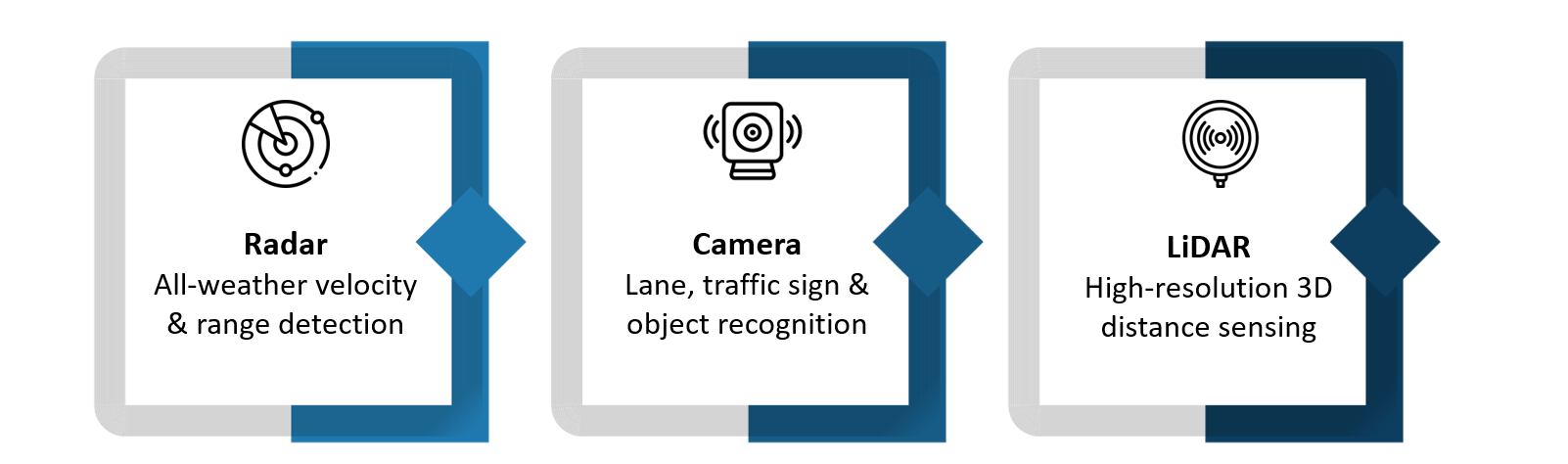
Radar excels at direct velocity measurement (via Doppler shift) and reliable performance in rain, fog, and low light where optical sensors degrade, but offers comparatively low spatial resolution and limited ability to classify what an object actually is. Cameras provide rich semantic information, lane markings, traffic signs, object classification, color, at relatively low cost, but performance degrades meaningfully in poor lighting, glare, and adverse weather, and cameras alone don't measure distance or velocity directly, requiring either stereo vision or fusion with another ranging sensor. LiDAR provides precise, direct distance measurement and high-resolution 3D point-cloud data largely independent of lighting conditions, valuable for accurate object shape and position, but at meaningfully higher cost than radar or cameras and reduced performance in heavy rain, snow, or fog compared to radar's all-weather strength.
Cost, Weather-Resilience, and Range Tradeoffs
These three factors trade against each other in ways that shape real vehicle program decisions. Radar remains the lowest-cost all-weather ranging sensor, which is why it appears on nearly every ADAS-equipped vehicle regardless of price segment. Cameras add rich semantic capability at low incremental cost but need favorable conditions or fusion support to perform reliably. LiDAR's cost has fallen substantially but still commands a meaningful premium over radar and cameras, which is why LiDAR adoption has concentrated in higher automation-level programs where its precision justifies the cost, rather than becoming a universal ADAS sensor across all price points. Range also varies significantly by sensor and use case, long-range radar for highway automatic cruise control needs different range and resolution characteristics than a short-range sensor suite for parking assistance or low-speed collision avoidance.
Which ADAS Functions Favor Which Sensor Combinations
Function requirements drive sensor strategy more than any general preference for one modality. Adaptive cruise control and forward collision warning have historically relied heavily on forward radar, sometimes paired with a forward camera for classification and lane-context, because reliable long-range velocity measurement in all weather matters more here than fine spatial resolution. Lane-keeping and traffic-sign recognition depend heavily on camera vision, since these are fundamentally classification and semantic-understanding tasks radar can't perform. Higher-automation functions, automated lane-change, highway pilot, and beyond, increasingly incorporate LiDAR specifically because the precision and reliability of direct 3D measurement becomes more important as the system takes on more decision-making responsibility from the driver.
ADAS Embedded System Engineering: Redundancy and Diversity Requirements
ADAS embedded system engineering for higher automation levels has to account for redundancy and sensor diversity as a functional safety requirement, not just a performance enhancement. ISO 26262's approach to redundancy favors diverse sensor modalities specifically because a single modality's failure mode (a camera blinded by direct sun glare, a radar confused by a specific multipath reflection) shouldn't be able to compromise the whole perception system if a second, diverse modality doesn't share that same failure mode. This is why higher-automation ADAS architectures increasingly specify radar, camera, and LiDAR together rather than any single sensor pair, diversity of failure mode matters as much as raw sensing capability for the safety case a higher automation level actually requires.
LiDAR System Design Considerations for Automotive Platforms
LiDAR system design for automotive integration carries its own specific engineering challenges beyond the sensor itself: mechanical or solid-state scanning mechanism choice affects reliability and cost differently, mounting location and field-of-view coverage has to be reconciled with vehicle styling and aerodynamics in ways that camera and radar integration, being more mechanically flexible, generally don't face as acutely, and point-cloud processing compute requirements are substantial enough to meaningfully shape the vehicle's overall compute platform sizing, not just the sensor's own bill-of-materials cost. Programs incorporating LiDAR for the first time often underestimate this integration and compute-budget impact relative to the sensor's headline cost alone.
Where the Industry Is Converging (and Where It Isn't) on Sensor Strategy
Broad convergence exists around radar-plus-camera as the baseline sensor suite for mainstream ADAS functions across most price segments, reflecting that combination's favorable cost-to-capability ratio for the most common ADAS use cases. Where the industry has notably not converged is on LiDAR's role at higher automation levels, some programs treat LiDAR as essential to a credible safety case for advanced automation, while others are betting on continued camera and radar advancement (higher resolution radar, camera-based depth estimation) to close the capability gap without LiDAR's added cost. This remains a genuinely open strategic question rather than a settled industry consensus, and a program's answer should follow from its specific automation-level target and safety case strategy rather than from industry trend-following alone.
ADAS Software and Embedded Software for ADAS Systems: How Sensor Choice Constrains Fusion Architecture
Sensor selection isn't a decision made independently of downstream software architecture. ADAS software and the broader embedded software for ADAS systems that fuses sensor data into a coherent perception output has to be architected around the specific sensor suite chosen, a fusion architecture designed around radar-and-camera doesn't extend trivially to incorporate LiDAR's point-cloud data without real rework, and a compute platform sized for camera-plus-radar processing may be significantly undersized for LiDAR's point-cloud processing demands. This is precisely why sensor selection needs to happen early and deliberately, in coordination with the fusion architecture and compute platform sizing decisions it directly constrains, rather than being treated as an independent, earlier-stage decision the software team simply has to accommodate afterward.
Embien's Capabilities
Embien brings automotive embedded system engineering experience across camera, radar, and LiDAR sensor integration, ADAS embedded software development, and sensor fusion ECU architecture design. Our engineering process evaluates sensor selection against the specific ADAS function, automation level, and safety case a program targets, rather than defaulting to a generic sensor suite regardless of the actual requirement.
To discuss automotive camera and radar integration, LiDAR system design, or embedded software architecture for an ADAS program, reach out to Embien's engineering team.