
Introduction
The shift to software-defined vehicle architecture doesn't just change how a vehicle's electronics are engineered, it's reshaping how OEMs source software and hardware in the first place. An automotive Tier 1 supplier relationship built around delivering a fixed-function ECU with embedded firmware baked in at manufacturing doesn't map cleanly onto a centralized compute architecture where software is developed, updated, and evolved largely independent of the hardware's production timeline. OEMs are rethinking these relationships not because Tier 1 suppliers stopped being valuable, but because the sourcing model itself has to change to fit how SDV architecture actually works.
In short: software defined vehicles (SDV): the new competitive baseline means the OEM-supplier relationship has to shift from buying a finished, fixed-function component to co-developing a software platform that keeps evolving after the vehicle ships, and that shift changes contract structures, IP ownership, and which capabilities an OEM needs to keep in-house versus source externally.
How SDV Architecture Changes What OEMs Need From Tier 1 Suppliers
Traditional automotive sourcing built around distributed ECUs meant an OEM could specify a function precisely, brake control, window lift, climate control, and a Tier 1 supplier could deliver a self-contained component meeting that specification with minimal ongoing OEM involvement post-delivery. Centralized, software-defined architecture inverts this: a zonal or centralized compute platform runs software from multiple domains that has to be integrated, updated, and evolved together over the vehicle's service life, which means the OEM needs far deeper, ongoing visibility into and control over the software running on that platform than the traditional "buy a finished component" relationship provided. This is less about Tier 1 suppliers becoming less capable and more about the OEM's own required level of software ownership increasing regardless of who writes the code.
The Shift From Hardware-Defined to Software-Defined Sourcing Relationships
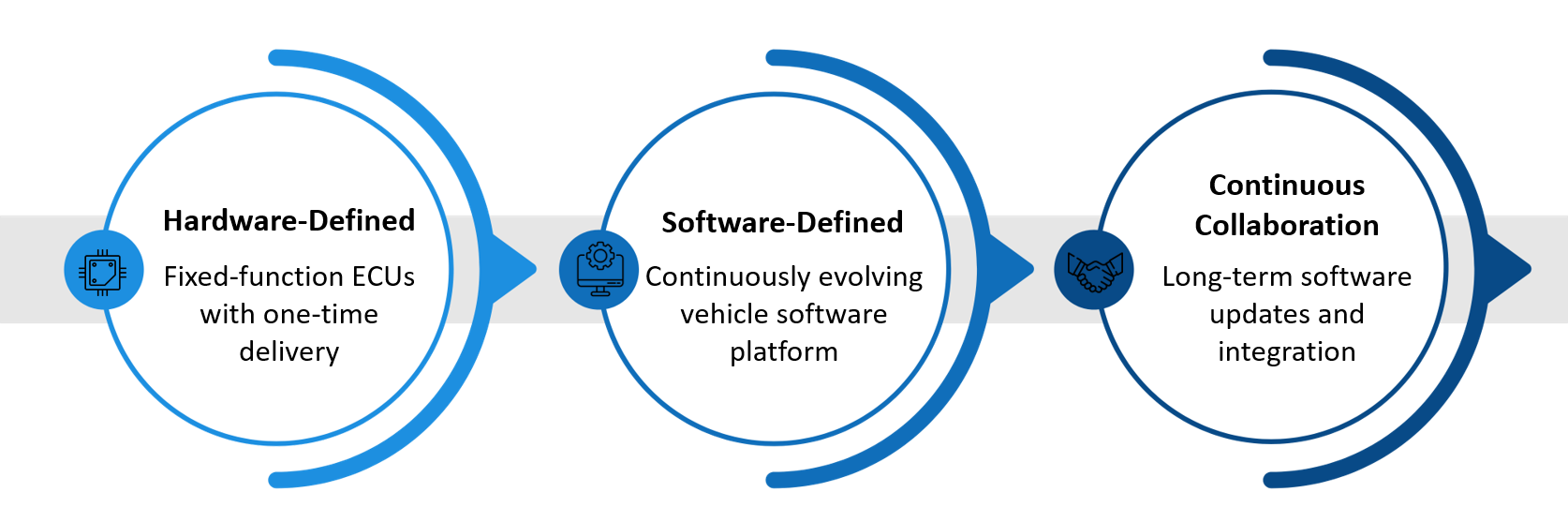
A hardware-defined sourcing relationship is transactional by nature: specify, procure, integrate, done until the next model year. A software-defined sourcing relationship has to be structured for continuous collaboration, because the software the OEM is sourcing keeps changing throughout the vehicle's field life, well past the initial delivery. This changes contract structures meaningfully: IP ownership and source code access terms matter far more when an OEM needs to maintain and update software over a decade of vehicle service life, and update responsibility, who is obligated to fix a defect discovered in year six of a vehicle's service life, needs contractual clarity that a traditional one-time-delivery component contract never had to address.
Automotive Software Development for Tier 1 Suppliers: The New Skill the Relationship Demands
Automotive software development for Tier 1 suppliers increasingly means bringing platform software engineering capability, not just embedded firmware for a specific function, AUTOSAR Adaptive expertise, containerization and OTA update infrastructure, and integration discipline for a shared compute platform running software from multiple previously-separate domains. Tier 1 suppliers that have built this platform-level software capability are positioned very differently in SDV-era sourcing conversations than those still organized purely around discrete, function-specific hardware components, because the OEM's actual pain point has shifted from "who can build this ECU" to "who can help us integrate and maintain software across a shared platform over years."
Where In-House Software Capability Is Replacing Outsourced Integration
Many OEMs have responded to this shift by insourcing the software integration and platform-ownership layer that used to sit entirely with suppliers, building internal teams that own the vehicle's software architecture, update strategy, and cross-domain integration even while continuing to source individual software components and hardware from external partners. This isn't a rejection of outsourcing generally, it's a recognition that the platform-level integration and long-term ownership function is now a core competency an OEM competing on software-defined vehicle capability can't fully delegate away, even as it continues sourcing specific components and development capacity externally.
New Entrants This Shift Is Enabling
The software-defined shift has opened room for software-first suppliers with limited or no traditional hardware manufacturing footprint, companies whose core offering is a software platform, a middleware layer, or specialized domain software (perception stacks, HMI frameworks, OTA infrastructure) rather than a manufactured component. These entrants compete on software engineering depth in a specific domain rather than on manufacturing scale or an established hardware supply relationship, a genuinely different competitive basis than the traditional Tier 1 landscape was organized around, and one that's reshaping which suppliers get invited into early-stage SDV architecture conversations.
What This Means for Engineering Partners Positioning for SDV Work
An engineering partner positioning for SDV-era work needs to demonstrate platform-level software capability, not just domain-specific embedded expertise: AUTOSAR Adaptive experience, containerization and orchestration for automotive compute platforms, OTA update architecture, and crucially, the ability to work within an OEM's own software ownership model rather than delivering a black-box component the OEM has limited visibility into. Partners still organized purely around delivering discrete hardware-plus-firmware components without this platform-integration capability will find themselves positioned for an increasingly narrow slice of SDV-era sourcing.
Risks OEMs Are Navigating in This Transition
OEMs face real risks in this transition beyond the sourcing-model shift itself: the insourcing decision requires building genuine software engineering capability at a pace and scale many traditionally hardware-focused OEMs are still developing, the multi-supplier software integration challenge (getting software from several suppliers to run reliably together on one shared compute platform) is a nontrivial engineering problem in its own right, and the long-term software maintenance obligation that comes with owning more of the software stack directly extends an OEM's support burden well past what a traditional component-sourcing model required. Navigating this transition well requires an honest assessment of which capabilities genuinely need to be in-house versus which can be effectively partnered for, rather than defaulting to either extreme.
Software-Defined Vehicle Supply Chain and OEM Sourcing Shift: The Bigger Picture
The software-defined vehicle supply chain and OEM sourcing shift underway right now is still actively settling into new equilibria across the industry, different OEMs are choosing different points on the insource-versus-partner spectrum, and the Tier 1 landscape is still sorting into suppliers that have successfully made the platform-software transition and those still catching up. Engineering partners and suppliers that understand this shift as a genuine restructuring of the sourcing relationship, not just a technology upgrade layered onto the old model, are the ones positioned to grow with it rather than be disrupted by it.
Embien's Capabilities
Embien brings automotive software development experience spanning AUTOSAR Classic and Adaptive architectures, embedded software for zonal and centralized compute platforms, and secure OTA update infrastructure, positioned to support both traditional Tier 1 component relationships and the platform-level software integration SDV architecture increasingly demands. Our engineering teams work within an OEM's own software ownership model rather than delivering opaque, black-box components.
To discuss software development or platform integration support as an automotive Tier 1 supplier partner for an SDV program, reach out to Embien's engineering team.