
Introduction
A counterfeit or re-marked semiconductor entering a commercial product usually means a warranty claim. The same part entering custom military hardware means a platform that may fail in the field, or worse, a covert reliability or security risk designed into the supply chain by an adversary rather than introduced by accident. As global semiconductor supply chains have grown longer, more distributed, and harder to audit end to end, component provenance has become a first-order engineering concern for defense electronics, not a procurement afterthought.
In short: trusted sourcing for custom military hardware means treating component provenance as a design input from the first schematic, not a purchasing checkbox applied after the design is finished, because the mitigations that actually work, second-sourcing, authentication features, traceable documentation, all have to be planned for before the bill of materials is locked.
Why Counterfeit and Grey-Market Components Are a Rising Defense Risk
Counterfeit electronic components enter defense supply chains through several well-documented paths: recycled parts pulled from e-waste and re-marked with false date codes and specifications, grey-market brokers selling excess or diverted inventory outside authorized distribution, and in rarer but more concerning cases, deliberately altered parts intended to introduce a hardware-level vulnerability. Global component shortages make this worse, not better, because shortage conditions push buyers toward broker channels precisely when counterfeit activity in those channels tends to spike. A part that looks correct on the outside, correct markings, correct package, can fail electrical testing, fail early in the field, or in the worst case, function correctly under normal conditions while harboring a deliberately introduced flaw that only manifests under specific circumstances.
Trusted Foundry Programs: What They Do and Don't Guarantee
Trusted foundry and accredited supplier programs exist specifically to address this risk for the most sensitive defense microelectronics, certifying that a facility's design, fabrication, and packaging processes meet defined security and integrity standards. These programs provide strong assurance for the specific parts sourced through them, but they don't automatically extend to every component in a system. A board built around a trusted-foundry microcontroller can still incorporate passives, connectors, or secondary ICs sourced through ordinary commercial channels, and each of those components carries its own provenance risk that a trusted-foundry certification on the main processor does nothing to address. Trusted sourcing has to be evaluated at the level of the full bill of materials, not just the parts that get the most scrutiny by default.
Component Traceability and Documentation Requirements for Custom Military Hardware
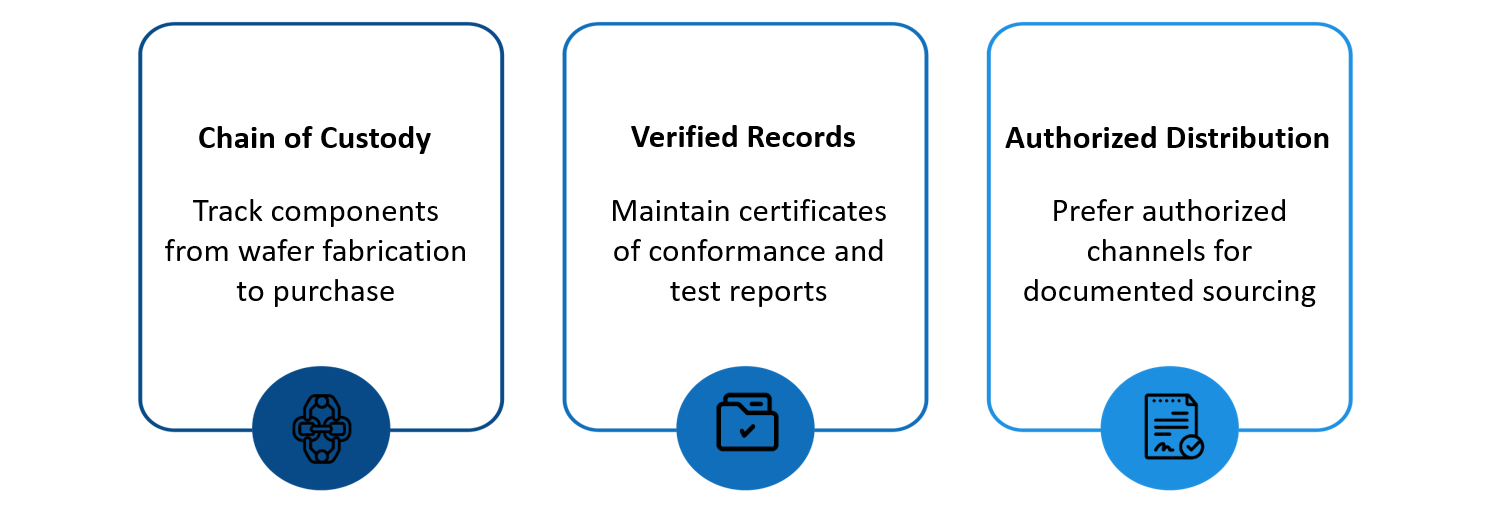
Traceability is the practical backbone of trusted sourcing: a documented chain of custody from wafer fab through packaging, test, and distribution to the point of purchase, with certificates of conformance and, where required, counterfeit-detection test reports at each transfer point. For custom military hardware, program requirements increasingly specify authorized-distributor-only sourcing precisely because authorized channels carry this documentation as a matter of course, while broker channels frequently cannot produce it, or produce documentation that itself cannot be independently verified. Building traceability requirements into the procurement specification at design time, rather than trying to retrofit them once a shortage forces a broker purchase, keeps the program from facing an impossible choice between schedule and provenance risk late in a build.
Design-Stage Mitigations: Second-Sourcing and Authentication Features
Component-level risk mitigation starts well before procurement. Qualifying a second, functionally equivalent source for critical components during the design phase, rather than single-sourcing and hoping availability holds, gives a program a legitimate alternative when a primary source becomes constrained, reducing the pressure that pushes buyers toward unverified broker inventory. Where the threat model justifies it, physical or cryptographic authentication features, unique die identifiers, cryptographic device attestation, physically unclonable function circuits, let a system verify component authenticity at power-up rather than relying entirely on procurement-time paperwork. These techniques add cost and design complexity, so the right level of authentication is a risk-based decision made explicit early, not a default applied uniformly regardless of the actual threat a given component's compromise would represent.
Semiconductor Industry Services and Export-Control Compliance
Trusted sourcing for defense programs intersects directly with export-control compliance, and treating them as separate workstreams is a common and costly mistake. Reputable semiconductor industry services engagements handle component evaluation, qualification, and vendor relationship management with export classification built into the process from the start, confirming a component's ECCN or USML classification alongside its electrical and reliability qualification rather than as a separate legal review bolted on afterward. This matters because export classification can constrain which suppliers, which countries of origin, and in some cases which specific fabrication facilities are acceptable for a given program, information that needs to shape sourcing decisions before a part is designed in, not after.
Why Choose Embedded Engineering for Military Applications?
Why choose embedded engineering for military applications from a partner rather than handling sourcing purely as an internal procurement function? Because the mitigations described above, second-sourcing decisions, authentication feature selection, traceability requirements, are engineering decisions as much as procurement ones, and they need to be made by people who understand both the component's role in the design and the supply chain risk it carries. An embedded engineering partner with direct semiconductor vendor relationships and export-control experience can fold sourcing risk assessment into the same design reviews that already cover electrical and reliability qualification, rather than treating it as a parallel process that only surfaces problems after the design is locked.
Embedded Security in Semiconductors: A Complementary, Not a Substitute, Discipline
Embedded security in semiconductors, secure boot, hardware root of trust, tamper detection, protects against a different class of threat than trusted sourcing does, and the two disciplines are complementary rather than substitutes for each other. A component with a strong hardware root of trust still needs to actually be the genuine part it claims to be; a hardware security feature built on a counterfeit or compromised die offers no real assurance at all. Programs that invest heavily in embedded security features while treating component sourcing as a purely commercial concern are leaving half of the actual threat model unaddressed. Trusted component sourcing for defense electronics supply chains and embedded security engineering need to be planned together from the same system-level threat assessment.
Embien's Capabilities
Embien's semiconductor development support work is built on direct supply chain partnerships with Renesas, NXP, STMicroelectronics, Infineon, and Texas Instruments, giving programs access to qualification data, change-notification programs, and authorized sourcing channels rather than relying on broker inventory. Our hardware design process treats component grade, provenance, and export classification as design inputs evaluated together at component selection, the same discipline we apply across automotive, industrial, and defense programs.
To discuss sourcing strategy or semiconductor supply chain risk for a defense electronics program, reach out to Embien's engineering team.