
Introduction
Most embedded Linux driver development assumes a mainline-tracking kernel, a fast-moving distro, and a board support package the team can rebuild and re-flash as often as needed. Defense platforms standardizing on Red Hat Enterprise Linux break most of those assumptions at once. RHEL's value to a defense program is exactly what makes it awkward for driver work: a long, deliberately conservative support lifecycle, a certified and often frozen kernel baseline, and a change-control posture that treats an out-of-tree driver the way it would treat any other unsupported kernel modification. Camera and sensor driver development for defense platforms on RHEL has to work within that model, not against it.
In short: driver development for a RHEL-based defense platform means designing for a kernel baseline that will not move for years, documenting and packaging the driver the way RHEL's own subsystems are packaged, and validating against the specific certified kernel the platform will actually ship, not whatever kernel happens to be convenient in a development lab.
Why RHEL, Not a General Embedded Linux Distro, for Defense Platforms
Defense and government platforms increasingly standardize on RHEL for reasons that have little to do with typical embedded Linux selection criteria. RHEL carries FIPS 140-validated cryptographic modules, a documented and auditable patch and CVE-response process, and support lifecycles measured in a decade or more, all of which matter enormously for a platform that has to pass a security accreditation process and then stay fielded for a long service life. A general-purpose embedded Linux distribution optimized for fast iteration and the newest hardware support is optimizing for exactly the opposite priorities.
The tradeoff is that RHEL's kernel is deliberately conservative, backporting security and stability fixes onto a fixed upstream version rather than tracking the latest mainline kernel. A camera or sensor driver written against a bleeding-edge kernel API frequently does not transfer cleanly onto RHEL's supported baseline without real rework.
Driver Development Constraints Under RHEL's Certification Model
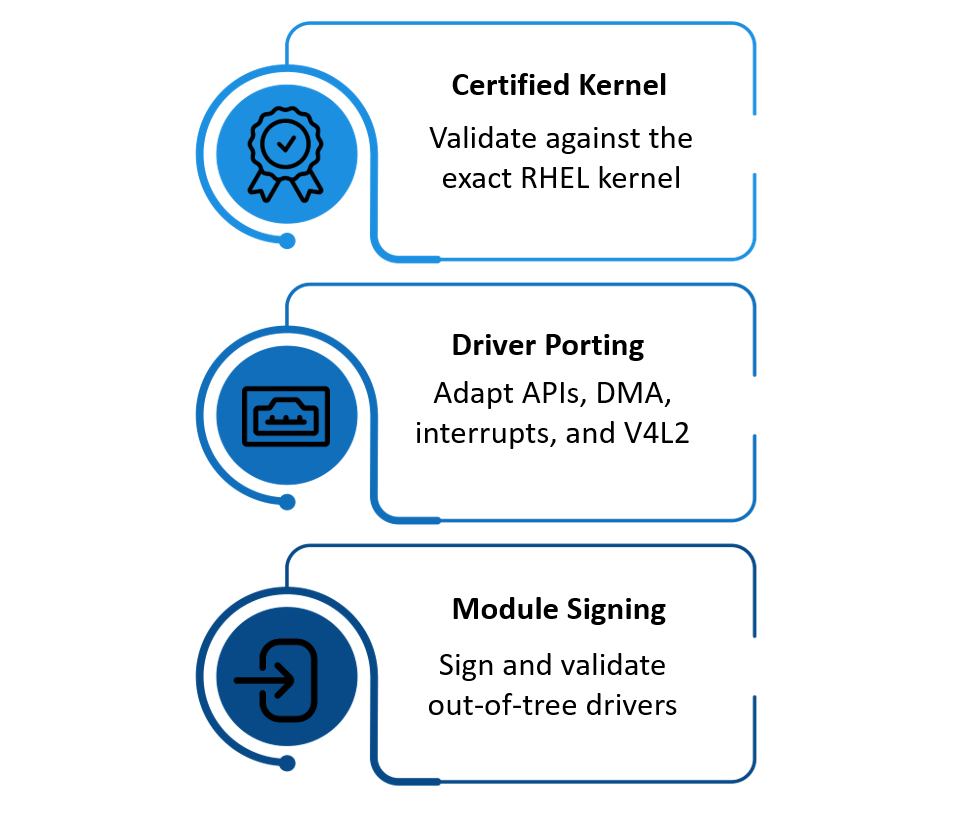
RHEL's certification and support model treats the kernel largely as a fixed artifact from the customer's point of view. That has direct consequences for driver work: an out-of-tree kernel module has to be built, signed, and validated against the exact certified kernel version the platform ships, and re-validated against every kernel update the program actually adopts, which on a conservative defense refresh cycle may be infrequent but is never optional. DKMS-style automatic rebuilding, common in general-purpose Linux driver deployment, is often unsuitable in this context because it reintroduces exactly the kind of uncontrolled, unaudited rebuild step that a certified platform's change-control process is designed to prevent.
This is also where the question of why is driver porting necessary in the first place actually gets answered concretely: a driver written for a recent mainline kernel almost always needs porting work, adjusted APIs, different DMA and interrupt handling conventions, updated V4L2 or media-controller framework usage, before it will build and run correctly against RHEL's certified baseline.
Embedded Driver Development for Custom Hardware on a Fixed Kernel Baseline
Embedded driver development for custom hardware already carries its own complexity, undocumented register behavior, timing-sensitive initialization sequences, vendor reference code that assumes a different kernel version than the target platform. Doing that work against a fixed, certified kernel baseline adds a further constraint: every kernel API the driver touches has to be verified against that specific baseline's actual behavior, not against whatever documentation exists for the chip in general. In practice this means treating the RHEL kernel version as a hard specification from day one of the driver architecture, rather than discovering incompatibilities during the platform's certification testing when they are far more expensive to fix.
USB Driver Development and Peripheral Interfaces on RHEL Defense Platforms
Not every peripheral on a reconnaissance or surveillance platform sits on a MIPI-CSI or dedicated imaging bus. Auxiliary sensors, storage modules, and communication peripherals frequently attach over USB, and USB driver development on RHEL carries its own certification-model constraints: USB device class drivers and any custom USB-attached sensor interface still have to go through the same kernel-version validation discipline as a camera driver, and USB's hot-plug behavior adds device enumeration and power-management edge cases that need explicit testing against the platform's actual certified kernel rather than assumed from generic USB driver behavior on a desktop distribution.
Camera and Sensor Integration Patterns That Survive Long Support Cycles
A defense platform's driver has to keep working, unmodified or minimally modified, for a support cycle measured in years, so integration patterns that rely on frequent updates are the wrong starting point. Structuring the driver around the Linux media-controller and V4L2 frameworks, rather than a vendor-specific ad hoc interface, gives the platform a stable, well-documented API surface that RHEL itself continues to support across its lifecycle. Isolating hardware-specific quirks into a clearly bounded platform-data or device-tree layer, rather than scattering conditional logic through the core driver, keeps the driver portable if the platform's specific sensor module changes during the program's life without requiring a rewrite of the interface the rest of the imaging pipeline depends on.
Working with OEM Sensor Vendors Under Export-Control Constraints
Sourcing and integrating imaging sensors for a defense platform routinely runs into export-control considerations that a commercial embedded project never encounters: some sensor vendors restrict reference driver code and documentation access based on the end customer and end use, and some sensor and optics combinations themselves fall under export licensing. Planning driver development timelines around vendor documentation availability, and confirming export-control classification early with the sensor vendor and the program's compliance team, avoids a late-stage discovery that the reference material the driver work was planned around cannot actually be shared for this specific program.
Testing and Qualification Implications
Driver validation for a RHEL defense platform has to answer to two different audiences: functional testing that the driver correctly operates the camera or sensor across its full operating envelope, and platform qualification testing that confirms the driver does not compromise the certified kernel's security posture or stability guarantees. That second category is often unfamiliar to teams coming from general embedded Linux work, and typically requires kernel module signing validation, confirmation that the driver does not disable or bypass kernel lockdown or SELinux policies the platform depends on, and documentation suitable for the platform's own security accreditation package, not just an internal test report.
Embien's RHEL Camera Driver Project for a Defense OEM
Embien's own project history includes exactly this class of work: for an Israeli Defence OEM, our team optimized complex camera drivers on Red Hat Enterprise Linux to ensure high-throughput image acquisition for an automated reconnaissance system. The project required working within RHEL's certified kernel constraints while still meeting the platform's real-time image-acquisition throughput requirements, the same tension between certification discipline and imaging performance described throughout this post.
Programs evaluating a similar camera and sensor driver development for defense platforms on RHEL effort should expect the certification-model constraints, not the driver's core functional logic, to be where most of the real engineering time goes.
Embien's Capabilities
Embien has direct experience with embedded driver development for custom hardware on certified, long-lifecycle Linux platforms, including RHEL-based camera driver work for a defense OEM's automated reconnaissance system. Our embedded software team works within a program's certification and change-control model from the first architecture decision, rather than treating certification as a testing-phase concern layered on afterward.
To discuss a driver development requirement for a certified or long-lifecycle embedded Linux platform, reach out to Embien's engineering team.