
Introduction
An automotive-grade component qualified to AEC-Q100 survives a demanding but well-understood stress regime: thermal cycling, vibration, humidity, all within an environment where the worst threat to silicon is heat. Aerospace embedded systems, particularly anything operating above the atmosphere's protective shielding, face a threat automotive qualification never tests for at all: ionizing radiation that can corrupt a memory bit, latch up a CMOS device into a destructive short, or degrade a transistor's characteristics permanently over a mission's lifetime. Component selection for this environment is a genuinely different discipline from automotive or industrial grade selection, not a stricter version of the same one.
In short: radiation-hardened and MIL-SPEC component selection for aerospace electronics starts with understanding which radiation effects actually threaten a specific mission profile, then choosing the least expensive combination of hardened parts, design-level mitigation, and margin that meets that specific threat model, rather than defaulting to full rad-hard parts across the board.
How Aerospace and Defense Component Grades Differ From Automotive AEC-Q100
AEC-Q100's qualification regime, HTOL, temperature cycling, THB, ELFR, tests for wear-out and defect-driven failure mechanisms that accumulate over a vehicle's operating life. It says nothing about radiation tolerance because automotive electronics, shielded by the atmosphere and a vehicle body, do not need it. Aerospace and defense component grades layer radiation qualification on top of, not instead of, the same categories of environmental stress testing: a satellite or high-altitude platform component still needs to survive thermal cycling and vibration, but it additionally needs characterized and specified behavior under total ionizing dose and single-event effects that AEC-Q100 was never designed to address.
Radiation Effects: Total Dose, Single-Event Upset, and Latch-Up
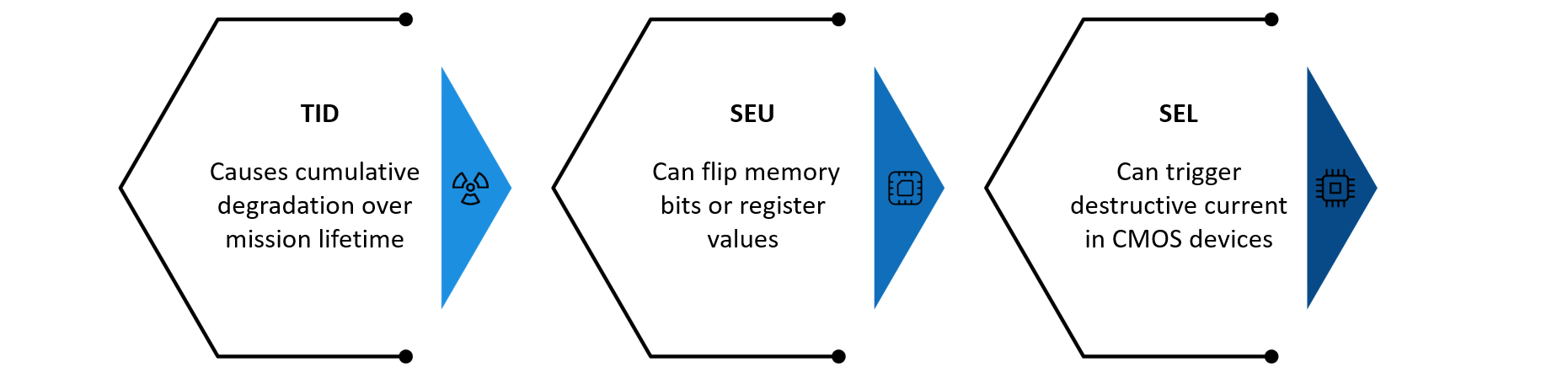
Three radiation effect categories drive most aerospace component selection decisions:
- Total Ionizing Dose (TID): Cumulative radiation exposure over a mission's lifetime gradually shifts transistor threshold voltages and increases leakage current, eventually degrading or failing the device. TID tolerance is typically specified in kilorads (krad) and scales with mission duration and orbital or altitude environment.
- Single-Event Upset (SEU): A single high-energy particle strike can flip a memory bit or a register value without permanently damaging the device, a transient soft error rather than hardware failure. SEU rates are typically mitigated through error-correcting memory and redundant logic rather than through part selection alone.
- Single-Event Latch-Up (SEL): A particle strike can trigger a parasitic thyristor structure in CMOS devices, creating a low-impedance path that draws destructive current until power is cycled. SEL is a hard failure mode, not a transient one, and is generally addressed through latch-up-immune process technology or current-limiting protection circuits rather than software mitigation.
These three effects call for different mitigation strategies, and conflating them, treating SEU mitigation as if it also addresses SEL risk, for example, is a common and costly design mistake.
MIL-SPEC Qualification Categories and What They Actually Test
MIL-STD-883 defines the test methods used to qualify military and aerospace microelectronics, covering mechanical, environmental, and electrical stress screening, but MIL-STD-883 compliance alone does not imply radiation tolerance. A component can be fully MIL-STD-883 qualified, hermetically packaged, screened with 100% burn-in, and still have no specified radiation performance at all if it was never characterized against TID or single-event effects. Programs sourcing components for a radiation environment need to look specifically for radiation test reports (often per MIL-STD-750 or manufacturer-specific radiation characterization data) as a qualification requirement distinct from, and in addition to, general MIL-STD-883 screening.
Avionics Compliance: Where Component Selection Meets DO-254 and DO-178C
Avionics compliance under DO-254 (hardware) and DO-178C (software) does not mandate radiation-hardened components outright, most avionics operate within atmospheric shielding that substantially reduces radiation exposure relative to space, but it does require documented evidence that component selection was matched to the platform's actual operating environment and failure-consequence classification. A component selected for a Design Assurance Level A avionics function needs a documented rationale connecting its qualification evidence to the function's criticality, which for high-altitude or high-reliability platforms may include radiation susceptibility data even when full space-grade rad-hard selection is not the appropriate choice.
Design-for-Radiation-Tolerance Techniques Short of Full Rad-Hard Parts
Full radiation-hardened components, built on specialized process technology specifically to resist TID and single-event effects, carry a substantial cost and availability premium over commercial or even standard MIL-SPEC parts. Several design-level techniques can close much of the reliability gap for missions that don't justify that premium: error-correcting code (ECC) memory and triple-modular redundancy in logic address SEU risk without requiring rad-hard silicon; current-limiting and power-cycling watchdog circuits can recover a system from an SEL event without permanent damage; and radiation-tolerant (as distinct from fully rad-hard) component families, built on standard process technology but characterized and sometimes layout-hardened against radiation effects, offer a middle tier between commercial parts and full rad-hard selection.
How to Develop Fault-Tolerant Embedded Systems for Aerospace
Answering how to develop fault-tolerant embedded systems for aerospace in practice starts with an honest mission-specific radiation environment analysis, orbital altitude and inclination, mission duration, shielding provided by the platform structure, rather than defaulting to worst-case assumptions that drive unnecessary cost. From that analysis, fault tolerance is typically built in layers: component-level hardening where the threat model justifies it, architectural redundancy (voting logic, redundant sensors, watchdog-supervised resets) to catch what component selection alone can't prevent, and software-level error detection and graceful degradation as the final layer for effects that get through the first two.
Cost and Availability Tradeoffs Engineers Should Plan for Early
Rad-hard components can cost 10-100x their commercial equivalents and frequently carry lead times measured in months rather than weeks, figures that need to enter a program's budget and schedule planning at the architecture stage, not discovered during procurement. Because rad-hard parts also tend to lag several process generations behind commercial silicon, a rad-hard microcontroller or FPGA is often significantly less capable than its commercial counterpart, which can mean the overall system architecture needs to be adapted to a smaller compute or memory budget than a commercial-first design approach would assume.
Embedded Systems for Defense and Aerospace Applications: When Full Rad-Hard Selection Is Actually Necessary
Not every aerospace program needs full rad-hard component selection, and over-specifying it is a real and common cost driver. Low-earth-orbit missions of short duration, high-altitude platforms operating within most of the atmosphere's shielding, and ground-based defense electronics all face meaningfully lower radiation exposure than a deep-space or geostationary mission, and the appropriate component strategy should reflect that difference rather than applying a uniform worst-case standard regardless of actual mission profile. Building embedded systems for defense and aerospace applications well means matching the component strategy, full rad-hard, radiation-tolerant, or standard MIL-SPEC with added design-level mitigation, to the mission's actual radiation environment, not to the most conservative assumption available.
Embien's Capabilities
Embien's aerospace and defense engineering experience spans reliability-critical hardware including a Li-Ion battery monitoring system for aerospace applications built with formal Software Composition Analysis and TARA processes, alongside ruggedized MIL-STD-461/810 power electronics for defense platforms. Our hardware design process treats component grade and environmental qualification, including radiation susceptibility where a program's mission profile requires it, as a design input evaluated at component selection, not a compliance step added afterward.
To discuss component selection strategy for an aerospace or defense embedded program, reach out to Embien's engineering team.