
Introduction
A medical device, an industrial controller, or a defense system routinely needs to stay in production and in field service for ten, fifteen, sometimes twenty years, while the semiconductor components inside it were never designed with anywhere near that lifespan in mind. Hardware obsolescence management in product design is the discipline that closes that gap, and most product teams don't take it seriously until a critical component's end-of-life notice arrives and production is suddenly at risk, at which point the available options are all more expensive and more disruptive than they would have been if planned for from the start.
In short: component lifecycles in consumer-driven semiconductor markets run three to five years on average, far shorter than the production and service life many embedded products require, and closing that gap takes deliberate design choices, second-sourcing, abstraction layers, generous component margin, made early, plus a disciplined monitoring and response process for when end-of-life notices arrive anyway, because for a long-lifecycle product they always eventually do.
Why Component Lifecycle Mismatches Production Lifecycle in Embedded Products
Semiconductor manufacturers optimize their product roadmaps around consumer and mobile markets, where a component generation typically sells in volume for a few years before the manufacturer moves capacity to a newer process node or a higher-margin part. A microcontroller, sensor, or connectivity chip selected for a new embedded product today may already be in the back half of its manufacturer-supported life by the time the product reaches volume production, and routinely reaches end-of-life well before a long-lifecycle industrial, medical, or defense product's planned production run, let alone its subsequent field-service tail, is complete. This mismatch is structural, not a planning failure by any single team, and it means obsolescence risk has to be designed for as an expected event rather than treated as an occasional surprise.
Early Warning Signs a Component Is Heading Toward End-of-Life
Components rarely go end-of-life without warning, but the warning signs are easy to miss without an active monitoring process. A manufacturer's product change notification (PCN) announcing a die shrink, a fab transition, or a packaging change is often the first formal signal, and while it may not be an end-of-life notice itself, it frequently precedes one. Lengthening lead times and allocation constraints from a component's usual distributors are an informal but reliable early indicator that a part is nearing the end of its supported production run. And a manufacturer's own product roadmap and lifecycle status pages, when checked periodically rather than only at the point of an active shortage, often flag a part's 'mature' or 'not recommended for new designs' status well before a formal discontinuation notice follows.
Obsolescence Management Hardware Strategies That Reduce Risk From the Start
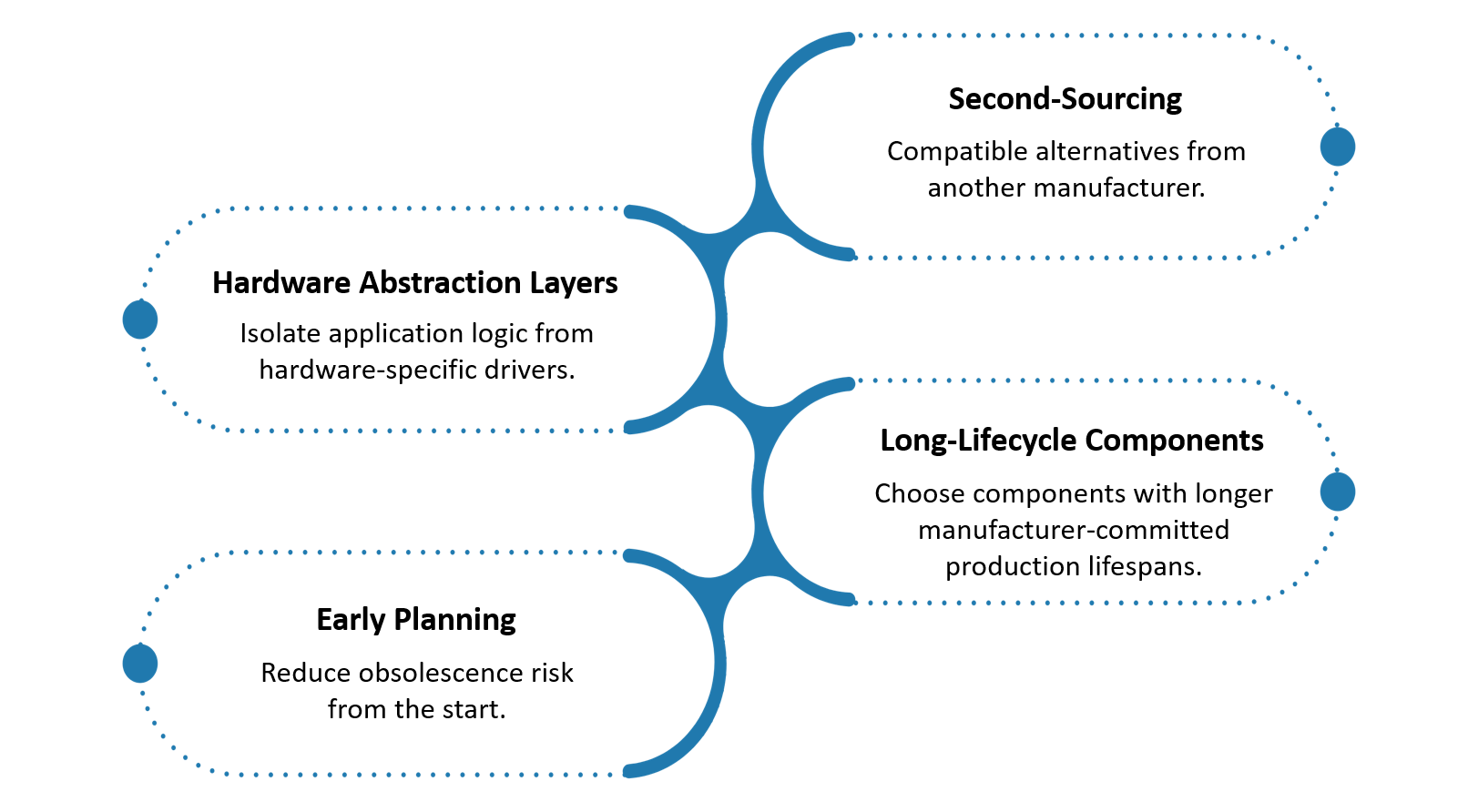
The most effective obsolescence management hardware strategies are decided during initial component selection, not retrofitted after a part is already designed in. Second-sourcing, choosing components with a genuinely compatible pin-for-pin or software-compatible alternative from a different manufacturer, gives a product a fallback path that doesn't require a board respin when the primary source goes end-of-life. Hardware abstraction layers in firmware, isolating the application logic from a specific part's low-level driver interface, mean a component substitution can often be absorbed as a driver-layer change rather than requiring the entire firmware stack to be re-validated. And selecting components with generous manufacturer-committed production lifespans, or with an explicit longevity program, automotive-grade and industrial-grade parts often carry longer committed support windows than consumer-grade equivalents, reduces how often obsolescence has to be managed reactively in the first place.
How to Handle End-of-Life Components? Last-Time-Buy and Bridge-Sourcing Strategies
Even disciplined design-stage mitigation doesn't eliminate obsolescence risk entirely for a long enough product lifecycle, and how to handle end-of-life components? once a discontinuation notice actually arrives comes down to a small set of practical response strategies. A last-time-buy, purchasing enough inventory of the discontinued component to cover the product's remaining planned production and a reasonable service-parts buffer, is the most straightforward response when the required quantity and the component's cost and storage characteristics make it financially sensible. Bridge-sourcing through authorized aftermarket or franchised distribution channels can extend availability further for parts where a last-time-buy alone doesn't cover the full remaining need, though it requires careful supplier vetting to avoid counterfeit risk. And for a component where neither last-time-buy nor bridge-sourcing realistically covers the product's remaining lifecycle, a planned substitution or design refresh, ideally scheduled proactively rather than forced by an inventory deadline, becomes the necessary path.
Re-Engineering for Obsolescence: When a Redesign Is the Right Call
Redesigning around a discontinued part becomes the right call when its replacement isn't a drop-in substitute, requiring board layout changes, firmware driver rework, or in some cases re-verification against the product's original certification evidence if it's a regulated medical, automotive, or aerospace product. This is real engineering effort with a real cost and schedule, and the decision to redesign proactively, ahead of a forced last-time-buy deadline, versus reactively, after inventory is already exhausted, has a significant effect on that cost: a proactive redesign can be scheduled around the engineering team's other priorities, while a reactive one competes for resources under genuine production-continuity pressure.
Documentation Practices That Make Future Redesigns Cheaper
The cost of a component substitution or redesign years after a product's original development depends heavily on documentation quality that was decided at the time of original design, not retrofitted later. Complete, current bills of materials with manufacturer part numbers and approved second sources recorded from the start, design rationale documentation explaining why specific components and design choices were made, not just what was chosen, and firmware architecture documentation that makes the hardware abstraction boundary clear to an engineer who wasn't on the original design team, all directly reduce the time and risk involved in a redesign performed by whoever is maintaining the product years after the original team has moved on to other programs.
Embedded Product Lifecycle Management as an Ongoing Discipline, Not a One-Time Decision
This discipline treats obsolescence monitoring as a continuous process running for the product's entire production and service life, not a one-time risk assessment performed during initial design. This means periodically re-checking the bill of materials against current manufacturer lifecycle status, maintaining relationships with distributors and component manufacturers who can provide early warning, and revisiting the last-time-buy-versus-redesign decision as a component's situation evolves rather than only reacting when a formal end-of-life notice forces the question. Products with the lowest total cost of ownership over a long service life are consistently the ones where this monitoring discipline was built into the maintenance program from the start, not added after the first crisis.
How This Connects to Component Grade Decisions Made Earlier in the Design
Obsolescence risk connects directly to the automotive, industrial, and commercial component grade decisions made during original component selection, since grade and committed production lifespan are frequently linked: an automotive- or industrial-grade part often carries a longer manufacturer-committed support window specifically because those markets also expect long product lifecycles, while a commercial-grade equivalent, chosen for lower unit cost in a consumer product, typically carries no such extended-lifecycle commitment. A team weighing component grade purely on unit price without factoring in the grade's associated lifecycle commitment is very often setting up the same obsolescence risk this article addresses, just deferred a few years down the road rather than avoided. Folding that lifecycle commitment into the original grade decision is itself a form of hardware obsolescence management in product design, applied before a single unit ships rather than after a shortage forces the issue.
Embien's Capabilities
Embien brings component lifecycle and obsolescence management experience across long-lifecycle medical, industrial, and defense embedded programs, including second-source qualification, hardware abstraction layer architecture, and last-time-buy and re-engineering decision support. Our engineering process treats component longevity as a first-class design input alongside cost and performance from the earliest architecture decisions.
To discuss hardware obsolescence management in product design or a lifecycle risk assessment for an existing product's bill of materials, reach out to Embien's engineering team.