
Introduction
Product teams choosing between embedded Android and a leaner embedded Linux build often frame the question as a technology preference when it's really a product-category decision with real downstream consequences for team composition, certification burden, and hardware cost. Embedded Android vs embedded Linux: which OS fits your product? depends less on which platform is more capable in the abstract, both are Linux-kernel-based, and more on whether the specific product genuinely needs Android's app ecosystem and UI framework or whether that overhead outweighs its benefit for the use case at hand.
In short: embedded Linux development without the Android layer wins for resource-constrained, headless, or highly customized products where a lean footprint and full control over the software stack matter most, while embedded Android wins for products that genuinely benefit from a rich touch UI, a broad app ecosystem, and Google service integration, and the right choice comes down to matching the product's actual requirements to what each platform is built to optimize for.
What Embedded Android Actually Means vs General Embedded Linux
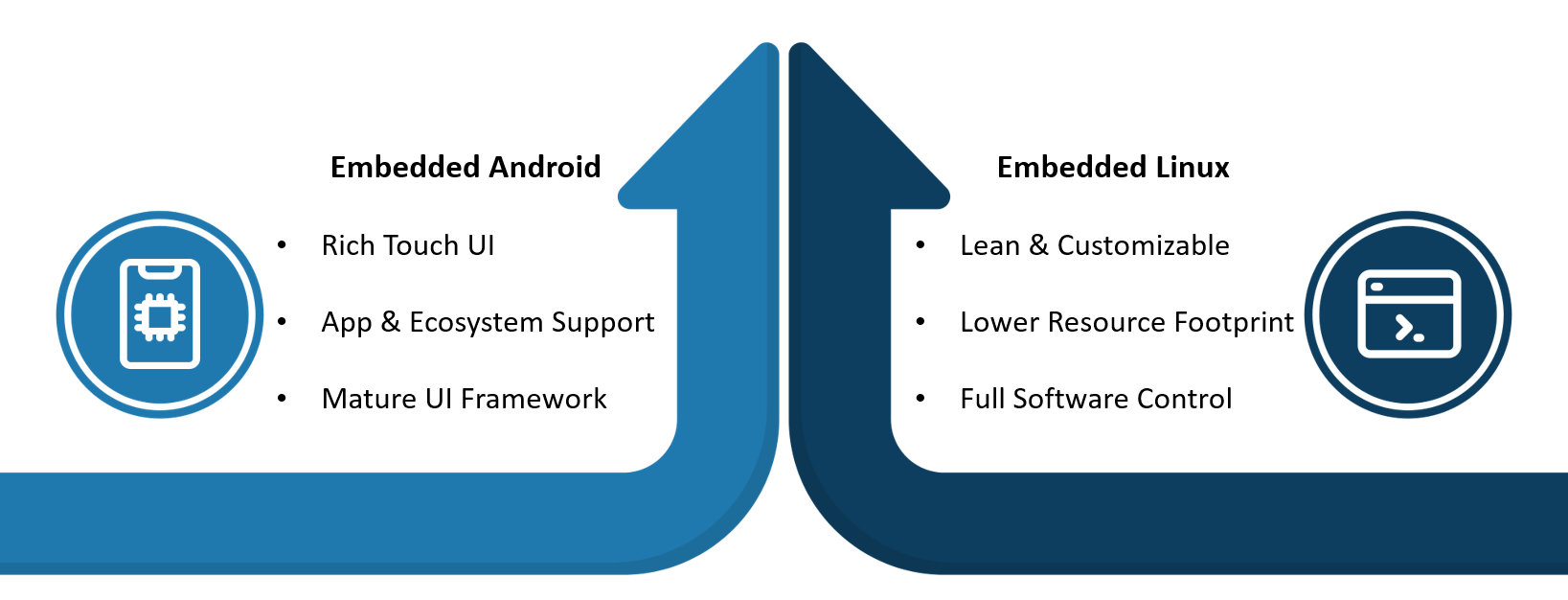
Embedded Android is, under the hood, a specific, heavily customized Linux distribution: AOSP (Android Open Source Project) runs on the Linux kernel, with Android's own Hardware Abstraction Layer, Binder IPC mechanism, Zygote process model, and Dalvik/ART runtime layered on top to support Java and Kotlin applications and Android's UI framework. General embedded Linux, by contrast, refers to a custom-built Linux system, typically assembled with Yocto Project or Buildroot, that includes only the kernel, drivers, and userspace components a specific product actually needs, without Android's application framework, runtime, or UI layer. The practical distinction that matters for a product decision isn't which is "real" Linux, both are, it's how much of Android's substantial framework overhead a given product actually needs versus how much a leaner, purpose-built Linux image can strip away.
Where Android's App Ecosystem and UI Framework Are Worth the Overhead
Embedded Android earns its overhead when a product genuinely benefits from what the Android framework provides: a mature, well-understood touch UI toolkit that a broad pool of Android developers already knows, access to the Google Play ecosystem and Google Mobile Services when consumer-facing app distribution matters, and a runtime and framework that handles complex UI composition, animation, and multi-app lifecycle management that would take substantial in-house engineering effort to replicate on a bare Linux UI stack. Products like consumer-facing tablets, in-vehicle infotainment systems, and point-of-sale terminals with rich, frequently-updated UIs are the recurring category where Android's framework overhead pays for itself in reduced UI development effort and access to a large existing developer talent pool.
Where a Leaner Embedded Linux Build Wins on Resource Constraints
A custom, minimal embedded Linux build wins decisively where resource constraints are tight: lower RAM and flash footprint than Android's framework requires, faster boot times, since Android's Zygote and framework initialization adds meaningful boot latency a lean Linux init sequence doesn't carry, and full control over exactly which kernel modules, drivers, and userspace services ship, without inheriting Android's assumptions about process lifecycle and app sandboxing that don't fit a headless or single-purpose embedded product. Industrial controllers, network gateways, headless IoT devices, and any product where boot time, memory footprint, or real-time responsiveness matters more than a rich touch UI consistently favor a purpose-built embedded Linux image over the Android framework's overhead.
Licensing and Certification Differences: GMS and Compliance
Licensing carries real practical weight in this decision. AOSP itself is open source and free to use, but Google Mobile Services, the Play Store, Google Play Services, and the associated APIs many consumer-facing Android products want, requires a separate Google licensing agreement and Compatibility Test Suite (CTS) certification process, adding both cost and a compliance timeline a plain embedded Linux product never has to account for. A product that doesn't need GMS can build on bare AOSP without that licensing burden, but then loses access to the Play Store distribution and Google service integration that's often the actual reason a team considered Android in the first place, an important nuance that shapes whether the Android choice truly delivers the ecosystem benefit the team expected.
Development Team and Tooling Implications of Each Choice
The two paths call for meaningfully different engineering skill sets. Embedded Android development draws on Java/Kotlin application developers, Android framework and HAL engineers familiar with AOSP's Binder IPC and Treble architecture, and native-code expertise for any C/C++ code that needs to interface with hardware below the Java application layer. General embedded Linux development draws more heavily on C/C++ systems engineers comfortable with kernel driver development, Yocto or Buildroot build systems, and direct Linux userspace application development without Android's framework abstractions in between. A team already staffed for one path but not the other should weigh that existing expertise seriously, retraining or hiring for an unfamiliar platform is a real, often underestimated cost of switching between them mid-program.
Android NDK: Where Native Code Still Matters in an Android Product
Even a fully committed embedded Android product frequently needs native code below the Java/Kotlin application layer, and that's exactly what the Android NDK exists for: direct hardware interfacing through JNI bridges to custom HAL modules, performance-critical processing that benefits from compiled native code rather than the managed runtime, and porting existing C/C++ libraries and codebases into an Android application without a full Java reimplementation. Teams building embedded Android products still need real native embedded Linux development skill for this layer, it doesn't eliminate the need for systems-level C/C++ expertise, it just changes where that expertise gets applied within the overall software stack.
Custom Embedded Linux Distribution Creation: What the Non-Android Path Actually Involves
Custom embedded Linux distribution creation using Yocto Project or Buildroot involves selecting and configuring exactly the kernel version, board support package, and userspace packages a specific product needs, building a root filesystem image tailored to the target hardware, and maintaining that custom distribution's security patches and package updates over the product's field life without Android's ecosystem-wide update infrastructure to lean on. This gives a product team complete control over the software stack's footprint and behavior, but that control comes with the corresponding responsibility of maintaining the build system and update pipeline in-house rather than inheriting Android's more standardized (if heavier) OTA and security patch infrastructure.
A Concrete Illustration of the Platform Work Involved
How to port Android to NXP i.MX8? is a concrete, frequently-asked version of this broader decision, and walking through it illustrates the real engineering effort embedded Android involves regardless of which specific SoC is targeted: adapting NXP's BSP and kernel sources for the specific i.MX8 variant, implementing or adapting HAL modules for the platform's display, camera, and connectivity peripherals, integrating the Android framework layer on top of that BSP, and validating the full stack against Google's Compatibility Test Suite if GMS certification is a goal. This platform-bring-up effort, board support package integration, HAL development, framework validation, is substantial engineering work that a team evaluating embedded Android should budget for realistically rather than assuming it's a straightforward configuration exercise on top of a vendor-supplied reference BSP.
A Practical Decision Framework by Product Category
Products with a rich, frequently-updated touch UI, a need for third-party app distribution, or a desire to tap into a large existing Android developer talent pool should lean toward embedded Android despite its framework overhead and licensing considerations. Products that are headless, resource-constrained, safety- or real-time-critical, or need tight control over exactly what ships in the software image should lean toward a custom embedded Linux build without the Android layer. Products in between, needing some UI sophistication but also tight resource budgets, deserve a genuine build-versus-buy analysis rather than defaulting to whichever platform the team happens to have prior experience with, since that default, comfortable as it is, isn't always the platform actually best matched to the product's real requirements.
Embien's Capabilities
Embien brings both embedded Android and general embedded Linux development experience, including AOSP BSP bring-up, HAL and Binder IPC development, native integration work, and custom Yocto and Buildroot-based Linux distribution creation for resource-constrained and real-time embedded products. Our engineering process evaluates platform choice against the product's actual UI, ecosystem, and resource requirements rather than defaulting to a familiar stack.
To discuss embedded Linux development or embedded Android platform architecture for a product program, reach out to Embien's engineering team.