
Introduction
Most embedded AI deployments still fall into one of two camps: raw sensor data streamed to the cloud for centralized model training, or a static, pre-trained model deployed to the device for local inference with no further learning once it ships. Federated learning is a genuinely different third approach, one where ML model training: designing for the edge from the start means the model improves continuously from real-world device data while that raw data never actually leaves the device it was generated on, only model updates, not the underlying data, get shared and aggregated.
In short: federated learning coordinates many edge devices to collaboratively improve a single shared model, each device trains locally on its own data and shares only the resulting model update, a central server aggregates those updates into an improved shared model, and the raw data driving that improvement never leaves any individual device, making federated learning genuinely well-suited to privacy-sensitive and bandwidth-constrained deployments today, while still facing real practical limits around device heterogeneity and coordination overhead that keep it immature for some use cases.
What Federated Learning Is and How It Differs From Standard Edge Inference
Standard edge AI deployment trains a model centrally, typically in the cloud on aggregated data, and then deploys that fixed, frozen model to edge devices purely for local inference, the device runs the model but never changes it. Federated learning inverts part of that flow: training itself happens locally, on-device, using each device's own locally collected data, and what gets sent back to a coordinating server is only the resulting model update, adjusted weights or gradients, not the raw data that produced it. The server aggregates updates from many participating devices into an improved global model, which then gets redistributed back to devices for another round of local training, an iterative cycle that lets the shared model keep improving from real-world, distributed data without that data ever being centrally collected.
Why Data Privacy and Bandwidth Constraints Are Driving Interest in It
Data privacy concerns are the most immediate driver behind federated learning's growing adoption: a medical wearable, a smart home device, or an industrial sensor generating sensitive personal or operationally confidential data can contribute to model improvement without that raw data ever being transmitted off the device or stored centrally, directly addressing both regulatory privacy requirements and genuine user trust concerns that centralized data collection increasingly runs into. Bandwidth constraints compound the case in a different but related way, transmitting continuous raw sensor data from thousands or millions of edge devices to a central server for training is often simply impractical at scale, while transmitting compact model updates periodically is a dramatically smaller data footprint, making federated learning attractive on pure infrastructure-cost grounds even before privacy enters the calculation.
The Coordination Architecture: Local Training and Model Aggregation
A federated learning system's coordination architecture has two halves working together. On each participating device, a local training round runs against that device's own accumulated data, typically during idle compute time or while charging so it doesn't compete with the device's primary function, producing an updated set of model weights or gradients specific to that device's local data. On the coordination side, a central aggregation server collects these local updates from a subset of participating devices each round and combines them, commonly through a weighted averaging approach, into an improved global model that gets redistributed for the next round of local training. Getting this aggregation right, so that the combined model genuinely improves rather than degrading from conflicting or unrepresentative local updates, is the core algorithmic challenge federated learning research continues to refine.
Real-World Constraints: Device Heterogeneity, Connectivity, and Compute
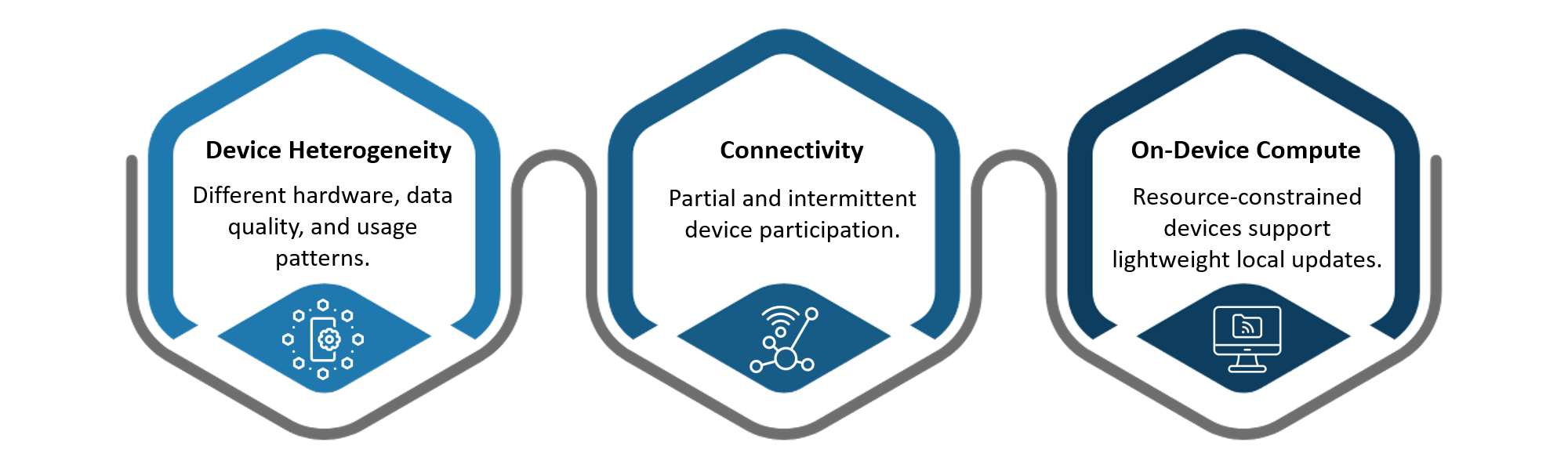
Federated learning's real-world deployment runs into constraints that a purely academic treatment of the algorithm tends to understate. Device heterogeneity, different hardware generations with different compute capability, different amounts and quality of locally collected data, and different usage patterns, means local training rounds don't produce uniformly reliable updates, and aggregation logic has to account for that variability rather than treating every device's contribution as equally trustworthy. Connectivity constraints mean not every device is reachable for every aggregation round, especially in the field-deployed embedded and IoT devices where federated learning has genuine appeal, requiring aggregation strategies robust to partial and intermittent device participation. And on-device compute constraints limit how sophisticated the local training round itself can be, a genuinely resource-constrained embedded device may only be capable of a lightweight local update rather than a full training pass, shaping what model architectures are realistically compatible with federated learning on that class of hardware.
Where Federated Learning Makes Sense Today vs Where It's Still Immature
Federated learning is genuinely production-ready today for use cases with a large population of reasonably capable, intermittently connected devices generating privacy-sensitive data where centralization is either regulatorily difficult or practically expensive, predictive text and personalization models on consumer devices are the most mature real-world example. It remains considerably less mature for use cases needing tight coordination guarantees, verifiable robustness against malicious or corrupted local updates, or deployment on genuinely resource-constrained microcontroller-class embedded hardware, where the tooling, standardized frameworks, and field-proven deployment patterns are still actively developing rather than settled. A team evaluating federated learning honestly needs to assess which category its specific use case actually falls into rather than assuming the concept's growing attention translates into universal readiness.
What Embedded Teams Need to Consider Before Attempting It
A team considering federated learning for an embedded product needs to weigh several practical questions before committing: whether the device population and connectivity pattern realistically support the aggregation-round cadence the approach depends on, whether on-device compute is genuinely sufficient for local training rather than only inference, whether the privacy and bandwidth benefits actually outweigh the meaningfully higher system complexity federated learning introduces compared to either pure cloud training or a static deployed model, and whether the team has, or can access, the specialized machine-learning engineering expertise federated learning's coordination and aggregation logic requires beyond standard embedded AI deployment skill.
ML Model Training: Designing for the Edge From the Start
The deeper lesson federated learning illustrates, even for teams who ultimately choose a simpler architecture, is that ML model training: designing for the edge from the start produces meaningfully better outcomes than retrofitting an edge deployment onto a model and training pipeline originally designed assuming centralized cloud data. Considering data locality, device compute constraints, and privacy requirements during the initial model architecture and training-pipeline design, rather than after a cloud-trained model is already built, keeps genuinely edge-native approaches like federated learning available as an option later rather than closed off by early architectural decisions.
Federated Learning at the Edge for Embedded AI: A Growing but Specialized Toolset
This category increasingly has dedicated framework support emerging alongside the broader growth in edge AI tooling generally, though that tooling remains less mature and less standardized than the frameworks available for conventional centralized model training and static on-device inference. Teams pursuing it today should expect to invest real engineering effort in aggregation infrastructure and device-side training optimization rather than finding a fully turnkey solution, an honest expectation that shapes realistic project timelines.
The Practical Payoff of Keeping Raw Data Off the Cloud
That payoff is federated learning's core practical benefit, and it's worth restating plainly: a product can keep improving its AI capability from real deployed-device data, the exact data that best reflects real-world usage conditions, without taking on the regulatory, security, and infrastructure burden of centralizing that data first. For the right use case, a large device population, meaningful privacy sensitivity, and workable connectivity patterns, that payoff is substantial enough to justify the additional system complexity federated learning introduces.
Embien's Capabilities
Embien brings embedded AI/ML model design and optimization experience spanning on-device training constraints, model size reduction for resource-limited hardware, and privacy-aware architecture for connected embedded products. Our engineering process evaluates federated and other edge-native training approaches against a product's actual device population, connectivity, and compute profile rather than defaulting to a centralized cloud-training pipeline by habit.
To discuss ML model training: designing for the edge from the start or federated learning feasibility for an embedded AI product, reach out to Embien's engineering team.