
Introduction
A power supply that has passed FCC Part 15 and CE marking is not, on its own, ready for a military program. Commercial EMC testing checks that a product does not interfere with its neighbours and does not fail under everyday conditions. Defense and aerospace programs ask a harder question: will this power electronics design keep working, and keep quiet on the spectrum, inside a shielded avionics bay, a vehicle electrical system full of switching noise, or a field environment that cycles from -40°C to +85°C with shock and sustained vibration layered on top? That is what MIL-STD-461 (EMI/EMC) and MIL-STD-810 (environmental) actually test for, and it is why so many commercially proven power designs fail their first qualification pass.
In short: MIL-STD-461 sets conducted and radiated emissions and susceptibility limits far stricter than commercial EMC standards, while MIL-STD-810 defines the shock, vibration, and thermal-cycling regime a design has to survive physically. EMI/EMC standards compliance for a defense-grade power supply means designing filtering, shielding, grounding, and mechanical robustness in together from the first schematic, not bolting them on after a failed test.
Why Commercial Power Electronics Fail Military Qualification
Most commercial power supplies are optimized for cost and efficiency first, with EMC treated as a pass/fail gate late in the program. That approach breaks down against military requirements for three structural reasons. First, MIL-STD-461's emissions limits are typically 20-40 dB tighter than FCC Part 15 Class B across large portions of the spectrum, particularly in the conducted-emissions bands below 10 MHz where switching power supplies are naturally noisy. Second, MIL-STD-461 tests susceptibility as rigorously as emissions, subjecting the design to injected RF, transient pulses, and magnetic fields that commercial EMC standards barely touch. Third, the mechanical and thermal stresses in MIL-STD-810 routinely loosen or fatigue exactly the components, shielding seams, filter capacitors, ground straps, connector shells, that a design relied on to pass its emissions test in the first place. A power supply that passed pre-compliance checks on the bench can fail the same tests again after a vibration profile has worked a shield joint loose.
The practical result is that EMI/EMC standards compliance for a military program is rarely a single test event. It is an iterative process across both standards, because a change made to satisfy MIL-STD-810's mechanical requirements can reopen an already-passed MIL-STD-461 test, and vice versa.
MIL-STD-461: Conducted and Radiated Emissions Basics
MIL-STD-461 organizes its requirements into a set of test procedures, prefixed CE (Conducted Emissions), CS (Conducted Susceptibility), RE (Radiated Emissions), and RS (Radiated Susceptibility), each with numbered variants that apply depending on platform type (ground, sea, air, space) and installation. For power electronics, four procedures dominate the qualification effort:
- CE102 (Conducted Emissions, Power Leads): Limits conducted noise on power input/output leads from 10 kHz to 10 MHz, directly targeting switching-converter ripple and its harmonics.
- CS101 (Conducted Susceptibility, Power Leads): Injects audio-frequency AC onto power leads to verify the supply keeps operating normally in the presence of bus noise.
- CS114/CS115/CS116 (Bulk Cable Injection, Impulse, Damped Sinusoidal Transients): Simulate the transient environment of a real platform's wiring harness, lightning-induced transients, switching transients from adjacent equipment, and similar events.
- RE102 (Radiated Emissions, Electric Field): Limits radiated field strength from 2 MHz up to 18 GHz or higher depending on platform, which is where switching frequency selection and layout have the largest effect.
Getting a design through these procedures on the first pass depends on decisions made well before any formal testing begins: switching frequency and topology selection, input/output filter architecture, layer stack-up and return-path control, and shielding and grounding strategy at the enclosure level.
MIL-STD-810: Shock, Vibration, and Temperature Cycling Requirements
Where MIL-STD-461 governs the electromagnetic environment, MIL-STD-810 governs the physical one, and for power electronics the two are more connected than they first appear. The standard's relevant test methods for a power supply program typically include:
- Method 514 (Vibration): Category-specific random and sine vibration profiles simulating transport and in-service operation, which stress solder joints, connector retention, and any component not adequately staked or secured.
- Method 516 (Shock): Functional and crash-safety shock pulses that test whether the design, and its mechanical mounting, survives a sudden mechanical event without functional failure.
- Method 501/502 (High/Low Temperature): Storage and operating extremes, often -40°C to +71°C or wider for the harshest platform categories, that push component derating, connector contact resistance, and thermal expansion mismatches.
- Method 503 (Temperature Shock): Rapid transitions between temperature extremes that specifically target seal integrity and solder-joint fatigue from differential thermal expansion.
This is where the two standards genuinely interact: a shielding gasket or filter connector that passed CE102/RE102 at room temperature can develop a gap after thermal cycling has changed its compression, or after vibration has loosened its retaining hardware, reopening an emissions failure that had already been closed out. So it is worth asking directly: how does environmental testing ensure product reliability in a way EMC testing alone can't? Environmental testing under MIL-STD-810 verifies that the electrical performance validated under MIL-STD-461 will still hold after the unit has actually experienced the shock, vibration, and thermal stress of its service life, not just on the bench where it was built.
EMI/EMC Testing Equipment: What In-House Pre-Compliance Actually Requires
Sending every design iteration to an accredited test house is slow and expensive, so a serious ruggedized power electronics design for MIL-STD-461 and MIL-STD-810 program invests in in-house EMI/EMC testing equipment for pre-compliance screening long before a formal qualification run. A practical pre-compliance setup typically includes a spectrum analyzer with a preamplifier for RE102-range measurements, a Line Impedance Stabilization Network (LISN) to characterize conducted emissions on power leads consistently with CE102's test setup, near-field H-field and E-field probes for locating the physical source of an emissions peak on the board, and a semi-anechoic or shielded enclosure large enough to isolate the unit under test from ambient RF noise.
This EMI/EMC testing equipment doesn't replace accredited third-party qualification, MIL-STD-461 compliance still requires a certified test report, but it changes the economics of the program. Catching a CE102 violation with it during layout review costs an engineering afternoon. Catching the same violation at the accredited test house costs a re-spin, a new test slot, and weeks of schedule.
Common Redesign Triggers Engineers Should Watch For Early
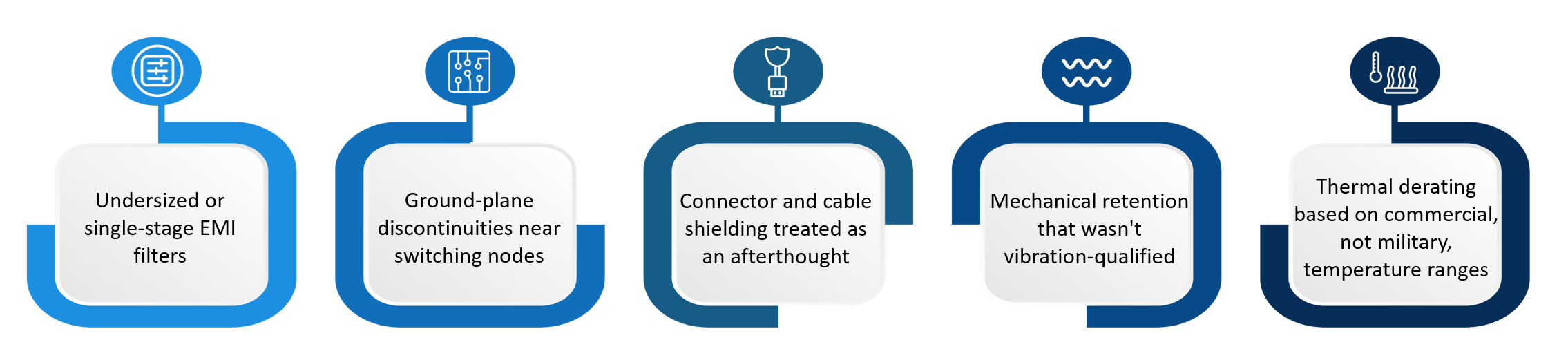
Certain design choices reliably trigger a redesign cycle once MIL-STD-461/810 testing begins, and catching them at the schematic and layout review stage is far cheaper than catching them at the test house:
- Undersized or single-stage EMI filters: A filter sized to just clear FCC Part 15 rarely has the attenuation margin CE102 demands, especially once component tolerances and temperature drift are accounted for.
- Ground-plane discontinuities near switching nodes: Splits or slots in the return path directly beneath a high-di/dt switching node are a leading cause of RE102 failures that don't show up until full-system radiated testing.
- Connector and cable shielding treated as an afterthought: A well-filtered PCB can still fail CE102/RE102 if the enclosure penetration where cables exit isn't properly bonded and shielded.
- Mechanical retention that wasn't vibration-qualified: Components or sub-assemblies secured only by their own leads or a friction fit routinely fail Method 514, and the resulting mechanical shift often reopens an EMC finding too.
- Thermal derating based on commercial, not military, temperature ranges: A component rated for a 0°C to +70°C commercial range simply won't survive Method 501/502's extremes, regardless of how well it performed electrically.
Watching for these five triggers during design review, rather than discovering them during a scheduled qualification test, is the single highest-leverage practice in a ruggedized power electronics design for MIL-STD-461 and MIL-STD-810 program.
EMI/EMC Case Studies: Embien's Ruggedized Power Supply Project
Embien's own project history includes ruggedized power supply work for a defense customer, engineered specifically against MIL-STD-461 and MIL-STD-810 requirements rather than adapted from a commercial baseline after the fact. Real EMI/EMC case studies like this one tend to follow a consistent pattern: emissions and susceptibility requirements are mapped against the platform's specific test plan at the start of the program, filter and shielding architecture is designed in from the first schematic revision rather than added after a failed pre-compliance scan, and the mechanical enclosure and connector strategy is reviewed jointly with the electrical design so that a vibration or thermal-cycling fix doesn't quietly reopen an emissions finding.
That kind of cross-discipline EMI/EMC case study, where electrical, mechanical, and test engineering are treated as one coordinated effort rather than three separate handoffs, is what actually keeps a ruggedized power electronics program on schedule. It's a pattern worth studying before a program's first qualification attempt, not after a failed one.
Frequently Asked Questions
How does environmental testing ensure product reliability?
MIL-STD-810's environmental testing exposes a design to the shock, vibration, and temperature extremes it will actually experience in service, then verifies the electrical performance validated separately under MIL-STD-461 still holds afterward. That combination, rather than either standard alone, is what gives a program confidence the unit will remain reliable and EMC-compliant throughout its deployed life, not just as it left the bench.
Do MIL-STD-461 and MIL-STD-810 need to be tested together?
They're formally separate test standards with separate procedures, but because mechanical and thermal stress can degrade the shielding, grounding, and filtering that MIL-STD-461 compliance depends on, a design should be reviewed against both standards' requirements concurrently rather than sequentially, even though the accredited test events themselves are run separately.
Embien's Capabilities
Embien has direct experience taking power electronics through MIL-STD-461 and MIL-STD-810 qualification for defense customers, including a documented ruggedized power supply project engineered against both standards from the outset. Our electro-mechanical design team works EMI/EMC standards compliance and mechanical ruggedization as one coordinated discipline, not two separate handoffs, backed by in-house EMI/EMC testing equipment for pre-compliance screening ahead of accredited qualification.
To discuss a ruggedized power electronics program, or any MIL-STD-461/810 qualification requirement, reach out to Embien's mission-critical engineering team.