
Introduction
"Mission-critical" gets attached to programs across defense, aerospace, medical, and industrial domains often enough that it has started to lose specificity as a label. A program manager evaluating vendors, budgets, and verification plans needs a working definition that actually changes decisions, not a description that could apply to almost any product a customer cares about. Mission-critical embedded systems are a specific category with specific engineering consequences, and treating the label loosely tends to produce either wasted rigor on systems that don't need it or, worse, insufficient rigor on systems that genuinely do.
In short: an embedded system earns the mission-critical label when its failure directly prevents the mission it supports from succeeding, not merely when it is important, expensive, or inconvenient to fix, and that distinction should drive every downstream decision about redundancy, verification, and vendor selection.
Mission-Critical vs. Safety-Critical vs. Business-Critical: The Real Distinctions
These three terms get used interchangeably in casual conversation but describe genuinely different failure consequences. A safety-critical system's failure can cause injury or loss of life, this is the category IEC 61508 and DO-178C/DO-254 are built around, and it demands the most rigorous verification regardless of mission context. A business-critical system's failure causes financial or operational damage, a factory line going down, a service outage, but doesn't directly threaten life or an operational mission's success. Mission-critical systems sit specifically in the category where failure prevents a defined mission or operation from succeeding, a reconnaissance platform that can't transmit its imagery, a communications system that goes silent mid-operation, which can overlap with safety-critical (a mission failure that also endangers personnel) but isn't automatically the same thing. A program manager who conflates these three categories tends to either over-engineer systems that are merely business-critical, or under-verify systems that are genuinely mission-critical but don't obviously look safety-critical on paper.
Failure-Mode Consequences That Actually Define Mission-Critical Systems
The cleanest test for whether a system belongs in the mission-critical systems category is to ask what happens to the mission, not the product, when it fails. A power supply that fails mid-deployment on a defense platform doesn't just cost a warranty claim, it can end the mission the platform was deployed to support. A camera driver that stalls during an automated reconnaissance run doesn't just produce a support ticket, it can mean the reconnaissance objective is not met at all. This framing matters because it shifts the analysis from the component's cost or complexity, which is often how engineering teams instinctively rank importance, to the consequence chain the component sits inside, which is what should actually drive the level of engineering rigor applied to it.
Redundancy and Fail-Safe Design Patterns This Classification Demands
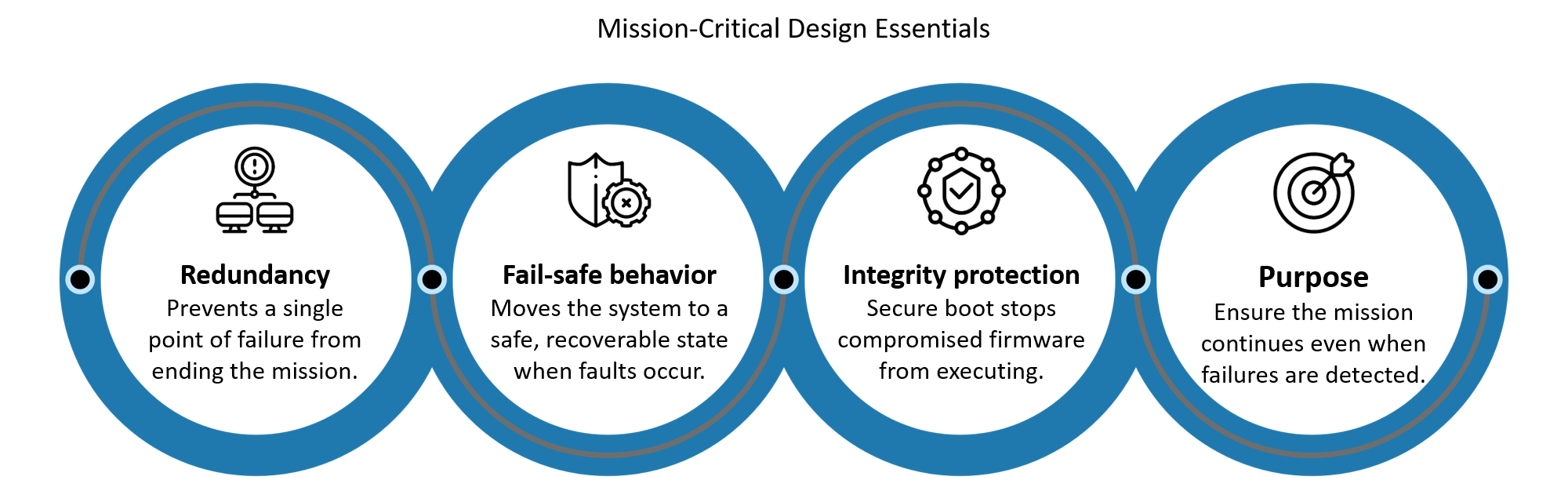
Once a system is genuinely classified as mission-critical, specific design patterns follow almost automatically. Redundancy, whether hardware duplication, redundant sensor paths, or software-level voting logic, exists specifically to prevent a single point of failure from ending the mission. Fail-safe behavior, a defined, safe, recoverable state the system falls back to when a fault is detected, matters as much as redundancy itself: a secure bootloader that detects a firmware integrity failure and halts safely, rather than continuing to execute compromised code, is a fail-safe pattern doing exactly the job the mission-critical classification demands. These patterns cost real engineering time and often real unit cost, which is precisely why the classification needs to be made deliberately and specifically, not applied broadly out of an abundance of caution that a budget can't actually sustain.
How to Ensure Reliability in Mission-Critical Embedded Systems
How to ensure reliability in mission-critical embedded systems comes down to closing the gap between a component's specified behavior and its actual behavior under the mission's real operating conditions, not just its behavior on a bench under nominal conditions. This is why Embien's own mission-critical defense work treats environmental qualification, MIL-STD-461 and MIL-STD-810 testing for a ruggedized power supply, RHEL certification-model validation for a camera driver, link-resilience testing for a video streaming pipeline, as inseparable from the core functional design rather than a separate compliance activity layered on at the end. A system that works reliably on the bench but has never been validated against the specific stresses its actual mission will impose has not actually had its mission-critical reliability demonstrated at all.
Mission-Critical Embedded Systems Demand Continuous Verification
A mission-critical classification doesn't end at initial qualification. Mission-critical embedded systems demand continuous verification because a change anywhere in the system, a firmware update, a component substitution, a manufacturing process change at a supplier, can reopen a previously-closed reliability or security finding. This is precisely the pattern seen when a shielding gasket that passed emissions testing loosens after vibration exposure, or when a firmware update to a secure bootloader needs re-validation against the same integrity requirements the original design met. Program managers who treat mission-critical qualification as a one-time gate rather than an ongoing discipline tend to be surprised by exactly this kind of regression, usually at the least convenient point in a program's schedule.
Mission-Critical Defense Applications: How This Classification Shapes Vendor Selection
For mission-critical defense applications specifically, the classification should directly shape which engineering partner a program chooses, not just which components it specifies. A vendor with direct experience across the actual failure modes a mission-critical defense system faces, environmental ruggedization to MIL-STD-461/810, certified-platform driver development under RHEL's change-control model, secure boot and firmware integrity design, real-time link resilience under contested RF conditions, brings pattern recognition a generalist embedded vendor simply hasn't built. Embien's own portfolio spans exactly this range: a ruggedized MIL-STD-461/810 power supply, RHEL camera driver work for an Israeli Defence OEM, a low-latency secure video streaming pipeline for an Indian Defence organization, an FPGA-based antenna front-end controller, and a secure ArduPilot bootloader with Indian cybersecurity compliance, each addressing a different mission-critical failure mode within the same broader discipline.
Questions a Program Manager Should Ask Before Calling Something Mission-Critical
Before applying the label, and the engineering budget it implies, a program manager should be able to answer a short set of questions with specifics rather than generalities: What mission outcome, exactly, fails if this system fails? What is the actual operating environment, not the nominal one, this system has to survive? What is the acceptable recovery behavior if a fault does occur, and has that fail-safe path itself been tested? And who, specifically, on the engineering team or partner side has direct experience with this system's specific failure modes, rather than adjacent but different ones? A program that can answer all four concretely is applying the mission-critical classification correctly. A program that can't is either mislabeling a business-critical system, or has not yet done the analysis a genuinely mission-critical system requires.
Embien's Capabilities
Embien's mission-critical engineering experience spans defense and aerospace hardware and software: ruggedized MIL-STD-461/810 power electronics, RHEL-based camera driver development, secure low-latency video streaming, FPGA-based RF front-end control, and secure bootloader development with defined fail-safe and integrity-verification behavior. Our engineering process treats mission-critical classification as a design input from the first architecture review, shaping redundancy, verification, and vendor and component selection from day one rather than retrofitting rigor after a failure.
To discuss a mission-critical embedded system requirement for a defense, aerospace, or other high-reliability program, reach out to Embien's engineering team.