
Introduction
Streaming video from a phone to a cloud server assumes things a tactical UAV link cannot: stable bandwidth, low round-trip latency to a nearby base station, and an RF environment nobody is actively trying to disrupt. None of those assumptions hold over a contested tactical link. Secure drone communication for real-time surveillance has to deliver usable video to an operator making a decision in seconds, over a link that can be narrow, noisy, and under deliberate interference, without leaking the feed to anyone listening in.
In short: secure drone communication for UAV surveillance means treating codec selection, encryption, and link resilience as one integrated design problem rather than three separate layers bolted together, because a choice made for one routinely constrains what is possible in the other two.
Why Consumer Streaming Architectures Don't Survive Tactical Bandwidth Limits
Consumer video streaming is built around abundant, relatively stable bandwidth and tolerates a few seconds of buffering latency without consequence. Tactical UAV links have neither luxury. Bandwidth on a tactical downlink is often measured in hundreds of kilobits per second, not the tens of megabits a consumer stream assumes, and it can vary sharply as the platform maneuvers, gains altitude, or moves behind terrain. A streaming architecture built around adaptive bitrate ladders designed for cellular or Wi-Fi congestion will oscillate badly under these conditions, repeatedly renegotiating quality in ways that cost more latency than they save in bandwidth.
The practical implication is that uav image processing and encoding decisions have to be made for the worst plausible link state, not the average one, with graceful degradation built in explicitly rather than inherited from a general-purpose streaming stack that was never designed for this environment.
H.264 vs H.265 at the Edge: Codec Tradeoffs for Tactical Links
H.265 (HEVC) delivers roughly 40-50% better compression than H.264 (AVC) at equivalent visual quality, which sounds like an easy choice for a bandwidth-constrained link. In practice the decision is more nuanced for embedded UAV platforms:
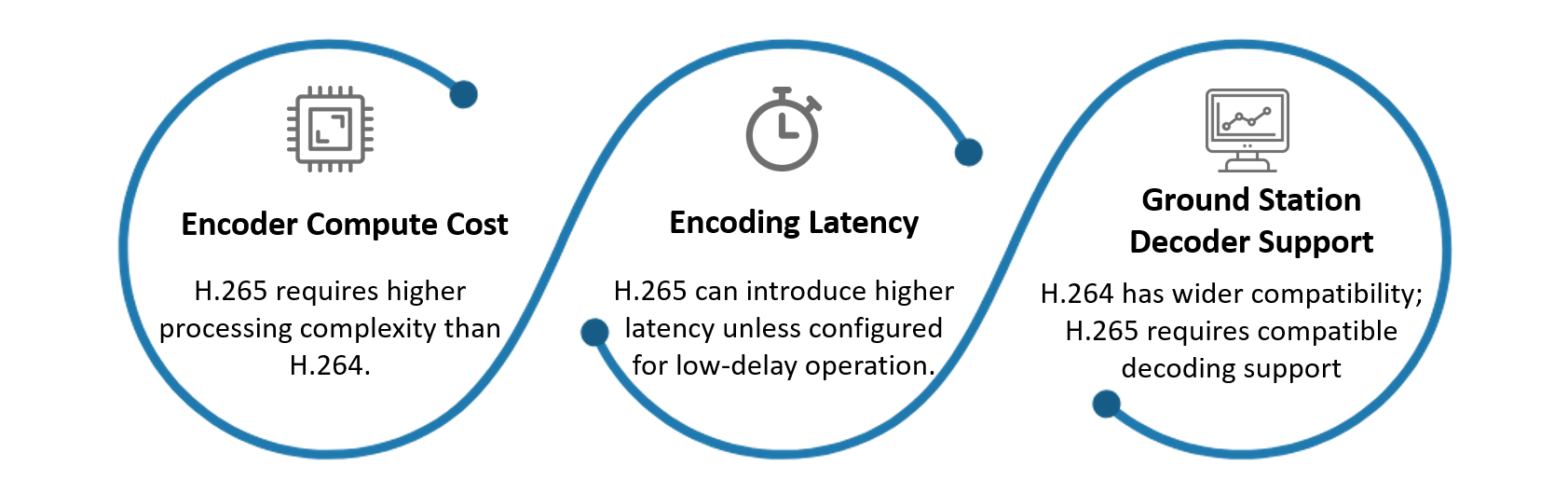
- Encoder compute cost: H.265's compression gain comes from more complex prediction and transform modes, which demands more compute per frame. On a SWaP-constrained flight computer, that can mean a dedicated hardware encoder block is required rather than a software fallback, or a lower resolution/frame-rate ceiling to stay within the platform's power and thermal budget.
- Encoding latency: H.265's more complex reference structures can add encoding latency relative to a comparably tuned H.264 pipeline unless the encoder is specifically configured for low-delay operation (single reference frame, no B-frames, small GOP size).
- Decoder availability at the ground station: Ground control station hardware and legacy analysis tooling sometimes lags in mature H.265 hardware decode support, which matters when the video has to reach multiple downstream consumers, not just one dedicated viewer.
The right choice depends on the specific flight computer's encode silicon and the ground station's decode capability, evaluated together rather than picking a codec in isolation and hoping the rest of the chain keeps up.
Latency Budgets for Real-Time Surveillance Decisions
Glass-to-glass latency, the time from a photon hitting the sensor to a pixel appearing on the operator's screen, is the metric that actually matters for a surveillance decision, and it is a budget that has to be allocated deliberately across every stage: sensor readout, encode, transmission, decode, and display. A design that optimizes encoding efficiency but ignores buffering at the transmission or decode stage can still end up with multi-second glass-to-glass latency that makes the video useless for anything time-sensitive, such as confirming a moving target's position before it changes.
Low-delay encoder configuration (small or zero B-frame count, tuned rate control, short GOP structures) trades some compression efficiency for lower per-frame latency, and for surveillance decision-making that tradeoff is almost always worth making deliberately rather than accepting whatever a general-purpose encoder profile defaults to.
UAV Image Processing at the Edge: What Changes for Real-Time Video
Doing meaningful uav image processing on the platform itself, stabilization, target-region cropping, basic enhancement, before the video is ever encoded changes the bandwidth and latency equation. Cropping to a region of interest and transmitting it at higher fidelity, rather than the full frame at reduced fidelity, often serves an operator's actual decision better within the same bandwidth budget. But every processing stage added before encode adds its own compute and latency cost, so the choice of what to process on-platform versus what to defer to the ground station is itself a SWaP and latency tradeoff, not a free win.
This is also where flight computer selection intersects with video pipeline design: a platform's drone flight controller embedded development effort and its video processing pipeline typically share the same compute budget, so encode and image-processing decisions cannot be made without visibility into what the flight control stack itself needs to reserve for stable flight.
Link Security: Encryption Without Breaking Real-Time Constraints
Encrypting a real-time video stream without adding unacceptable latency requires choosing cipher modes and key-management approaches that fit a streaming, not batch, data pattern. AES-GCM and similar authenticated-encryption modes suit this well because they can encrypt and authenticate a stream of packets without requiring the whole payload up front, unlike modes designed around fixed-size blocks of already-complete data. Key management matters as much as the cipher choice: a session key negotiated once at link establishment, refreshed on a defined schedule, avoids the latency and complexity of per-frame key exchange while still limiting the exposure window if a key is ever compromised.
The security design has to be validated against the same worst-case link conditions as the video pipeline itself, an encryption scheme that works cleanly on a stable bench link but adds unacceptable overhead or fails to resynchronize cleanly after a dropout is not actually production-ready for a tactical UAV platform.
Resilience to Jamming and Intermittent Connectivity
A tactical UAV link has to assume the RF environment is actively hostile, not just noisy. Practical resilience measures include frequency-hopping spread spectrum or similar anti-jam waveforms at the radio layer, forward error correction tuned to the expected error pattern rather than generic FEC settings, and a video pipeline that degrades gracefully rather than stalling completely when packets are lost, dropping frame rate or resolution rather than freezing or disconnecting outright. Reconnection behavior after a link interruption deserves as much design attention as the steady-state streaming path; a pipeline that takes several seconds to resynchronize encryption state and resume streaming after a brief dropout can cost an operator the exact moment the video was needed most.
Defense UAV Case Study: Embien's Low-Latency Video Streaming Project
Embien's own project history includes exactly this problem: for an Indian Defence organization, our team developed a low-latency video streaming protocol for a UAV platform, optimizing the H.264/H.265 codec pipeline specifically to achieve real-time aerial surveillance capability over bandwidth-constrained tactical networks. This defense uav case study reflects the same pattern described above: codec configuration, encoding latency, and link behavior were treated as one coordinated design problem rather than separate, independently-optimized layers, because a bandwidth-constrained tactical link punishes any component that was tuned in isolation.
That kind of defense uav case study is a useful reference point for any program evaluating low-latency video streaming for uav surveillance: the hard part is rarely any single component in isolation, it is making the codec, encryption, and link-resilience choices work together under the platform's actual worst-case conditions rather than its best-case bench test.
Embien's Capabilities
Embien has direct experience building secure, low-latency video pipelines for defense UAV platforms, alongside broader mission-critical embedded work including ruggedized MIL-STD-461/810 power electronics and RHEL-based camera driver development for defense OEMs. Our embedded video and connectivity team treats codec selection, encryption, and link resilience as a single design problem from the first architecture review, not a set of components integrated after the fact.
To discuss a secure video streaming or UAV connectivity requirement, reach out to Embien's mission-critical engineering team.