
Introduction
Every program that reaches for an FPGA instead of a microcontroller is making a bet: that the workload genuinely needs parallel, deterministic hardware logic badly enough to justify meaningfully higher development cost and complexity. Embedded systems FPGA decisions get made both ways too often, teams reach for an FPGA out of habit or perceived prestige when a microcontroller would have done the job at a fraction of the cost, and teams stick with a microcontroller past the point where its sequential processing genuinely can't keep up, forcing brittle workarounds instead of the parallel hardware solution the problem actually calls for. Getting this decision right early avoids both failure modes.
In short: an FPGA earns its place when a workload needs genuine hardware parallelism, deterministic sub-microsecond timing, or interfaces running faster than a microcontroller's sequential instruction execution can service, while a microcontroller remains the right default for anything a sequential processor can handle within its timing budget, because FPGA development carries real cost, power, and time-to-market tradeoffs that only pay off when the workload actually needs what programmable logic uniquely provides.
What an FPGA Actually Is, in Plain Terms, vs a Microcontroller
A microcontroller executes instructions sequentially, one after another, however fast its clock runs, meaning two operations that could theoretically happen simultaneously still compete for the same processing pipeline unless offloaded to separate hardware peripherals. An FPGA (Field-Programmable Gate Array) is fundamentally different: it's an array of configurable logic blocks and interconnects that get programmed, via a hardware description language like VHDL or Verilog, into custom digital circuits that all operate simultaneously, in parallel, with no instruction-fetch overhead standing between the logic and the result. This isn't a faster way of doing what a microcontroller does, it's a genuinely different computational model, hardware built to match the problem's structure directly, rather than software instructions executed against general-purpose hardware.
Workloads Where FPGA Parallelism Genuinely Wins
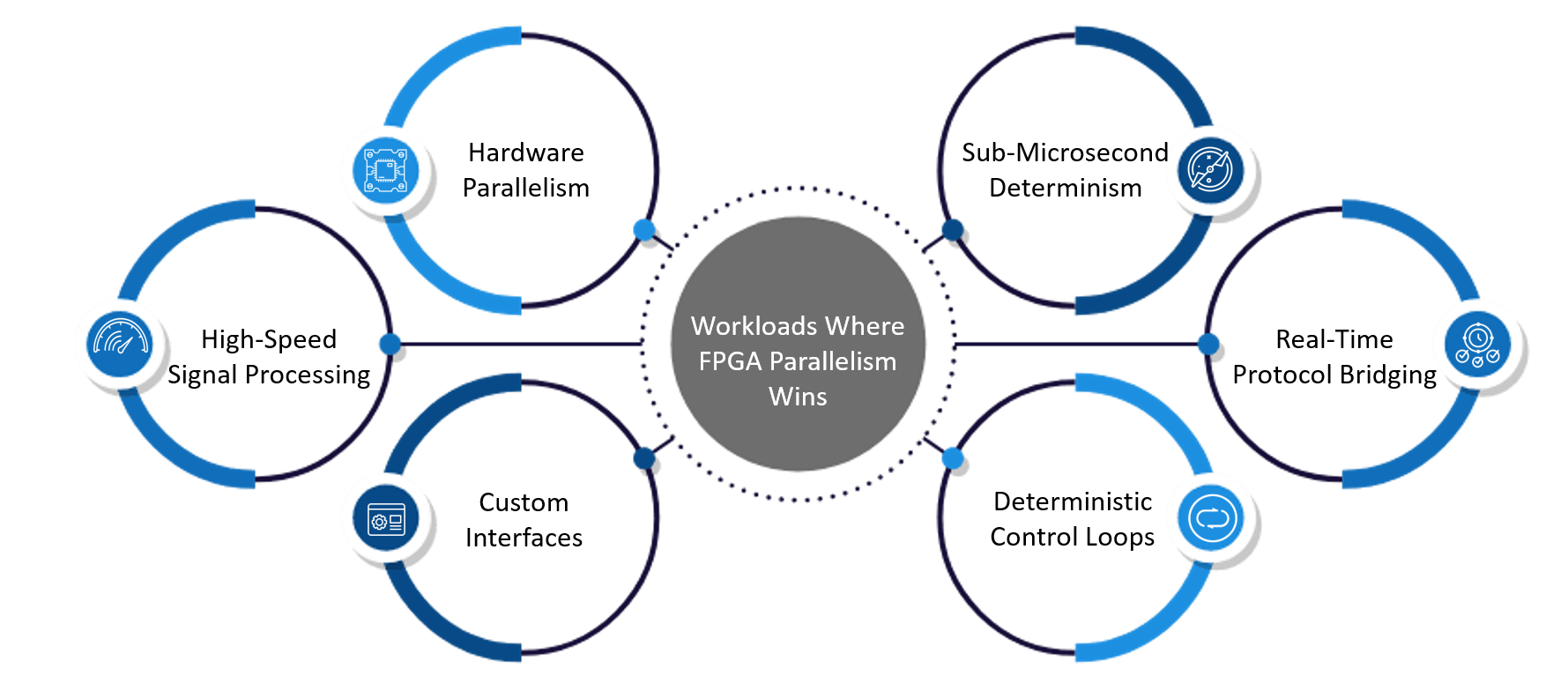
Certain workload categories consistently favor FPGA implementation because their performance requirements come directly from needing many operations to happen simultaneously or with sub-microsecond determinism a sequential processor's interrupt latency and instruction pipeline simply can't guarantee. High-speed signal processing, processing multiple sensor channels or a wide data bus in parallel, real-time protocol bridging, translating between two high-speed interfaces with no buffering delay, custom, non-standard interface implementations that no off-the-shelf microcontroller peripheral supports, and deterministic control loops requiring guaranteed, jitter-free timing regardless of what else the system is doing, are the recurring categories where FPGA parallelism delivers a result a microcontroller architecturally cannot match, not just one it happens to be slower at.
Cost, Power, and Development-Time Tradeoffs
FPGA development carries real costs that have to be weighed honestly against the performance benefit. Unit cost for an FPGA is typically higher than an equivalent-capability microcontroller, and remains a meaningful bill-of-materials line item even at volume, unlike a microcontroller whose cost drops sharply with scale. Power consumption is often higher too, particularly for a large FPGA running well below its full logic capacity for a relatively simple task. And development time and required expertise are both greater, HDL development, timing closure, and hardware verification demand a different skill set and typically a longer development cycle than equivalent microcontroller firmware, meaning FPGA development time-to-market cost has to be weighed against the schedule pressure a program is actually under.
Common Misconceptions That Lead Teams to Over- or Under-Use FPGAs
Two opposite misconceptions cause real project cost in practice. The first is assuming an FPGA is simply a faster, more capable processor and reaching for one whenever performance headroom seems desirable, without confirming the workload actually needs hardware parallelism rather than just faster sequential execution, which a higher-clock microcontroller or a DSP might deliver at lower cost and complexity. The second, equally costly misconception is assuming a microcontroller can always be made to work with enough clever software optimization, interrupt prioritization tricks, and peripheral offloading, when the underlying timing or parallelism requirement genuinely exceeds what sequential execution can deliver regardless of how cleverly the firmware is written, leading to a fragile, over-engineered microcontroller solution that an FPGA would have handled cleanly and robustly from the start.
Hybrid Architectures: MCU + FPGA Together
Many of the most effective embedded architectures don't choose exclusively between microcontroller and FPGA, they combine both, using each where its computational model fits best. A common pattern uses an FPGA to handle the hard-real-time, high-speed, or highly parallel portion of a workload, sensor data acquisition, protocol timing, signal conditioning, while a microcontroller or an FPGA-embedded soft processor handles higher-level logic, communication, and user interface functions that don't need hardware-level determinism. This division of labor lets each component do what it's genuinely best at rather than forcing either one to handle a workload poorly matched to its computational model.
FPGA Embedded System Design and Programming: What the Work Actually Involves
FPGA embedded system design and programming spans hardware description language development in VHDL or Verilog, timing closure analysis to confirm the design meets its target clock frequency across worst-case conditions, and verification through simulation and, increasingly, formal methods for safety- or mission-critical designs where a functional bug discovered after fabrication or field deployment is prohibitively expensive to fix. This work also frequently includes soft-processor integration, embedding a processor core like MicroBlaze or a RISC-V soft core directly within the FPGA fabric to handle software-appropriate logic alongside the hardware-parallel portions of the design, exactly the kind of hybrid architecture that lets one chip serve both computational models when board space or system cost rules out a separate discrete microcontroller.
The FPGA Design Process: From Architecture to Verified Silicon
A disciplined FPGA design process moves through architecture definition, deciding what logic genuinely needs hardware parallelism versus what can run on an embedded soft processor, RTL development in VHDL or Verilog, synthesis and place-and-route targeting the specific FPGA device chosen, timing closure iteration when initial results don't meet the target clock frequency, and verification through both simulation and, for designs with real consequences if wrong, hardware-in-the-loop testing against the actual target interfaces. That discipline is what separates a reliable outcome from one that discovers timing violations only after boards come back from fabrication. Embien's own experience delivering a custom FPGA-based controller for a German defense OEM's Antenna Front-End system, built around a Xilinx Artix-7 FPGA (XC7A100T) running a MicroBlaze soft processor and a full RTOS-based software stack to manage RF switches and attenuators while maintaining full backward compatibility with legacy RS422 protocols, illustrates this hybrid hardware-software approach directly: hard-real-time RF control logic implemented in FPGA fabric, with a soft processor handling the higher-level protocol and configuration logic that didn't need hardware-level determinism.
The Case for Bringing in Outside FPGA Expertise
Why use an FPGA? Benefits of outsourcing FPGA development become clear for teams that don't have HDL expertise in-house and don't want to build that capability for what might be a single program's specific requirement. FPGA design work benefits substantially from specialized experience, timing closure and verification methodology in particular have a steep learning curve that's expensive to acquire on a single project's timeline, making an experienced outside FPGA design partner frequently the more cost-effective path than building in-house capability from zero for teams whose core competency lies elsewhere.
A Growing Middle Ground: Targeted Acceleration
Embedded design with FPGA acceleration describes a specific pattern worth calling out separately from full custom FPGA architecture: using a small FPGA or an FPGA fabric integrated alongside a processor specifically to accelerate one well-defined bottleneck, a particular signal-processing step, a custom interface, or a cryptographic operation, while the rest of the system runs on conventional processor-based software. This targeted acceleration pattern captures much of FPGA's parallelism benefit for the specific operation that needs it without requiring the entire system architecture to be redesigned around programmable logic.
A Simple Decision Framework for Early-Stage Architecture Calls
A workable early-stage framework asks a few direct questions: does the workload require multiple operations to happen genuinely simultaneously, not just quickly in sequence; does it require deterministic timing tighter than a microcontroller's interrupt latency and instruction pipeline can reliably guarantee; and does the interface or protocol involved fall outside what standard microcontroller peripherals support. A clear yes to any of these points toward FPGA or a hybrid architecture; a program without any of these characteristics is very likely better served, at lower cost and shorter time-to-market, by a microcontroller, even a fast one, than by programmable logic reached for out of habit rather than genuine requirement.
Embien's Capabilities
Embien brings deep embedded systems FPGA design experience spanning HDL development, timing closure, and hybrid FPGA-plus-soft-processor architectures, including delivering a custom FPGA-based RF control system for a German defense OEM built on Xilinx Artix-7 silicon with a MicroBlaze soft processor and full RTOS software stack. Our engineering process evaluates FPGA versus microcontroller architecture decisions against the workload's actual parallelism and timing requirements, not by default preference for either.
To discuss embedded systems FPGA architecture or programmable logic design for a product program, reach out to Embien's engineering team.