
Introduction
RTOS selection ranks among the most consequential, and most quietly under-scrutinized, decisions a product team makes. Unlike a library choice or a build tool, an RTOS choice threads through driver architecture, task structure, timing behavior, and certification strategy for the product's entire life, and switching later means re-architecting substantial portions of the firmware rather than swapping a dependency. Choosing between bare-metal and RTOS is actually the first decision, and it deserves real scrutiny before the FreeRTOS-versus-Zephyr-versus-ThreadX conversation even starts, because plenty of genuinely simple embedded products are better served by no RTOS at all.
In short: bare-metal remains the right choice for simple, single-purpose firmware without real concurrency demands, while an RTOS earns its complexity once a product needs multiple independent, timing-sensitive tasks coordinated reliably, and among the RTOS options, FreeRTOS wins on ecosystem size and ubiquity, Zephyr wins on modern architecture and growing vendor support, and ThreadX wins on safety-certification pedigree, with the right choice depending on the product's certification needs, existing team expertise, and long-term maintenance plan more than any single technical feature comparison.
Why Choose RTOS Over Bare Metal? What Actually Differs at the Architecture Level
The answer comes down to how the firmware handles concurrency and timing as complexity grows. Bare-metal firmware, a single main loop plus interrupt service routines, works well and stays simple for products with limited, well-understood concurrent behavior, a straightforward sensor-to-actuator control loop, for instance. Once a product needs several genuinely independent activities running with different timing requirements, a communication stack, a user interface, sensor sampling, and a control loop, all needing to make progress without blocking each other, bare-metal's single-loop-plus-interrupts model starts requiring increasingly convoluted state machines and interrupt-driven scheduling logic to fake the concurrency an RTOS provides natively through preemptive task scheduling, inter-task communication primitives, and timing services. The complexity an RTOS adds is real, but past a certain concurrency threshold, it's genuinely less complexity than the hand-rolled alternative bare-metal would otherwise require.
FreeRTOS: Ecosystem Size vs Minimal Built-In Services
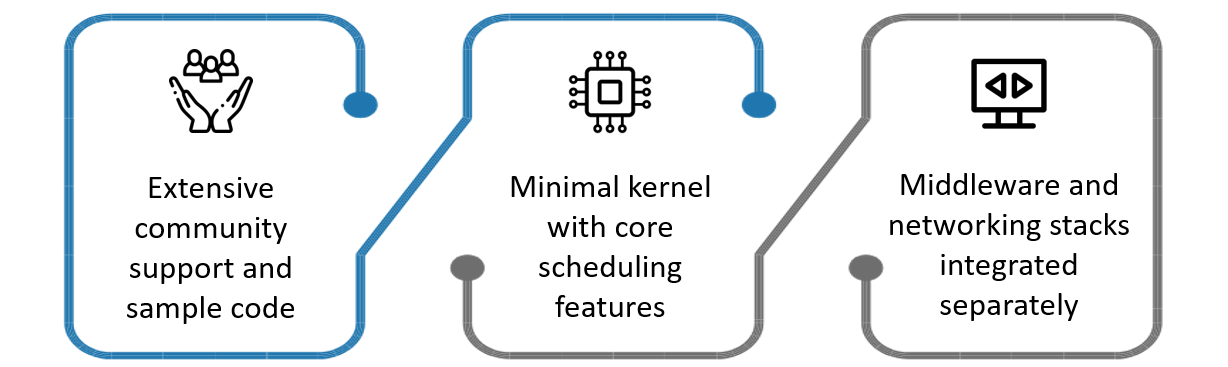
FreeRTOS's greatest strength is its sheer ecosystem scale: the most widely deployed RTOS kernel in embedded systems, supported across virtually every microcontroller vendor's toolchain, with a vast body of community knowledge, sample code, and third-party middleware built around it. This ubiquity translates directly into hiring and training ease, most embedded engineers have at least some FreeRTOS familiarity already, and into a lower-risk default choice for teams without a strong reason to look elsewhere. FreeRTOS's kernel itself is deliberately minimal, though, providing core scheduling and inter-task communication primitives without the broader framework services, standardized driver models, build system, device tree support, that a more integrated RTOS platform bundles in, meaning teams often assemble additional middleware, networking stacks, filesystem support, security libraries, separately around the FreeRTOS kernel rather than getting them as part of an integrated platform.
Zephyr: Modern Architecture and Growing Vendor Support
Zephyr, a comparatively newer entrant with strong Linux Foundation backing, takes a more integrated platform approach than FreeRTOS's minimal-kernel philosophy: a unified build system, native device tree support borrowed from the Linux kernel ecosystem, a standardized driver model, and built-in networking and Bluetooth stacks that come as part of the platform rather than being assembled separately. This more opinionated, integrated architecture appeals particularly to teams building connected products who want networking and security capability included rather than integrated piecemeal, and vendor support for Zephyr has grown substantially as major silicon vendors have added first-class Zephyr support to their SDKs. The tradeoff is a steeper initial learning curve than FreeRTOS's simpler kernel-only model, and a comparatively smaller, though rapidly growing, body of community experience and third-party resources than FreeRTOS's much longer install base has accumulated.
ThreadX: Safety-Certification Pedigree and Commercial Licensing
ThreadX (now Eclipse ThreadX, following its open-sourcing by Microsoft) carries a safety-certification track record that neither FreeRTOS nor Zephyr matches to the same degree: pre-certified safety packages for IEC 61508, ISO 26262, IEC 62304, and DO-178C are available for ThreadX, backed by the kind of certification evidence and vendor support a safety assessor recognizes readily, meaningfully reducing the certification effort for products that need to meet one of these standards. This certification pedigree, built over decades of deployment in safety-relevant embedded products, is ThreadX's clearest differentiator, and for a program with genuine safety-certification requirements, the reduced certification effort ThreadX's pre-certified packages provide can outweigh FreeRTOS's or Zephyr's advantages in ecosystem size or architectural modernity.
Licensing Models and Their Real Cost Implications
Licensing differs meaningfully across the three and deserves genuine cost analysis, not an afterthought. FreeRTOS is available under a permissive MIT license at no cost, with an optional commercial long-term support and safety-certified variant available for teams that want vendor-backed certification evidence. Zephyr is Apache 2.0 licensed, fully open source with no commercial licensing tier required, reflecting its Linux Foundation governance model. ThreadX, since its 2019 open-sourcing, is available under an MIT-style license for its core kernel, though the pre-certified safety packages and extended commercial support that make ThreadX distinctive for safety-critical work typically carry their own commercial licensing and support agreements. A team's actual cost comparison needs to weigh not just the base kernel license but the cost of whatever certification evidence, middleware, and long-term support the specific product actually needs across each option.
FreeRTOS Development: What the Work Actually Looks Like in Practice
FreeRTOS development work centers on task and priority design, structuring the application's concurrent activities into appropriately prioritized tasks with correctly sized stacks, and careful use of FreeRTOS's inter-task communication primitives, queues, semaphores, event groups, to coordinate between tasks without introducing priority inversion or deadlock. Because the kernel is minimal by design, this work also frequently involves selecting, integrating, and validating third-party middleware, TCP/IP stacks, filesystem libraries, security libraries, separately from the kernel itself, work that a more integrated platform like Zephyr would otherwise fold into a more standardized configuration process.
Zephyr RTOS Development: Working Within a More Opinionated Platform
Zephyr RTOS development work looks different in character: more time spent working within Zephyr's device tree and Kconfig-based build configuration system to enable and configure the specific drivers, networking stacks, and services a product needs, and comparatively less time spent separately integrating third-party middleware since much of that functionality is already part of the Zephyr platform. This more structured, configuration-driven development model has a steeper initial learning curve for teams unfamiliar with Zephyr's Linux-derived build system conventions, but tends to produce more consistent, portable code across different target hardware once a team is past that initial learning curve, since Zephyr's device tree abstraction is specifically designed to isolate hardware-specific configuration from application logic.
A Decision Framework Based on Product Category and Certification Needs
A product with hard safety-certification requirements, IEC 61508, ISO 26262 at higher ASIL levels, IEC 62304, DO-178C, should weigh ThreadX's pre-certified safety packages seriously against the certification effort and cost of achieving equivalent evidence with FreeRTOS or Zephyr independently. A connected product needing integrated networking, security, and a modern, standardized build and driver architecture, without an immediate hard safety-certification requirement, is well served by Zephyr's more integrated platform approach. A product where team familiarity, ecosystem size, and minimal kernel overhead matter most, and where any needed middleware or certification evidence will be assembled or purchased separately, is well served by FreeRTOS's ubiquity and simplicity. None of these are wrong choices in the abstract, the wrong choice is picking without weighing the product's actual certification timeline and team expertise against what each platform is genuinely built to optimize for. Whichever direction a program leans, choosing between bare-metal and RTOS the right way means starting from the product's real concurrency and certification needs rather than from habit.
Embien's Capabilities
Embien brings RTOS selection and integration experience across FreeRTOS, Zephyr, and ThreadX, spanning task architecture design, driver and middleware integration, and safety-certification support for products requiring IEC 61508, ISO 26262, or IEC 62304 compliance. Our engineering process evaluates RTOS choice against a product's actual concurrency, certification, and long-term maintenance requirements rather than defaulting to whichever platform a team happens to know best.
To discuss choosing between bare-metal and RTOS or RTOS selection and integration for a product program, reach out to Embien's engineering team.