
Introduction
Humanoid robotics moved from research-lab curiosity to a genuinely commercial investment category faster than most embedded engineering organizations planned their skills roadmap around. Humanoid robotics embedded engineering now competes for the same specialized talent, real-time control, power electronics, embedded edge AI, that automotive, industrial, and defense programs have been drawing on for years, and demand is growing faster than the supply of engineers who've actually built systems in this space.
In short: the humanoid and industrial robotics surge is primarily an embedded engineering demand shock, not a pure AI-model story, and companies that treat it as a software or AI hiring problem alone are underestimating what it actually takes to ship a working physical robot.
What's Driving the Humanoid Robotics Investment Surge
Several trends converged to make humanoid and advanced industrial robotics investable at scale rather than confined to research budgets. Edge AI compute capable of real-time perception and control now fits within a robot's realistic power and thermal envelope, where it previously required infrastructure no mobile platform could carry. Foundation models for perception and manipulation have matured enough to generalize across tasks that previously needed hand-tuned, task-specific programming. And labor economics in manufacturing, warehousing, and logistics have made the business case for physical automation more compelling even where full autonomy isn't yet achievable, as long as the platform can reliably handle a meaningful subset of tasks. None of these trends by itself would have produced the current investment surge; together they made humanoid and advanced industrial robotics a plausible near-term commercial category rather than a decade-out research bet.
Where Industrial Robots vs. Humanoid Form Factors Each Make Sense
The humanoid form factor gets disproportionate attention, but it isn't the right answer for most near-term industrial automation problems. A fixed or wheeled industrial robot arm, purpose-built for a specific task, is almost always more reliable, more power-efficient, and easier to engineer than a general-purpose humanoid platform attempting the same task. Humanoid form factors earn their complexity specifically where a facility's existing infrastructure, tools, doorways, workstations, was built for human dimensions and human-shaped interaction, making a general-purpose bipedal platform genuinely more practical than re-engineering the environment for a specialized robot. Most manufacturers evaluating robotics investment right now are better served starting with task-specific industrial robots and reserving humanoid platforms for the narrower set of use cases where general-purpose human-environment compatibility is the actual constraint.
Robotic Process Automation (RPA) in Manufacturing: Use Cases vs. Physical Robotics
It's worth drawing a clear line between this trend and a related but distinct one. Robotic process automation (RPA) in manufacturing: use cases typically means software bots automating digital workflows, data entry, ERP transactions, report generation, not physical machines interacting with the physical world. Humanoid and industrial robotics embedded engineering is a different discipline entirely: real-time control loops, power electronics, sensor fusion, and mechanical actuation, closer to automotive or aerospace embedded engineering than to software process automation. Manufacturers sometimes conflate the two when building an automation roadmap, which leads to misallocating a software automation budget toward a problem that actually requires embedded hardware and controls engineering, or vice versa.
Embedded Hardware for Humanoid Robots: The Disciplines This Trend Pulls On
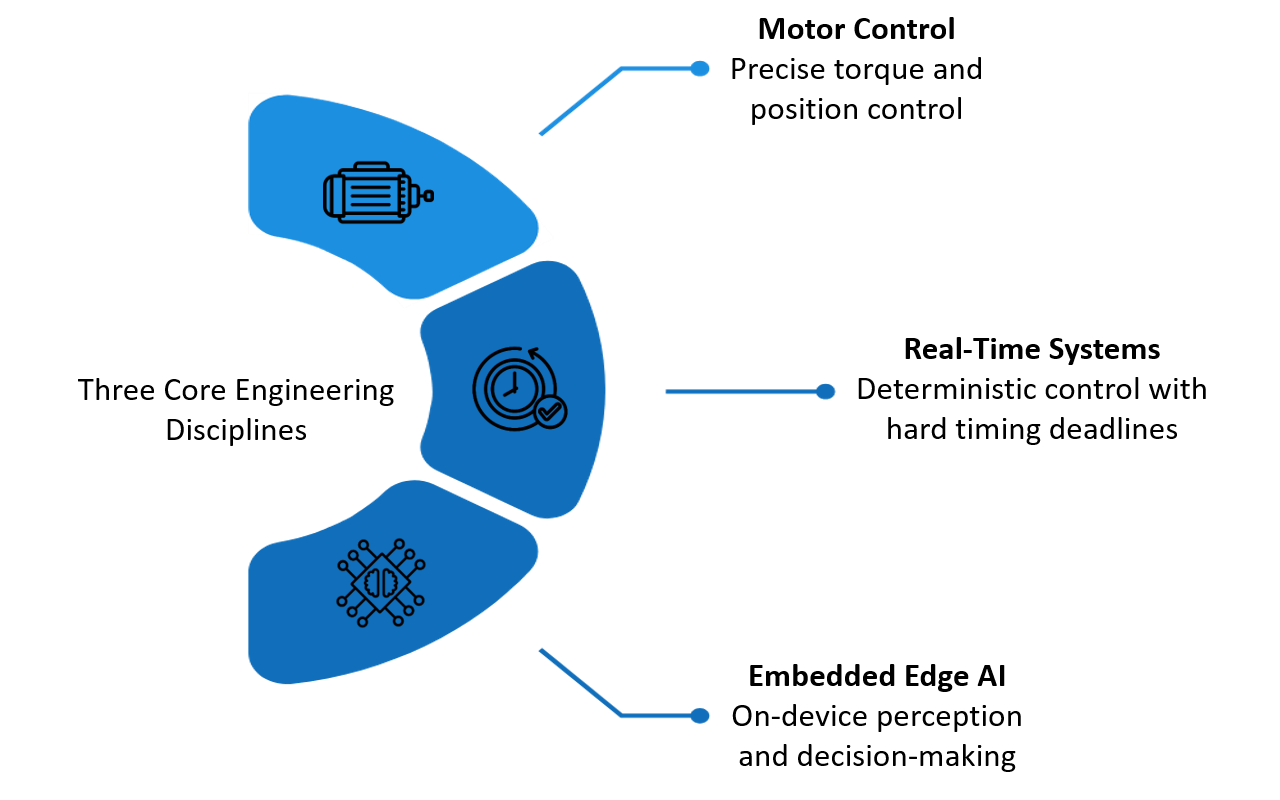
Embedded hardware for humanoid robots draws on a specific, demanding combination of engineering disciplines that few organizations have assembled in one team. Motor control engineering, precise torque and position control across multiple actuated joints, often with custom motor driver electronics tuned for the platform's specific power and torque requirements. Real-time systems engineering, control loops with hard timing deadlines where a missed cycle can mean a dropped object or a loss of balance, not just a degraded user experience. And embedded edge AI, perception and decision-making models running on-platform within the robot's power and thermal budget, coordinated with the real-time control loops rather than operating as a separate, loosely-coupled subsystem. Very few engineers have deep experience across all three; most robotics programs end up assembling specialists from adjacent domains, automotive motor control, industrial real-time systems, embedded AI, and integrating them, which is itself a nontrivial engineering management challenge.
Robotics Integration: The Skills Gap Companies Face Building In-House
Robotics integration at the systems level, getting mechanical design, power electronics, real-time control, and embedded AI to work together as one coherent platform rather than as separately-developed subsystems bolted together late, is where most companies building an in-house robotics capability for the first time underestimate the effort. The skills gap isn't usually in any single discipline in isolation, most organizations can hire a motor control engineer or an embedded AI engineer, it's in the systems integration experience needed to get those disciplines' outputs to work together under one shared real-time and power budget, a skill set built specifically by having done it before, not one easily hired for in isolation.
Physical AI Lifecycle Management: Where an Experienced Partner Adds the Most Value
Physical AI lifecycle management, the ongoing work of validating, updating, and maintaining a robot's embedded AI and control software across its deployed life, not just getting a first version working, is where an experienced embedded engineering partner tends to add the most value for a company new to this space. This includes managing model updates without destabilizing validated real-time control behavior, maintaining the same rigor in regression testing and safety validation for every software update that the original platform qualification required, and having already built the systems-integration playbook across motor control, real-time systems, and embedded AI that a first-time robotics program would otherwise have to develop from scratch under schedule pressure.
What to Watch for Over the Next 2-3 Years
Expect the practical center of gravity in this market to stay with task-specific industrial robots and constrained-mobility platforms for longer than the more visible humanoid demonstrations suggest, with humanoid form factors gaining real commercial traction first in the specific human-environment-compatibility use cases where they genuinely make sense rather than as a general-purpose replacement for task-specific automation. Expect continued rapid improvement in edge AI compute efficiency to keep expanding what's feasible within a mobile platform's power budget. And expect the systems-integration skill gap described above to remain the binding constraint on how fast individual companies can move, more than model capability or compute availability, for at least the next several years, which means demand for genuine humanoid robotics embedded engineering experience will keep outpacing supply well past this current investment cycle.
Embien's Capabilities
Embien brings the specific combination of disciplines humanoid and industrial robotics embedded engineering demands: motor control and real-time systems expertise built across automotive and industrial programs, embedded edge AI deployment on NVIDIA Jetson, NXP eIQ, and Cortex-M platforms, and systems integration experience bringing mechanical, electrical, and software subsystems together as one coordinated platform. Our team functions as the embedded engineering partner for companies building robotics capability without an in-house team already assembled across all three disciplines.
To discuss embedded engineering support for a robotics program, reach out to Embien's engineering team.