
Introduction
A physical AI model that performs beautifully in simulation is, at best, half of a finished product. Embedded systems for physical AI have to contend with latency, power, thermal limits, and sensor noise that a training simulation almost never models faithfully, which is exactly why so many promising simulation results fail to survive contact with real hardware. The gap isn't a model-quality problem that more training data fixes; it's an architecture problem that has to be addressed by designing hardware and model together, not by handing a finished model to a hardware team after the fact.
In short: sim-to-real hardware software co-design for physical AI means treating compute platform selection as part of the model development process from day one, so the model being trained is one the target hardware can actually run within its real power, thermal, and latency budget, rather than a model that has to be redesigned after simulation results look promising.
Why Sim-to-Real Transfer Commonly Fails in Physical AI Products
Simulation environments are built to make model training tractable, which means they routinely simplify away exactly the things that matter most once a model runs on real hardware. Sensor noise in simulation is typically synthetic and well-characterized; real sensors have failure modes, calibration drift, and environmental sensitivity a simulation rarely reproduces faithfully. Simulated actuators respond with idealized, instantaneous dynamics; real actuators have latency, backlash, and wear that change behavior over a product's service life. And simulation training runs on effectively unlimited compute; the deployed model has to run within whatever power and compute budget the physical product's battery, thermal envelope, and cost target actually allow. A model trained without these constraints in view can produce excellent simulation results and still be fundamentally unable to run on the hardware it was meant for.
Hardware Constraints That Simulation Environments Routinely Ignore
'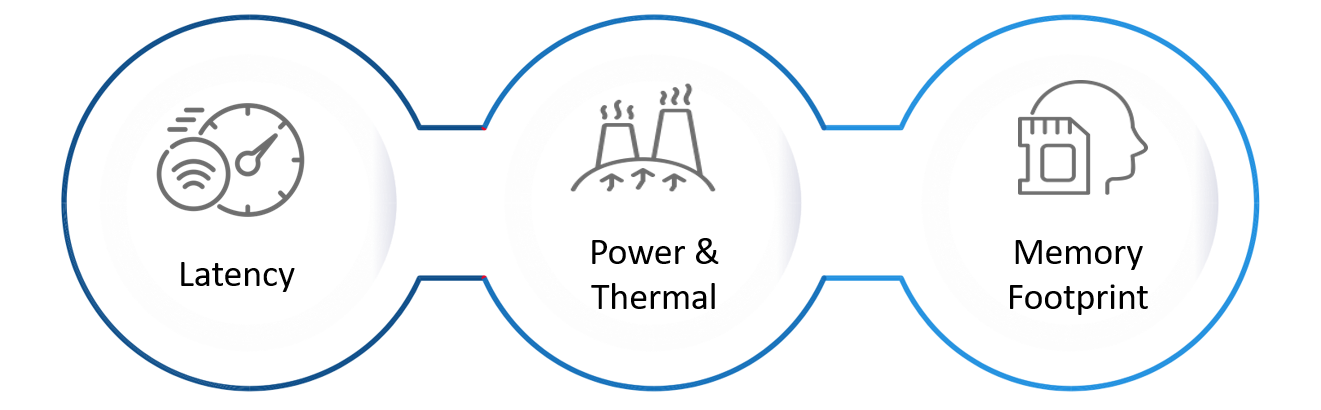
Three constraint categories consistently get short-changed in simulation-first development. Latency: a control-loop deadline that a simulation can ignore entirely becomes a hard real-time constraint the moment the model runs on embedded hardware, and a model architecture that wasn't designed with an inference-time budget in mind can miss that deadline no matter how accurate its outputs are. Power and thermal envelope: a model that trains and even runs inference on a workstation GPU may have no viable path to running within a battery-powered or passively-cooled embedded platform's actual power budget. And memory footprint: simulation training environments rarely constrain model size the way an embedded target's RAM and flash actually do, so a model can end up architecturally incompatible with its target hardware in ways that only surface once someone tries to actually deploy it.
What Co-Design Looks Like in Practice
Co-design means the target hardware's real-time, power, and memory budget shapes model architecture decisions during training, not after. In practice this looks like selecting the embedded compute platform, NVIDIA Jetson, NXP i.MX 8M with eIQ, or an ARM Cortex-M target for TinyML deployment, early enough that the model architecture, layer count, quantization strategy, input resolution, is chosen with that platform's actual inference budget in mind. It also means validating early prototypes against representative hardware, not just a training workstation, so latency, power draw, and thermal behavior under sustained inference load surface while the architecture is still easy to change, not after the model design is considered finished.
The Case for Involving Hardware Engineers Earlier in the AI Development Cycle
Physical AI teams organized with AI engineers working independently until a model is "ready," then handing it to a hardware team for deployment, consistently discover the deployment problems too late to fix cheaply. Involving hardware engineers from the model architecture stage, not just at integration, means questions like "what inference latency can this platform actually sustain under real thermal load" and "what quantization approach preserves accuracy on this specific NPU's supported operations" get answered while the model design is still flexible, rather than becoming a crisis when a nearly-finished model turns out to be unable to run on the target hardware at all.
Physical AI Edge Compute Development: Matching Model to Silicon
Physical AI edge compute development is where this tension gets resolved concretely. Different platforms support different operations efficiently, a model architecture built around operations well-supported by a target NPU's instruction set will run dramatically faster than an equivalent-accuracy model using operations that platform has to emulate in software. This means the model-optimization pipeline, quantization, pruning, hardware-specific compilation, has to be informed by the target platform's actual capabilities from early in training, not applied as a generic post-processing step to whatever architecture the AI team happened to choose.
Common Late-Stage Redesigns This Approach Avoids
Teams that skip co-design and discover the hardware mismatch late typically face one of a few expensive redesign paths: retraining the model with a smaller architecture that fits the target hardware's actual budget, after months of development around the original architecture; respinning the hardware to a more capable, more expensive, or more power-hungry platform to accommodate a model that was never actually going to fit the original target; or shipping a product with degraded real-world performance, reduced frame rate, longer response latency, than the simulation results suggested, because the deployment compromise was made under schedule pressure rather than by design. Each of these costs meaningfully more than the co-design discipline that would have avoided them.
How Does Embien Support Hardware-Software Co-Design?
How does Embien support hardware-software co-design for physical AI products specifically? Our teams bring embedded hardware design and AI model optimization together under one roof rather than as separate vendor relationships, meaning platform selection, model architecture decisions, and quantization strategy get evaluated against each other from the same design review rather than being handed off sequentially. This is the same full-lifecycle approach we bring to physical AI hardware development generally: hardware and software engineers in the same room from concept, not integration handled as an afterthought once each side has finished independently.
Embien's Capabilities
Embien combines embedded hardware design, FPGA development, and AI model optimization across NVIDIA Jetson, NXP eIQ, and ARM Cortex-M TinyML platforms under one engineering team, so physical AI products get co-designed from concept rather than assembled from independently-developed model and hardware workstreams. Our process validates model architecture against representative target hardware early, before an architecture decision becomes expensive to unwind, the same discipline that should apply to any team building serious embedded systems for physical AI.
To discuss hardware-software co-design for a physical AI product, reach out to Embien's engineering team.