
Introduction
Nearly every programmable logic controller on a factory floor today, regardless of manufacturer, Siemens, Rockwell, Schneider, Mitsubishi, Beckhoff, can be programmed using some combination of the same five languages, because virtually the entire PLC industry converged on a single standard: IEC 61131-3. Where to get PLC programming for factory automation? almost always means finding engineers fluent in this standard's language family, since it's what makes PLC logic portable in concept, if not always directly in code, across vendor ecosystems. PLC programming embedded into a broader automation system still has to account for vendor-specific tooling and hardware differences, but the underlying language standard is what makes PLC programming a genuinely transferable skill across the industry rather than a vendor-locked specialty.
In short: the IEC 61131-3 programming standard explained simply: it defines five standardized PLC programming languages, Ladder Diagram, Function Block Diagram, Structured Text, Instruction List, and Sequential Function Chart, each suited to different kinds of control logic, and understanding which language fits which problem is a core skill for anyone doing this work or integrating PLC logic into a larger automation architecture.
Why the Industry Needed a Single Programming Standard
Before IEC 61131-3's widespread adoption, each PLC manufacturer largely defined its own programming language and toolchain, meaning an engineer's PLC programming skill on one vendor's platform didn't transfer cleanly to another's, and a factory standardized on one vendor's PLCs faced real switching costs if it ever wanted to change suppliers. IEC 61131-3, first published in 1993 as part of the broader IEC 61131 standard for programmable controllers, addressed this by defining a common set of programming languages and a shared software model that vendors could implement within their own tooling. The standard didn't eliminate vendor-specific differences entirely, I/O configuration, hardware abstraction, and proprietary function block libraries still vary by manufacturer, but it did make the core programming languages themselves broadly consistent and transferable across the industry.
The Five IEC 61131-3 Languages and What Each Is Actually For
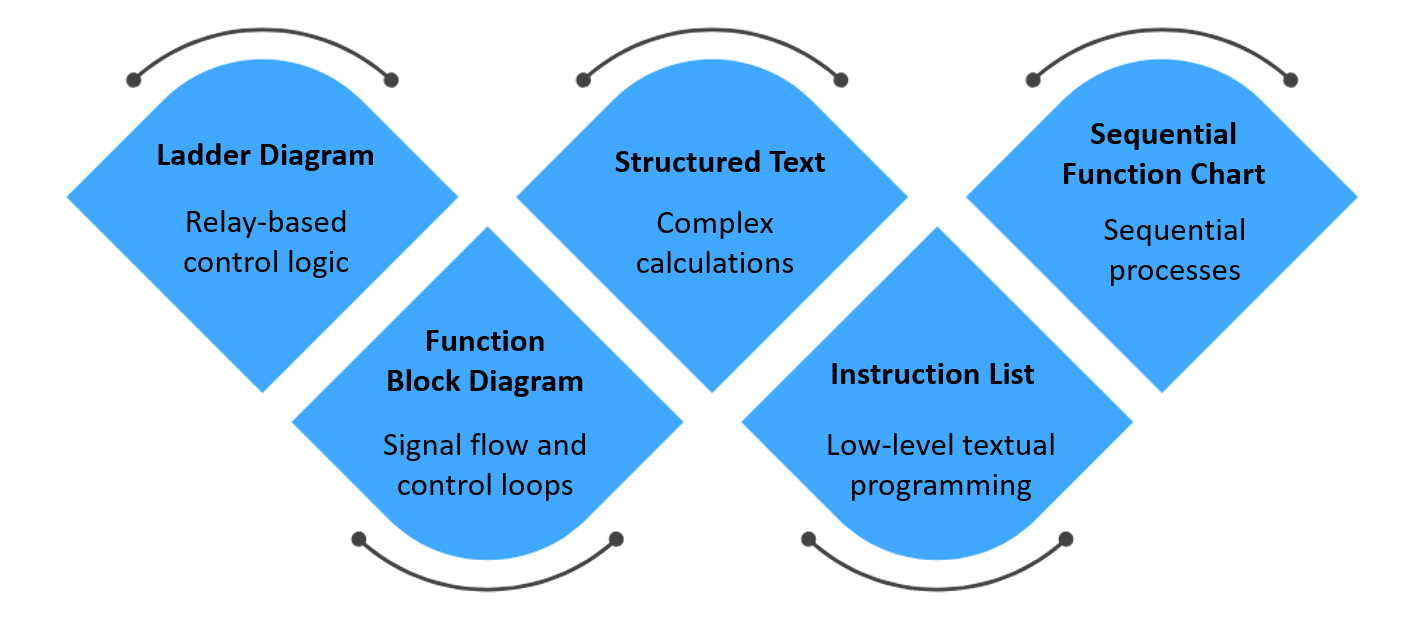
Ladder Diagram (LD) represents logic as a set of rungs resembling an electrical relay circuit diagram, and remains the most widely used PLC language specifically because it maps intuitively onto the relay-based control logic PLCs originally replaced, making it accessible to electricians and technicians without a traditional software background. Function Block Diagram (FBD) represents logic as interconnected functional blocks with inputs and outputs, well suited to control logic that's naturally expressed as signal flow between processing elements, PID control loops and analog signal processing are common FBD use cases. Structured Text (ST) is a high-level, Pascal-like textual language, the closest of the five to conventional programming, and is generally preferred for complex algorithms, mathematical calculations, and logic with extensive conditional branching that becomes unwieldy to express graphically. Instruction List (IL) is a low-level, assembly-like textual language, largely deprecated in the most recent IEC 61131-3 revisions but still encountered in legacy programs. Sequential Function Chart (SFC) represents logic as a sequence of steps and transitions, ideal for describing sequential or state-machine-like processes, a batch process moving through defined stages, for instance, where the control flow itself is fundamentally about sequencing rather than continuous calculation.
Choosing the Right Language for the Control Problem
Experienced PLC programmers typically don't commit to a single language for an entire project, IEC 61131-3 explicitly supports mixing languages within one program, using SFC to define the overall sequential structure of a process while implementing individual steps in ST for complex calculations or FBD for continuous control loops within those steps. This mix-and-match capability is one of the standard's more underappreciated strengths: rather than forcing an entire control program into whichever language is easiest to read for logic that resembles relay circuits, a well-structured IEC 61131-3 program uses each language where it's genuinely the clearest and most maintainable choice for that specific piece of logic.
PLC Programming Embedded Within Larger Automation Architectures
PLC programming embedded within a broader factory automation architecture increasingly has to account for integration beyond the PLC itself: communicating over industrial protocols like Profinet, EtherCAT, or Modbus to coordinate with drives, sensors, and SCADA systems, exposing data to MES and historian systems for production tracking, and increasingly interfacing with IIoT gateways for cloud-based analytics and predictive maintenance. A PLC program that's cleanly structured internally but poorly integrated with the surrounding automation ecosystem, exposing the wrong data, using non-standard variable naming that complicates SCADA tag mapping, undermines the value of the broader system even when the core control logic itself is sound.
Custom PLC Programming for Factories: Where Off-the-Shelf Logic Falls Short
Custom PLC programming for factories becomes necessary precisely where a facility's process doesn't match the generic logic templates a machine builder's standard PLC program assumes: a unique batching sequence, a non-standard safety interlock scheme required by a specific hazard the facility faces, or integration logic connecting a new piece of equipment to an existing, older automation architecture that wasn't designed to accommodate it. Doing this kind of work well starts with genuinely understanding the physical process being controlled, not just the I/O points involved, because control logic disconnected from the physical process's actual failure modes and operational realities tends to work in testing and cause problems once real production variability shows up on the floor.
PLC Programming and Integration: The Testing and Commissioning Reality
PLC programming and integration work doesn't end when the logic compiles cleanly in simulation, real commissioning on an actual factory floor surfaces timing issues, sensor noise, and edge cases that a desktop simulation environment simply can't reproduce faithfully. Structured commissioning practice, testing each I/O point individually before testing sequences, testing failure and interlock scenarios deliberately rather than only the happy path, and validating actual cycle times against the process requirements under real mechanical and electrical conditions, catches the gap between logic that looks correct and logic that performs correctly on the actual machine. This commissioning discipline matters as much to a successful deployment as the quality of the control logic itself.
Where PLC Programming Fits in the Broader Embedded Engineering Skillset
PLC programming sits at an interesting intersection within embedded engineering broadly: it shares real conceptual overlap with general embedded software development, real-time constraints, I/O handling, state-machine design, while operating within a domain-specific standard, toolchain ecosystem, and safety-certification framework (IEC 61508 and its machinery-specific derivative, IEC 62061, in particular) that's distinct from general-purpose embedded firmware work. Engineers moving between conventional embedded development and PLC programming generally find the underlying logic and control-system thinking transfers well, while the vendor-specific tooling, safety PLC certification requirements, and IEC 61131-3 language conventions represent a genuinely separate body of practical knowledge worth building deliberately rather than assuming will transfer automatically.
Embien's Capabilities
Embien brings embedded and industrial automation engineering experience spanning PLC programming embedded within larger control architectures, industrial protocol integration, and embedded controller development for factory automation systems. Our engineering process treats commissioning and real-world validation as integral to a PLC program's delivery, not a formality performed after the logic is considered complete.
To discuss custom PLC programming or industrial automation integration for a factory modernization program, reach out to Embien's engineering team.