
Introduction
Industry 5.0 gets discussed often enough as the next paradigm that it's easy to lose track of a more basic question: what did Industry 4.0 actually deliver, and what specifically is changing now. Industry 4.0 transformation as the launchpad for Industry 5.0 is the more accurate framing than treating the two as a clean replacement, Industry 5.0 builds directly on the digital infrastructure Industry 4.0 put in place rather than discarding it. Industry 4.0 vs Industry 5.0: what's changing on the factory floor is best answered concretely, in terms of what a plant manager or line engineer actually sees differently, not in the abstract language both movements tend to get described in.
In short: Industry 4.0 connected the factory floor, sensors, IoT, cloud analytics, cyber-physical systems, delivering real productivity and visibility gains but doing so with a largely technology-first mindset that left human-centricity and sustainability as afterthoughts, while Industry 5.0 adds those two dimensions deliberately on top of the digital backbone Industry 4.0 already built, making it an additional layer rather than a wholesale replacement.
Industry 4.0 Transformation in One Paragraph: What It Actually Delivered
Industry 4.0, dating roughly to 2011, brought cyber-physical systems, IoT connectivity, big data analytics, and cloud computing together to create interconnected smart factories. The results have been real and measurable: widespread adoption of IoT for real-time production monitoring, AI-optimized supply chains, and predictive maintenance programs that catch equipment failures before they cause unplanned downtime. A manufacturer that completed genuine Industry 4.0 adoption gained visibility into its operations that simply didn't exist in the era of isolated, unconnected machines, and that visibility is what made data-driven decisions about maintenance, quality, and throughput possible at scale for the first time.
Where Industry 4.0 Fell Short of Its Own Promises
Industry 4.0's heavy emphasis on automation and connectivity came with real costs that only became fully visible once adoption matured. Automating routine tasks displaced workers faster than reskilling programs could absorb them in many facilities, widening skills gaps rather than closing them. The energy consumption of the data centers and always-on IoT infrastructure that Industry 4.0 depends on became a genuine sustainability liability, contributing meaningfully to manufacturing's overall emissions footprint rather than reducing it. And the rigid, highly-optimized systems many Industry 4.0 implementations produced turned out to be surprisingly brittle under real disruption, supply chain shocks and geopolitical volatility exposed how little resilience some of the most heavily automated, tightly-optimized factories actually had once conditions deviated from what the system was tuned for.
What Industry 5.0 Adds: Human-Centricity and Sustainability Focus
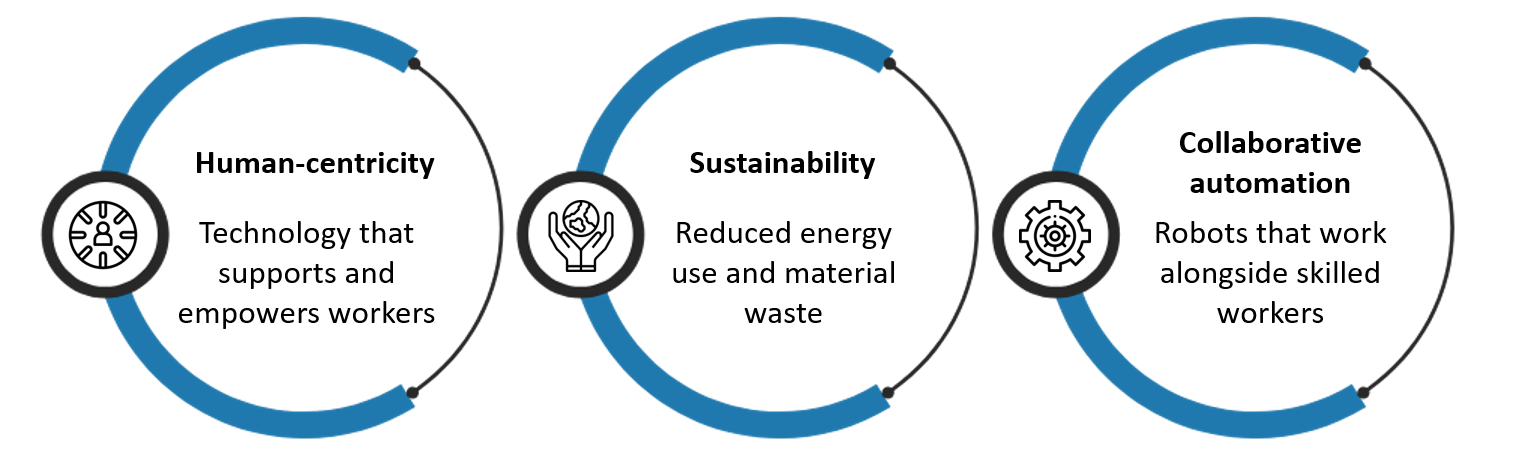
Industry 5.0, articulated by the European Commission around 2021, doesn't reject Industry 4.0's technology, it redirects it toward two goals Industry 4.0 treated as secondary at best: putting human well-being and judgment back at the center of factory operations rather than treating workers as a variable to be automated away, and embedding sustainability into production processes as a first-class design requirement rather than a compliance afterthought or marketing claim layered on after the fact. Collaborative robots designed to augment a skilled worker's judgment rather than replace it, and circular-economy production processes designed to minimize waste and energy use from the outset, are the concrete expressions of this shift.
Concrete Factory-Floor Examples of the Difference
The difference shows up in specific, observable ways on an actual production line. An Industry 4.0-only implementation might deploy a fully automated welding cell that excludes human operators entirely once installed; an Industry 5.0 approach deploys a collaborative robot that a skilled welder actively guides for the intricate parts of the job the robot alone can't judge well, reducing injury risk while keeping the human's expertise central to the outcome. An Industry 4.0 predictive maintenance system optimizes purely for uptime and cost; an Industry 5.0 approach layers sustainability metrics, energy consumption, material waste, into the same optimization, sometimes accepting a slightly less aggressive uptime target in exchange for meaningfully lower energy use. These aren't hypothetical distinctions, they're the actual design choices differentiating a 5.0-oriented factory floor from a 4.0-only one today.
Why This Isn't Really a Replacement, But a Layer on Top
A factory that never built out Industry 4.0's IoT connectivity, real-time data infrastructure, and analytics capability has no foundation to layer Industry 5.0's human-centric and sustainability priorities onto, there's no meaningful way to optimize for worker well-being or environmental impact without the real-time visibility Industry 4.0 infrastructure provides in the first place. This is precisely why Industry 4.0 transformation as the launchpad for Industry 5.0 is the accurate mental model: organizations that completed their digital transformation are the ones actually positioned to add the human-centric and sustainability dimensions Industry 5.0 demands, while organizations still early in digitalization need to build that Industry 4.0 foundation first, not skip straight to Industry 5.0's priorities without the infrastructure underneath them.
How to Implement Industry 4.0? Getting the Foundation Right First
How to implement Industry 4.0? for a manufacturer still building that foundation starts with the same fundamentals regardless of whether Industry 5.0 is the eventual destination: reliable IoT sensor connectivity across critical equipment, a data infrastructure capable of real-time analytics rather than batch reporting days after the fact, and predictive maintenance programs that actually change maintenance behavior rather than generating dashboards nobody acts on. Skipping straight to Industry 5.0-branded initiatives, collaborative robots, sustainability dashboards, without this underlying connectivity and data infrastructure tends to produce initiatives that look good in a press release but don't meaningfully change factory-floor outcomes, precisely because they're missing the Industry 4.0 foundation that makes them effective.
Sequencing the Transition Correctly
A well-sequenced smart factory implementation treats Industry 4.0 connectivity and Industry 5.0 human-centric and sustainability priorities as complementary phases of one continuous transformation rather than two separate initiatives competing for budget and attention. Practically, this means specifying new equipment and control systems with both dimensions in mind from the start, IoT connectivity and real-time data capability as the baseline, with human-machine collaboration interfaces and energy-efficiency instrumentation designed in alongside it, rather than retrofitting sustainability and human-centricity onto an Industry 4.0 system that was never architected to accommodate them.
What Manufacturers Should Actually Do Differently, If Anything
For manufacturers already well along in Industry 4.0 adoption, the practical shift Industry 5.0 calls for is less about new technology and more about how existing technology gets applied: evaluating automation decisions against worker impact and long-term skills development, not just throughput and cost; and treating energy and material efficiency as core optimization targets alongside uptime and yield, not as a separate sustainability report compiled after the fact. For manufacturers still early in digital transformation, the practical priority remains building genuine Industry 4.0 connectivity and data infrastructure first, with an eye toward designing that infrastructure so Industry 5.0's human-centric and sustainability priorities can be layered on without a second, disruptive infrastructure overhaul later.
Embien's Capabilities
Embien brings embedded systems, IoT integration, and industrial automation engineering experience spanning both the connectivity and data infrastructure Industry 4.0 requires and the human-machine collaboration and efficiency-focused design increasingly expected under Industry 5.0. Our engineering process treats sustainability and workforce impact as design inputs alongside throughput and cost from the earliest architecture decisions.
To discuss Industry 4.0 transformation as the launchpad for Industry 5.0 or factory modernization aligned with either paradigm, reach out to Embien's engineering team.