
Introduction
For a growing number of IoT product companies, the data their devices generate in the field is turning into a genuine business opportunity distinct from, and in some cases more valuable than, the hardware itself. IoT data analytics and visualization for businesses has moved from a supporting feature bundled into a device's companion app to a standalone product and revenue line in its own right, and companies that recognize this shift early are structuring their data architecture and go-to-market strategy around it deliberately rather than discovering the opportunity accidentally after years of device deployment.
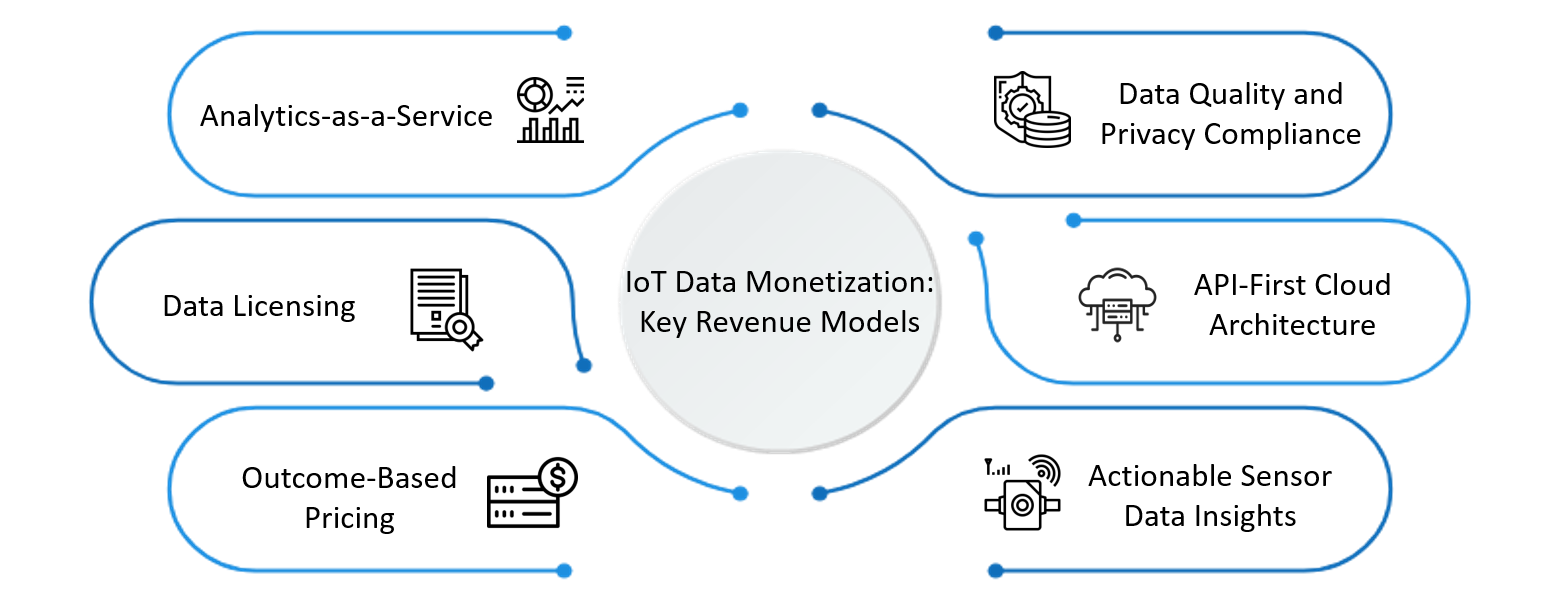
In short: IoT data monetization is moving from theoretical possibility to a real, measurable revenue line for companies with the data quality, integration, and privacy-compliance fundamentals in place, common models include analytics-as-a-service subscriptions, data licensing to third parties, and outcome-based pricing tied to the value the data enables, but companies that try to monetize data before those fundamentals are solid, or before genuinely validating that their specific data has real value to a specific buyer, consistently waste effort chasing a revenue line their data isn't actually ready to support.
Why IoT Data Monetization Is Moving From Theory to Real Revenue Line
IoT data monetization has been discussed as a future opportunity for long enough that it's worth being specific about what's actually changed to make it a present-tense revenue line rather than a slide-deck aspiration. Data volume and history have matured, companies with several years of accumulated device telemetry now have genuinely valuable historical datasets that a newly-deployed competitor can't replicate quickly. Buyer sophistication has grown too, industrial and enterprise customers increasingly understand what value operational data can deliver and are willing to pay for analytics and insight rather than treating it as a free add-on to hardware they already purchased. And the tooling for actually delivering data products, analytics dashboards, APIs, data pipelines, has matured enough that building a genuine data product no longer requires the kind of bespoke infrastructure investment it once did.
Common Models: Analytics-as-a-Service, Data Licensing, Outcome-Based Pricing
Three models recur across companies successfully monetizing IoT data today. Analytics-as-a-service packages a company's own processed insights, dashboards, reports, alerts derived from device data, as a subscription product sold to the same customers who bought the underlying hardware, monetizing the ongoing value of the data stream rather than only the one-time hardware sale. Data licensing takes a different path, selling access to raw or lightly processed data itself to third parties, market researchers, insurers, downstream service providers, who have their own use for it, a model that works best when a company's device fleet generates data with genuine third-party value beyond the company's own product ecosystem. And outcome-based pricing ties revenue directly to a measurable business outcome the data enables, reduced downtime, optimized energy consumption, improved yield, shifting the pricing conversation from data or analytics access toward the tangible business result the customer actually cares about.
Technical Prerequisites: Data Quality, Integration, Privacy Compliance
None of these monetization models work without solid technical fundamentals in place first. Data quality has to be genuinely reliable, consistent sampling, proper calibration, and effective handling of missing or erroneous readings, since a buyer paying for data or insights quickly loses trust in a product with visible data-quality problems, and that trust is difficult to rebuild once lost. Integration capability matters just as much, a customer paying for analytics or data access expects it to fit into their existing business intelligence and operational tooling rather than requiring them to adopt an entirely separate, isolated dashboard. And privacy compliance, particularly for any data with a personal or sensitive dimension, has to be built into the data architecture from the start, since a monetization strategy that runs into regulatory trouble or damages customer trust over privacy handling can undo the entire business case built around it.
Where This Intersects With Cloud Platform Architecture Decisions
A company's underlying cloud platform architecture decisions, made often years before data monetization became an active business goal, directly shape what monetization models are realistically achievable later. A data pipeline architected only for the company's own internal dashboard needs, without the multi-tenant access controls, API infrastructure, or data-export capability a licensing or analytics-as-a-service product requires, often needs significant retrofitting before it can support external-facing data products at all. Companies that anticipate data monetization as a future possibility, even before committing to a specific model, and architect their cloud platform with API-first design and clean data-access boundaries from the start, consistently find the eventual transition to an active data-monetization business far less disruptive than companies retrofitting that capability onto an internally-focused architecture under time pressure.
Common Mistakes Companies Make Trying to Monetize Data Too Early
The most common mistake is pursuing a data-monetization strategy before the underlying data quality and volume genuinely support it, launching an analytics product on top of data too sparse, too inconsistent, or too recently collected to deliver real insight, which damages customer trust in the broader product rather than building a credible new revenue stream. A closely related mistake is assuming a monetization model works simply because it worked for a different company in a different market, without first validating that the company's own specific data actually has comparable third-party or analytics value. And a frequent structural mistake is treating data monetization as a marketing or business-development initiative layered onto an unchanged technical architecture, rather than recognizing that a genuine data product usually requires real engineering investment in data quality, integration, and API infrastructure to become something an outside buyer will actually pay for.
Sensor Data Analytics Services: What Underpins a Credible Data Product
Whatever monetization model a company pursues, credible sensor data analytics services underneath it, reliable data pipelines, meaningful signal processing and feature extraction from raw sensor streams, and analytics that surface genuinely actionable insight rather than raw data dumps, are what actually make a customer willing to pay. A data-monetization strategy built on top of weak underlying analytics capability tends to be judged by its output quality regardless of how the business model itself is structured, making investment in the analytics layer itself, not just the go-to-market wrapper around it, a genuine prerequisite for any of the three monetization models to succeed commercially.
IoT Data Analytics for Smart Manufacturing: A Mature Proof Point
IoT data analytics for smart manufacturing is one of the more mature proof points for data monetization done well, where sensor data from industrial equipment increasingly gets packaged as predictive-maintenance and process-optimization analytics sold as a distinct subscription alongside the underlying equipment or sensor hardware, with customers demonstrably willing to pay for the operational value that analytics delivers, reduced downtime, better yield, more efficient energy use, separate from what they paid for the sensing hardware itself. This manufacturing-sector maturity offers a useful reference model for companies in other IoT verticals evaluating whether their own device data could support a similar transition from bundled feature to standalone revenue line.
How to Evaluate Whether Your Product's Data Has Real Monetization Potential
A grounded evaluation starts with concrete, specific questions rather than general optimism about data's inherent value: does the company have enough historical data volume and quality to support meaningful analytics or a credible dataset for licensing; is there an identifiable buyer, internal customer or external third party, with a demonstrated willingness to pay for that specific data or the insight derived from it; and does the current cloud architecture support delivering a data product without prohibitively expensive retrofitting. A company that can answer all three affirmatively has a real basis for pursuing IoT data monetization turning sensor data into revenue; a company that can't should treat those gaps as the actual roadmap items to address before committing further business strategy to a monetization plan the underlying data and architecture aren't yet ready to support.
Analytics-as-a-Service Business Models for IoT Data: Getting the Packaging Right
This packaging model succeeds or fails as much on pricing as on underlying data quality, tiering access to more advanced analytics or longer historical retention, integrating cleanly with the systems a business customer already uses, and pricing against the demonstrated business value delivered rather than an arbitrary per-device or per-seat rate, are the packaging decisions that determine whether a technically sound analytics product actually converts into sustained subscription revenue.
Embien's Capabilities
Embien brings IoT data pipeline and analytics architecture experience spanning sensor data acquisition, cloud platform design, and API-first architecture that keeps future data-monetization paths open rather than closed off by early architecture decisions. Our engineering process evaluates data quality, integration, and privacy-compliance fundamentals as the real prerequisites for a data-monetization strategy, not an afterthought to a business plan built independently of the underlying technical architecture.
To discuss IoT data analytics and visualization for businesses or evaluating a product's real data-monetization potential, reach out to Embien's engineering team. Every model covered here ultimately depends on the same foundation: credible IoT data analytics and visualization for businesses built on data the company can actually stand behind.