
Introduction
Managing a pilot fleet of a few dozen or a few hundred IoT devices and managing tens of thousands of them in the field are entirely different engineering problems, not the same problem at a bigger number. An IoT device management platform that works comfortably for a pilot deployment routinely breaks down, in provisioning throughput, update reliability, monitoring signal-to-noise, and operating cost, well before it reaches the scale a genuinely successful IoT product needs to support, and the gap between those two regimes is where a surprising number of otherwise well-engineered IoT products run into their first serious operational crisis.
In short: what works at small scale, manual provisioning steps, simple all-at-once OTA rollouts, alerting on every anomaly, breaks down predictably past a few thousand devices, and the fix is architectural: automated zero-touch provisioning and identity management, staged and monitored OTA rollout strategies, alerting designed around aggregate fleet health rather than per-device noise, and cost models evaluated explicitly as device count grows, all ideally designed in from the start rather than retrofitted once the fleet has already outgrown its original architecture.
What Works at Small Scale That Breaks Past a Few Thousand Devices
A pilot-scale IoT deployment can get away with practices that simply don't survive fleet growth. Manual or semi-manual device provisioning, an engineer walking through a checklist for each new device, works fine for tens of units and becomes an operational bottleneck well before reaching a few thousand. Pushing firmware updates to the entire fleet simultaneously is manageable, even if risky, at small scale, where a bad update affects a handful of easily-reachable devices, but becomes a genuine business risk at scale, where a bad update to an entire fleet of field-deployed devices can mean a costly, slow, device-by-device recovery. And alerting on every individual device anomaly is useful signal at small scale and becomes an unusable flood of noise once the fleet crosses into the thousands, burying the alerts that actually matter under the ones that don't. Recognizing which small-scale practices won't survive fleet growth, before they fail in production, is the first step toward designing for scale deliberately.
Fleet Provisioning and Identity Management at Scale
Provisioning tens of thousands of devices requires an automated, zero-touch onboarding process, where a device can securely establish its identity and register itself into the fleet management system with no manual per-device configuration step, typically through a factory-provisioned cryptographic identity and a device-initiated registration flow rather than a centrally pushed configuration. Identity management at this scale also has to handle device lifecycle events, decommissioning, replacement, credential rotation, as first-class, automatable operations rather than manual exceptions, since manual handling of even a small percentage of lifecycle events becomes a substantial ongoing operational burden once the fleet is large enough.
OTA Update Rollout Strategies That Avoid Fleet-Wide Failures
Staged rollout is the core discipline that separates a resilient OTA update strategy from one waiting to cause a fleet-wide incident: pushing an update to a small canary group first, monitoring for failures or unexpected behavior, and only expanding to progressively larger rings of the fleet once the update has proven itself, rather than pushing to every device at once. A robust rollback mechanism, letting an affected device or group of devices revert to a known-good firmware version automatically on update failure, is equally essential, since even a well-tested update can behave unexpectedly against real-world device and network conditions a test environment didn't fully replicate. Bandwidth and timing considerations matter too at scale, staggering update delivery across the fleet to avoid simultaneously overwhelming network and server infrastructure that a smaller pilot fleet's update traffic never stressed.
Monitoring and Alerting Design for Large, Heterogeneous Fleets
Monitoring at fleet scale has to shift from per-device visibility to aggregate fleet-health metrics, tracking the percentage of devices reporting a given error condition or falling outside expected operating parameters, rather than generating an individual alert for every device that deviates slightly from baseline. Effective alerting design at scale sets thresholds against the fleet's aggregate behavior, alerting meaningfully when 5% of devices in a fleet segment show a specific fault pattern, for instance, rather than alerting individually on every device that shows it, preserving the operational team's ability to distinguish a systemic issue worth immediate attention from expected, low-level device variance. Fleet heterogeneity, different hardware revisions, firmware versions, and deployment environments coexisting simultaneously, adds real complexity here, since monitoring thresholds and expected-behavior baselines often need to account for that heterogeneity rather than assuming a uniform fleet.
Cost Management as Device Count Grows
Per-device operating costs that look negligible in a pilot deployment, cloud connectivity and data transfer costs, device management platform licensing, cellular data plans, compound into a substantial ongoing operating expense once multiplied across tens of thousands of devices, and a cost structure that wasn't evaluated explicitly at scale during architecture decisions can turn a technically successful IoT product into a financially unsustainable one. Evaluating data transfer patterns for unnecessary volume, choosing a device management platform's pricing model against realistic fleet-size projections rather than pilot-scale usage, and considering edge-side data aggregation and filtering to reduce the volume of data actually transmitted to the cloud are the recurring levers that keep per-device operating cost sustainable as fleet size scales up by orders of magnitude.
Edge Device Management: Handling Intelligence and Decisions Closer to the Device
Edge device management becomes increasingly important as fleet scale grows, since pushing more processing, filtering, and even some decision-making to the edge device itself, rather than relying entirely on centralized cloud processing for every data point, reduces both the bandwidth and the centralized compute load that scale with fleet size. This shift also changes what "management" means at the edge: configuration and policy updates, local anomaly detection thresholds, and edge-side data aggregation rules all need to be managed and updated remotely across the fleet with the same rigor as firmware itself, rather than being set once at deployment and left static for the device's field life.
Practical Architecture Patterns That Scale From Day One
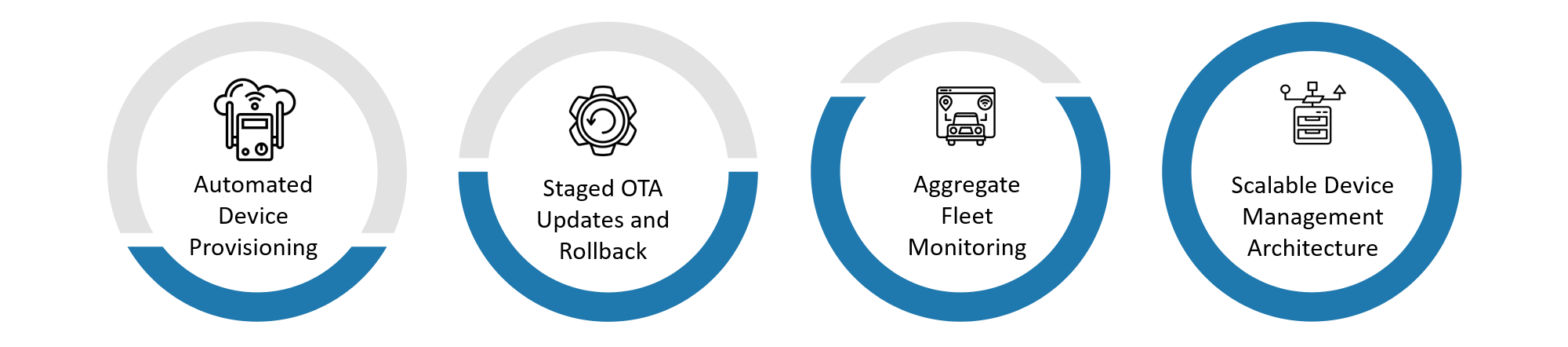
Products that handle scale gracefully consistently share a few architectural choices made early, well before the fleet actually reached a scale where they became necessary. Designing the provisioning and identity system for automation from the first deployed device, rather than manual processes intended to be automated "later," avoids a costly mid-flight migration. Building staged rollout and rollback capability into the OTA system from its initial version, rather than adding it after a fleet-wide update incident forces the issue, avoids learning that lesson the expensive way. And designing telemetry and monitoring around aggregate fleet metrics from the start, rather than per-device dashboards that don't scale conceptually past a few hundred devices, keeps the operational team's visibility usable as the fleet grows rather than requiring a monitoring redesign under production pressure.
Custom IoT Device Management Platform: Build, Extend, or Buy
Whether to adopt a commercial IoT device management platform, extend an existing one, or build a fully custom IoT device management platform in-house is a real decision most fleet-scale IoT products eventually face, and the right answer depends heavily on how closely the product's specific provisioning, update, and monitoring requirements match what a commercial platform assumes. A commercial platform usually wins on time-to-market and reduces the operational burden of building fleet-management infrastructure from scratch, while a custom platform wins when the product's specific device heterogeneity, connectivity constraints, or integration requirements don't fit a commercial platform's assumptions well enough to avoid expensive workarounds, making this evaluation worth doing explicitly and early rather than defaulting to whichever option the team happens to be more familiar with.
How Can IoT Device Management Improve My Business? Beyond Just Keeping the Lights On
The answer goes beyond simply avoiding the failure modes covered above. A device management platform that scales well also becomes a genuine business asset: faster, safer feature rollout through reliable OTA infrastructure, better product insight through aggregate fleet telemetry that reveals real-world usage patterns a pilot deployment never surfaces, and materially lower per-device operating cost that directly improves unit economics as the fleet scales, all outcomes a fragile, small-scale-only device management approach forecloses on by design.
IoT Device Management at Scale for 10,000+ Connected Devices: The Core Lesson
IoT device management at scale for 10,000+ connected devices ultimately comes down to one consistent theme running through every section above: practices that work by manual effort and individual attention at small scale need to become automated, aggregate, and staged well before the fleet reaches the size where manual approaches genuinely stop working, and the products that handle this transition smoothly are the ones that designed for it from day one rather than discovering the breaking point in production.
Embien's Capabilities
Embien brings IoT fleet architecture experience spanning zero-touch provisioning, staged OTA rollout design, and edge-to-cloud device management for large, heterogeneous connected device fleets. Our engineering process evaluates provisioning, update, and monitoring architecture against realistic fleet-scale projections rather than pilot-deployment assumptions from the earliest design decisions.
To discuss IoT device management platform architecture or scaling an existing fleet management approach for a growing connected product, reach out to Embien's engineering team.