
Introduction
MQTT and OPC UA both show up on nearly every industrial IoT architecture diagram, and that's precisely why they get confused for competitors when they're usually better understood as complementary. Choosing an IIoT protocol. isn't really a single decision, it's two related decisions: what transport moves data efficiently from the edge to the cloud, and what data model gives that data meaning and context once it arrives. MQTT was built to answer the first question well; OPC UA was built to answer the second, and increasingly, both. Choosing an IIoT protocol. is a decision worth slowing down for, because the transport and data-modeling choices made early in a program are expensive to unwind once dozens of field devices and edge gateways are already deployed against them.
In short: MQTT is a lightweight publish-subscribe messaging transport optimized for constrained devices and unreliable networks, while OPC UA is a richer standard that defines both a semantic information model and, since OPC UA Pub/Sub was introduced, its own transport options including MQTT itself, meaning the real choice for most industrial IoT deployments is less MQTT-versus-OPC-UA and more how to combine OPC UA's structured data model with MQTT's lightweight transport where each fits best.
MQTT: What It Was Actually Designed to Do
MQTT (Message Queuing Telemetry Transport) was designed from the outset for constrained devices, low bandwidth, unreliable connectivity, publishing telemetry over a broker-mediated publish-subscribe model. A device publishes a message to a topic; a broker distributes it to every subscriber interested in that topic, decoupling publishers and subscribers so they don't need to know about each other directly. MQTT's payload is opaque, a byte string, typically JSON or a binary encoding, with no built-in semantic structure defining what that payload means. This is MQTT's core strength and its core limitation simultaneously: minimal transport overhead makes it ideal for battery-powered sensors and cellular-connected field devices, but without an agreed payload schema, two systems exchanging MQTT messages have to separately agree on what the data actually represents.
OPC UA: What It Adds Beyond Transport
OPC UA (Open Platform Communications Unified Architecture) was designed to solve a different problem: giving industrial data a standardized, machine-readable meaning, not just moving bytes from one place to another. An OPC UA server exposes an information model, a structured, browsable address space describing devices, variables, methods, and their relationships, in a form any OPC UA client can discover and interpret without prior out-of-band agreement on data format. Where two MQTT-connected systems need a separately agreed schema to understand each other's payloads, an OPC UA client can query a server's information model directly and understand what a given data point represents, its units, its data type, and its relationship to other elements in the system. This built-in semantic self-description is what distinguishes OPC UA from a pure transport protocol like MQTT.
OPC UA Companion Specifications: The Layer That Makes Interoperability Real
OPC UA companion specifications extend OPC UA's generic information modeling capability into standardized, industry-specific data models: for CNC machines, for robotics, for packaging equipment, for specific process industries, defining exactly what variables and structures a device of that type should expose. Without a companion specification, two vendors' OPC UA implementations can technically interoperate at the protocol level while still describing equivalent equipment in incompatible ways. This solves the problem by standardizing not just the mechanism for exposing an information model, but the actual content of that model for specific equipment categories, which is what enables genuine plug-and-play interoperability between different vendors' machines on a factory floor, not just protocol-level connectivity between them.
Security Architecture: A Meaningful Point of Difference
Security is one area where the two protocols differ in a way that matters directly to an architecture decision. OPC UA was designed with security built into the specification from the start, message signing, encryption, and certificate-based authentication are native, standardized parts of the protocol. MQTT's core specification is comparatively minimal on security, TLS transport encryption and username/password or certificate-based broker authentication are common in practice, but they're implementation choices layered on top of MQTT rather than an integral part of the specification itself the way OPC UA's security model is. This doesn't make MQTT insecure in practice, well-implemented MQTT deployments with TLS and proper broker authentication are widely used in production, but it does mean security architecture requires more deliberate implementation decisions with MQTT than with OPC UA's more prescriptive built-in model.
Industrial Protocols and Factory Modernization: Where Each Fits in a Modern Architecture
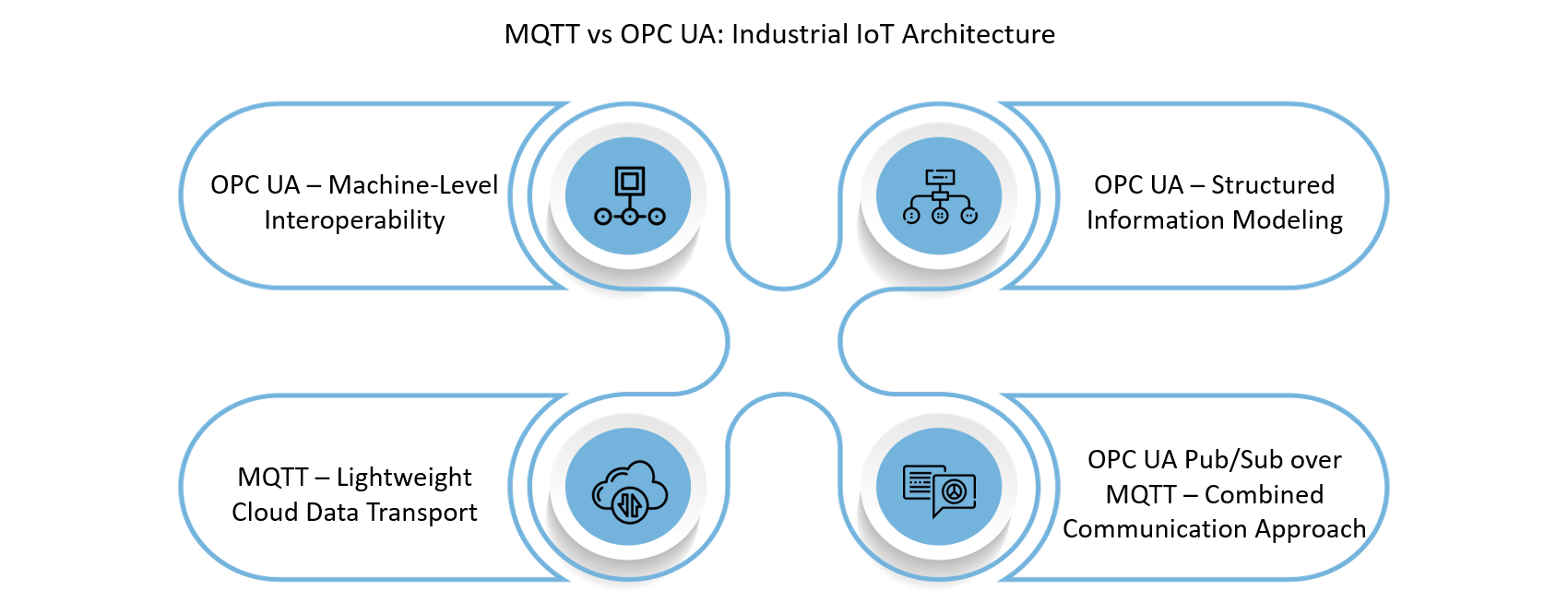
Industrial protocols and factory modernization initiatives today typically combine both protocols rather than choosing one exclusively. A common and increasingly standard pattern uses OPC UA at the machine and line level, where its rich information model and companion specifications let equipment from different vendors describe themselves consistently, and MQTT, often via OPC UA's own Pub/Sub transport binding, to carry that structured data efficiently up to cloud or enterprise systems across constrained or higher-latency network links. This layered approach captures OPC UA's semantic richness at the point where equipment interoperability matters most, and MQTT's lightweight efficiency at the point where bandwidth and connectivity constraints matter most, rather than forcing a single protocol to do both jobs adequately instead of either job well. Choosing an IIoT protocol. in this layered sense means picking the right tool for each layer of the architecture rather than picking one protocol to govern the whole stack.
Bridging Legacy Fieldbus Traffic: Practical Considerations
Industrial protocol integration work in a brownfield factory environment rarely starts from a clean slate, most factories already run a mix of fieldbus protocols, Modbus, Profinet, EtherCAT, alongside whatever IIoT layer is being added, and the integration architecture has to bridge these legacy protocols into whichever combination of MQTT and OPC UA the modernization plan calls for. Protocol gateways and edge devices that translate legacy fieldbus traffic into OPC UA's information model, or publish it directly as MQTT telemetry, are frequently the pragmatic answer, letting existing equipment participate in a modern IIoT architecture without a wholesale and often cost-prohibitive replacement of field-level hardware.
A Practical Decision Framework for the Two Protocols
A practical MQTT vs OPC UA protocol comparison for industrial IoT decision comes down to a few concrete questions rather than an abstract preference for one protocol over the other. Does the deployment need genuine cross-vendor equipment interoperability with self-describing data, lean toward OPC UA, ideally with an applicable companion specification. Is the primary requirement moving telemetry efficiently from many constrained, possibly cellular-connected field devices, lean toward MQTT. Does the architecture need both, structured, interoperable data at the machine level and efficient long-haul transport to the cloud, the OPC UA Pub/Sub over MQTT combination is specifically designed to deliver both without forcing a tradeoff between them.
Embien's Capabilities
Embien brings industrial protocol engineering experience spanning OPC UA information model design, MQTT-based telemetry architecture, and protocol gateway development bridging legacy fieldbus protocols into modern IIoT platforms. Our engineering process evaluates protocol architecture against the specific interoperability, bandwidth, and security requirements a factory modernization program actually needs, whatever the answer to choosing an IIoT protocol. turns out to be for that specific deployment.
To discuss protocol architecture for a factory modernization program, reach out to Embien's engineering team.