
Introduction
Ask a plant manager about IT-OT convergence and you'll usually hear about the operational upside, real-time production data flowing into MES and ERP systems, predictive maintenance driven by machine telemetry, remote monitoring replacing manual rounds. Ask a security team the same question and the tone shifts noticeably, because every one of those integration benefits also opens a path between IT networks that face the public internet daily and OT networks that were, for decades, designed with the working assumption that nothing outside the plant floor could ever reach them. IT-OT integration services done well close this gap deliberately; done as an afterthought, they're how a phishing email that compromises an office laptop ends up with a path to a programmable logic controller.
In short: why IT-OT convergence is a security risk not just a compliance checkbox comes down to a mismatch in how the two domains were designed: IT networks assume connectivity and defend against it with mature, continuously updated security tooling, while OT networks assume isolation and were never built with that same continuous security posture in mind, and simply satisfying a compliance framework's documentation requirements doesn't close that underlying architectural gap.
Why This Gap Exists: Two Networks Designed Under Opposite Assumptions
IT infrastructure has spent decades evolving under the assumption that it will face constant external threats, patched continuously, monitored actively, defended by a mature ecosystem of endpoint protection, network security, and threat intelligence tooling. OT infrastructure evolved under close to the opposite assumption: many PLCs, HMIs, and industrial controllers still in service today were designed and deployed when air-gapped isolation from any external network was the default security model, meaning security features taken for granted in IT, regular patching, strong authentication, encrypted communication, were often never built in at all because the threat model didn't call for them. IT-OT convergence connects these two environments, but connecting them doesn't automatically reconcile the security assumptions each was built around, and that reconciliation gap is exactly where the blind spot lives.
Industrial OEMs IT-OT Solutions: Where Real Deployments Get This Wrong
Industrial OEMs IT-OT solutions frequently get this gap wrong in a specific, recurring way: connectivity gets added to enable a genuinely valuable capability, remote diagnostics, cloud-based analytics, predictive maintenance, without a corresponding investment in network segmentation, monitoring, or access control for the OT side of that new connection. A gateway device added specifically to bridge OT data to a cloud analytics platform, if deployed with default credentials, unencrypted communication, or a flat network architecture that gives it unrestricted reach into the broader OT network, can become exactly the kind of foothold an attacker needs, not because the OEM's core automation product was insecure, but because the connectivity layer added around it wasn't designed with the same security rigor. This pattern is common enough that it deserves to be treated as a predictable risk to design against, not a rare edge case.
The Compliance Checkbox Trap
Many manufacturing organizations approach IT-OT security primarily through the lens of whatever compliance framework applies to their industry, and treat a completed audit or certification as evidence the security gap has been closed. This is precisely where the distinction between real security and paperwork security becomes critical: a compliance framework typically verifies that specific documented controls exist and specific processes are followed, but it doesn't guarantee that the underlying network architecture, segmentation, and monitoring are actually sufficient against a determined, adaptive attacker. An organization can pass a compliance audit while still running a largely flat network where a compromised IT endpoint has an unobstructed path to safety-critical OT systems, because the audit checked for the presence of a segmentation policy document without necessarily verifying the segmentation was implemented as thoroughly as the document describes.
Holistic Security: What Actually Closing the Gap Requires
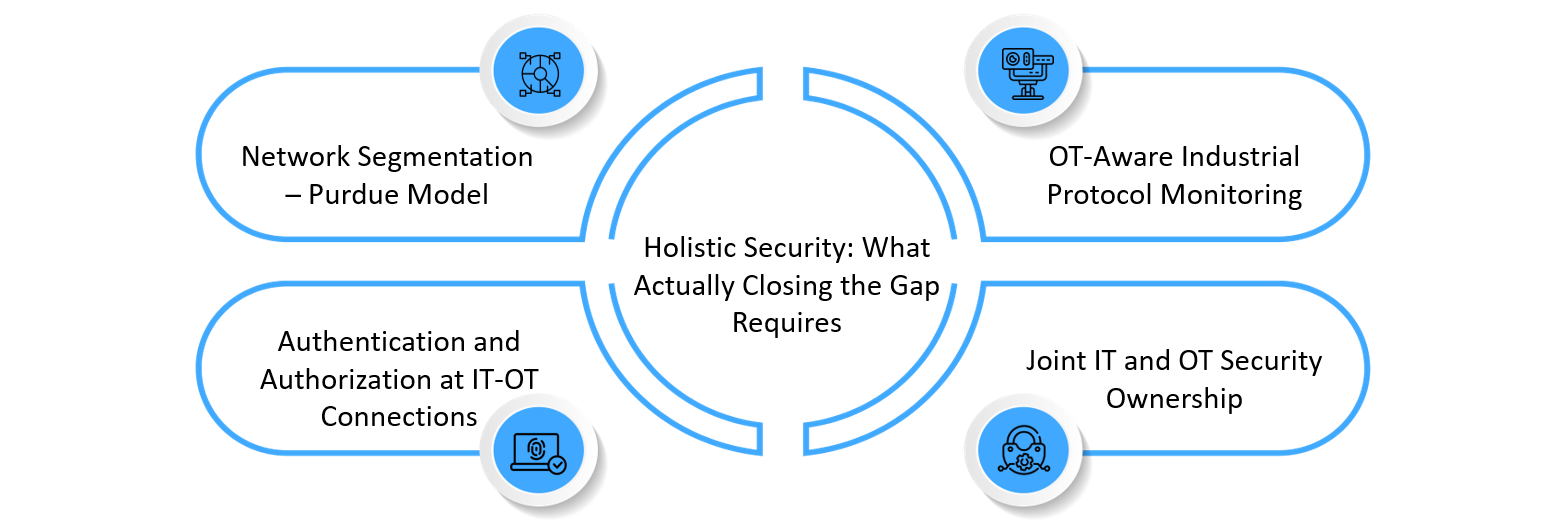
Holistic security for IT-OT convergence means treating the connected IT-OT environment as a single security domain to be architected and monitored coherently, rather than as two separately secured domains joined by a connection that itself goes unmonitored. In practice this means network segmentation enforced with real technical controls, not just policy, following a layered architecture like the Purdue Model rather than a flat network; OT-aware monitoring that can detect anomalous behavior in industrial protocols rather than relying solely on IT-style signature-based detection; and access control that treats every IT-to-OT connection point as a security boundary requiring authentication and authorization, not an internal, implicitly trusted link. This also means security ownership spanning both IT and OT teams jointly, since a gap that exists specifically at the seam between two domains can't be fully addressed by either team working in isolation from the other.
Where These Blind Spots Concentrate on the Plant Floor
IT-OT convergence security blind spots in manufacturing concentrate predictably at specific points: legacy OT equipment that can't support modern authentication or encryption but still needs some form of connectivity, third-party remote access provided to equipment vendors for maintenance and diagnostics, often outside the manufacturer's own monitored access control system, and shadow IT-OT connections, a plant engineer's well-intentioned but unofficial connection between a machine and the internet for easier remote access, that were never reviewed or approved by security teams at all. Mapping these specific blind spots explicitly, rather than assuming a general compliance-driven security program has implicitly covered them, is usually where a meaningful IT-OT security improvement program has to start.
Why This Blind Spot Persists Despite Growing Awareness
Awareness of IT-OT security risk has grown substantially across the manufacturing industry, yet the gap persists in large part because closing it well genuinely requires cross-functional investment, security budget and expertise applied specifically to OT environments, not just IT, and OT operations teams and security teams collaborating on decisions, like accepting brief production downtime for a security patch or segmentation change, that pit security priorities directly against production continuity priorities in ways IT security decisions rarely do as starkly. Organizations that treat IT-OT security purely as an IT initiative, without genuine OT operations buy-in and understanding of production constraints, consistently struggle to implement the segmentation and monitoring changes that would actually close the gap, regardless of how much security budget or executive attention the initiative otherwise receives.
How This Complements ISO 62443 and ISO 21434 Compliance Work
Organizations already working through ISO 62443 compliance for industrial control systems, or ISO 21434 for automotive-adjacent OT environments, have a real head start on closing this gap, since both standards' risk assessment and security-by-design principles directly address many of the same architectural weaknesses. But compliance work with either standard needs to be approached as a genuine security architecture exercise, closing the actual gap between IT and OT security postures, rather than a documentation exercise satisfying an auditor's checklist, for the resulting security posture to hold up against real-world attack patterns rather than just passing a scheduled compliance review.
Embien's Capabilities
Embien brings IT-OT integration engineering experience spanning secure gateway and edge device development, network segmentation architecture, and secure protocol implementation for industrial and manufacturing environments. Our engineering process treats IT-OT connectivity points as security boundaries requiring deliberate architecture from the start, not conveniences added without a corresponding security investment.
To discuss IT-OT integration services for a manufacturing environment, reach out to Embien's engineering team.