
Introduction
MISRA C first appeared in 1998, written for automotive embedded software, and more than a quarter-century later it remains the default coding standard referenced across nearly every safety-critical embedded C C++ programming effort, automotive, medical, industrial, aerospace, well beyond the automotive domain it was originally written for. That longevity isn't inertia, C's specific hazards, the ones MISRA C exists to eliminate, haven't changed since 1998, because they're inherent to the language itself, not artifacts of any particular era's coding practice.
In short: MISRA C coding rules explained for safety-critical embedded software come down to eliminating C's undefined and implementation-defined behavior, the language's most dangerous trait for safety-critical code, through a defined rule set that static analysis tooling can verify automatically, and MISRA compliance has become the practical, auditable way safety standards like ISO 26262 and IEC 62304 expect C code's reliability to be demonstrated.
What MISRA C Is and Who Created It, and Why
MISRA, the Motor Industry Software Reliability Association, published the first MISRA C guidelines in 1998 in direct response to a specific, recurring problem the UK automotive industry was seeing: safety-relevant embedded software written in C, chosen for its efficiency and hardware access, but exhibiting subtle bugs traceable directly to C's permissive, ambiguous language semantics. Rather than proposing a new, safer language, which would have meant abandoning decades of tooling, compiler support, and engineering experience with C, MISRA took the more practical path of defining a restricted subset of the C language, a set of rules identifying which C constructs are safe to use freely, which are outright banned, and which require documented justification when used. Later revisions, MISRA C:2004, MISRA C:2012, and its subsequent amendments, have kept the guideline current against evolving C standards and hard-won lessons from real safety-critical software failures, but the core mission, eliminating C's most dangerous ambiguities, has remained constant since 1998.
The Kinds of Undefined Behavior Embedded C C++ Programming Has to Guard Against
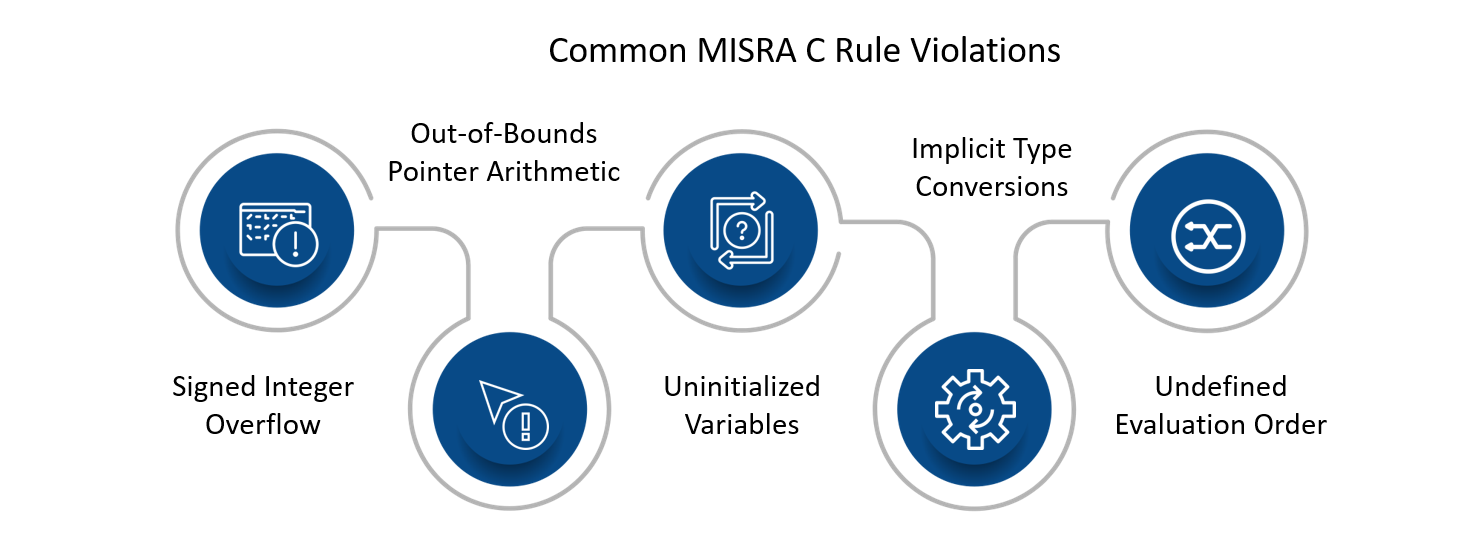
C's specification leaves a surprising amount of behavior undefined or implementation-defined by design, decisions deliberately left to the compiler for performance and portability reasons that become a serious liability in safety-critical code. Signed integer overflow, pointer arithmetic that goes out of bounds, reading an uninitialized variable, the order of evaluation for function arguments and certain expressions, and implicit type conversions that silently truncate or reinterpret data are all classic examples where two different compilers, or even the same compiler with different optimization settings, can produce genuinely different runtime behavior from identical source code. MISRA C's rules target exactly these constructs, banning or tightly constraining the code patterns most likely to trigger undefined behavior, so that a program's actual runtime behavior can be reasoned about and verified rather than left to whatever a specific compiler happened to do with an ambiguous construct.
How MISRA Compliance Is Actually Checked: Static Analysis Tooling
MISRA C compliance isn't verified by manual code review alone, dozens of MISRA rules require exactly the kind of exhaustive, mechanical pattern-matching across an entire codebase that static analysis tools are built for and human reviewers reliably miss at scale. Commercial static analysis tools, along with several open-source options, scan source code against the complete MISRA rule set, flagging violations with the specific rule number and file location, and most safety-critical development workflows integrate this scanning directly into the continuous integration pipeline so a MISRA violation is caught the moment it's introduced rather than discovered during a pre-release compliance audit. Some MISRA rules are advisory rather than mandatory, and tooling typically distinguishes between violations that must be fixed and those that require a documented deviation with engineering justification when a genuine, well-understood exception applies.
Common Pain Points Teams Hit Adopting MISRA C on Existing Codebases
Retrofitting MISRA C compliance onto an existing, previously unconstrained C codebase is where teams most often underestimate the effort involved. A mature codebase written without MISRA discipline from the start frequently contains thousands of violations once first scanned, many trivial to fix, but some reflecting genuinely useful patterns, certain pointer idioms, specific type conversions, that MISRA restricts and that require real refactoring rather than a mechanical find-and-replace. Teams also commonly underestimate the deviation-documentation burden: every genuine, justified exception to a MISRA rule needs a documented rationale that a safety assessor can review, and accumulating that documentation for a large legacy codebase retroactively is meaningfully more work than establishing the same discipline in a new codebase from day one.
Where MISRA C Is Required vs Merely Best Practice
MISRA C compliance is an explicit, often contractually mandatory requirement in automotive software developed under ISO 26262, particularly at higher ASIL levels where deviation from MISRA rules faces meaningfully more scrutiny. Outside automotive, MISRA C compliance is frequently adopted as best practice, and sometimes explicitly required, in medical device software governed by IEC 62304, industrial control systems following IEC 61508, and aerospace software, even where the specific safety standard doesn't name MISRA C directly, because MISRA compliance is a well-understood, auditable way to demonstrate the coding discipline those standards' broader software quality requirements call for. Even in non-safety-critical embedded projects, many organizations adopt MISRA C, or a subset of its rules, simply because the underlying discipline it enforces produces more reliable C code generally, not only in contexts where a regulator requires it.
C++ Programming for Embedded Software: Where MISRA C++ Fits
C++ programming for embedded software has its own parallel guideline, MISRA C++, addressing C++'s additional language features, templates, exceptions, multiple inheritance, operator overloading, that introduce their own categories of undefined behavior and complexity beyond what MISRA C already addresses for C. Teams choosing C++ for safety-critical embedded work specifically to gain features like RAII resource management, strong typing, and object-oriented design need to apply MISRA C++'s rule set with the same discipline as MISRA C, since C++'s additional expressiveness comes with additional ways to introduce exactly the kind of subtle, compiler-dependent behavior MISRA guidelines exist to eliminate in the first place.
Balancing Modern C++ Features Against Deterministic Behavior
C++ programming for embedded systems more broadly involves a real tension safety-critical teams have to navigate deliberately: modern C++ features that improve code safety and expressiveness, strong typing, RAII, constexpr, often come with runtime cost or non-deterministic behavior, dynamic memory allocation, exception handling overhead, that safety-critical and real-time embedded code frequently can't accept. MISRA C++ compliant embedded development typically restricts or bans dynamic allocation after initialization, exceptions in favor of explicit error-code handling, and certain template patterns that complicate static analysis, accepting some of modern C++'s expressiveness benefits while still meeting the deterministic, analyzable behavior safety-critical firmware requires.
RAPIDSEA Embedded Application Development Suite: MISRA Compliance Built Into the Platform
Embien's RAPIDSEA embedded application development suite incorporates MISRA C compliant modules as a core design principle, giving teams building on it a foundation of pre-verified, MISRA-compliant firmware building blocks, protocol stacks, drivers, bootloader components, rather than requiring every project to independently establish and verify MISRA compliance from a blank codebase. This matters directly for program timelines: a team building safety-critical firmware on those modules starts from a codebase that's already cleared the static-analysis and deviation-documentation burden for its foundational components, rather than needing to absorb that entire compliance effort as new project overhead.
Embien's Capabilities
Embien brings MISRA C and MISRA C++ compliant embedded software development experience across automotive, medical, and industrial safety-critical programs, including the MISRA-compliant modules built into our development suite. Our engineering process integrates static analysis tooling into the development pipeline from the start, catching MISRA violations as code is written rather than during a pre-release compliance audit.
To discuss embedded C C++ programming practices or MISRA-compliant firmware development for a safety-critical program, reach out to Embien's engineering team. Our teams apply this same embedded C C++ programming discipline across every safety-critical domain we serve.