
Introduction
Most write-ups of industrial cybersecurity incidents focus on the attack itself, how the adversary got in, what vulnerability was exploited, which malware family was involved. Far less gets written about what a plant's operations and security teams actually did in the hours and days after detection, and that response phase is where industrial cybersecurity services earn their value most directly. OT cybersecurity incident response for industrial control systems is a distinct discipline from IT incident response, because a compromised control system can't simply be taken offline and reimaged the way a compromised office laptop can, physical processes, safety systems, and production continuity all have to be weighed in real time.
In short: industrial automation cybersecurity incident response has to account for OT's physical-process constraints from the start, isolating an affected system quickly matters, but not at the cost of triggering an unsafe process state, and the real-world attacks the industry has learned the most from, from Stuxnet to Ukraine's grid attacks to Colonial Pipeline, each reshaped how OT security teams think about detection, segmentation, and recovery.
Why Industrial Automation Cybersecurity Incident Response Differs From IT
An IT security team responding to a compromised server has a relatively clean playbook: isolate the host, preserve forensic evidence, reimage, and restore from backup, largely without physical-world consequences beyond service downtime. An OT security team responding to a compromised PLC or SCADA system doesn't have that luxury. Abruptly cutting power to a control system mid-process can itself cause a safety incident, physical damage to equipment, or a hazardous process excursion, sometimes worse than the cyber incident being responded to. This means every OT incident response action, isolating a segment, taking a controller offline, has to be evaluated jointly by security and operations personnel against the specific physical process it affects, a coordination requirement IT incident response simply doesn't carry to the same degree.
Lessons From Stuxnet: The Attack That Changed How OT Security Is Understood
Stuxnet, discovered in 2010, remains the reference point for what a sophisticated OT-targeted attack looks like: malware that specifically targeted Siemens PLCs controlling centrifuges, manipulating their operation while feeding falsified normal-operation data back to monitoring systems, so operators saw no indication anything was wrong until physical damage had already occurred. The incident's lasting lesson wasn't really about the specific vulnerability exploited, it was the demonstration that a control system could be actively deceived at the monitoring layer, meaning detection strategies that rely solely on trusting a control system's own reported status are fundamentally insufficient. This is a large part of why independent, out-of-band anomaly detection, monitoring for unusual behavior at the network or physical-process level rather than trusting the control system's self-reported state, became a core OT security design principle afterward.
Lessons From the Ukraine Grid Attacks: Coordinated, Multi-Stage Intrusion
The 2015 and 2016 attacks on Ukraine's power grid demonstrated a different lesson: a sophisticated adversary can combine IT-side intrusion, spear-phishing to gain initial access, with OT-specific knowledge, understanding exactly which breakers to open and how to disable operator visibility and remote recovery capability, to cause a real physical outage affecting hundreds of thousands of customers. The multi-stage nature of the attack, initial IT compromise, lateral movement into OT, and a carefully planned final action, underscored that OT incident response planning has to account for adversaries who've already achieved IT-side persistence well before the OT-visible impact occurs, meaning by the time an OT incident is detected, the adversary may have had access and been conducting reconnaissance for months.
Lessons From Colonial Pipeline: When IT-Side Caution Shuts Down OT Operations
The 2021 Colonial Pipeline ransomware incident offers a different and often misunderstood lesson: the ransomware itself infected IT systems, not the OT pipeline control systems directly, yet the company proactively shut down pipeline operations because it couldn't confirm with sufficient confidence that the IT compromise hadn't spread to, or wouldn't affect, OT billing and operational systems. This illustrates a scenario OT incident response plans need to explicitly cover: deciding whether and how to continue OT operations when the IT side of the business is compromised but OT itself appears uncompromised, a decision that depends heavily on how well-segmented IT and OT actually are, and how confidently that segmentation can be verified under incident-response time pressure.
Why the Industrial IoT Attack Surface Keeps Growing
Recent industrial IoT security examples increasingly involve the expanding number of network-connected sensors, gateways, and edge devices that industrial digitalization has introduced, each one a potential entry point that didn't exist in a traditional, air-gapped OT environment. A compromised industrial IoT sensor or gateway with weak authentication or an unpatched firmware vulnerability can serve as a foothold for lateral movement into more sensitive control-system segments, particularly in environments where IT-OT convergence has been pursued for operational efficiency without matching security architecture investment. This growing attack surface is precisely why incident response planning today has to explicitly cover the industrial IoT layer, not just traditional PLCs and SCADA systems, as a distinct and expanding category of potential compromise.
Detection: What Actually Works in OT Environments
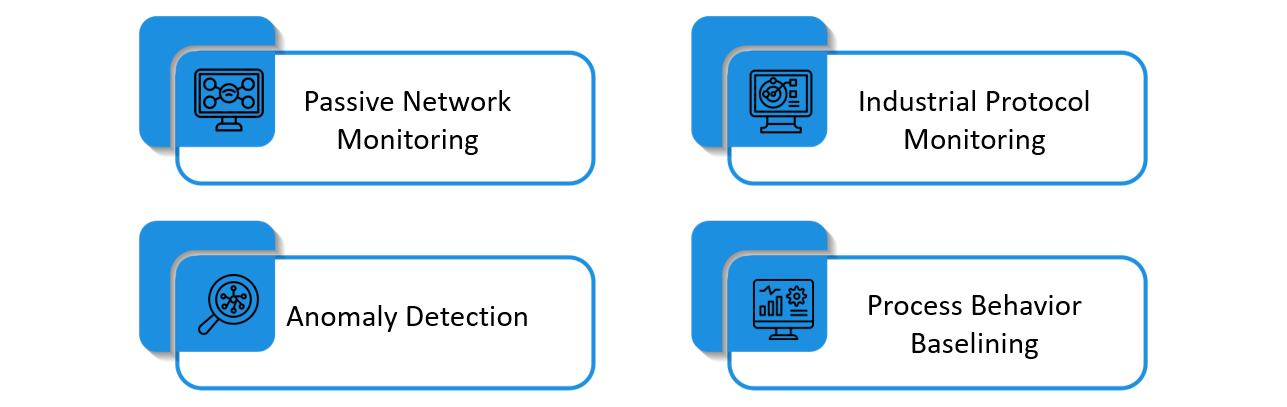
Effective OT threat detection differs from IT detection in what signal it relies on. Passive network monitoring tailored to industrial protocols, Modbus, DNP3, EtherNet/IP, that can flag anomalous command sequences or unexpected communication patterns without actively probing sensitive control systems, has become the preferred detection approach precisely because active scanning techniques common in IT security can themselves destabilize sensitive OT equipment. Baselining normal process behavior, expected command frequency, typical value ranges, normal communication patterns between specific devices, and alerting on deviations from that baseline catches many OT-specific attack patterns that signature-based detection, built primarily for IT malware, simply isn't designed to recognize.
Segmentation and Containment: The First Response Decision That Matters Most
Well-designed network segmentation between IT and OT, and between OT zones of differing criticality, following the Purdue Model's layered architecture, is what makes rapid, safe containment possible during an actual incident. An OT environment with strong segmentation gives responders the option to isolate an affected zone without shutting down the entire facility, exactly the containment flexibility Colonial Pipeline's less-segmented environment didn't provide with sufficient confidence. Organizations investing in segmentation before an incident occurs are making the single highest-leverage OT incident response investment available, because containment options during a live incident are fundamentally limited by whatever segmentation already exists, not by any recovery plan devised in the moment.
Recovery: Getting Back to Safe, Verified Operation
OT recovery carries a verification burden IT recovery doesn't face to the same degree: before returning a control system to production operation, teams need confidence that the system's control logic, configuration, and firmware haven't been subtly altered, not simply that malware has been removed. This often means restoring PLC logic and configuration from known-good, verified backups rather than trusting the currently-running configuration, and validating a controller's behavior against expected physical-process outcomes before resuming full production, a more rigorous bar than IT recovery's typical restore-and-monitor approach, because an undetected residual manipulation in OT can cause physical harm in a way a residual IT compromise typically doesn't.
Building an Industrial Cybersecurity (ICS) Incident Response Plan Before You Need One
Every lesson from Stuxnet, the Ukraine grid attacks, and Colonial Pipeline points to the same underlying conclusion: OT incident response has to be planned in advance, with operations and security stakeholders jointly defining segmentation, detection, and safe-containment procedures, rather than improvised during a live incident under safety and production pressure. Industrial cybersecurity (ICS) incident response plans that clearly define who decides to isolate a segment, what physical-process safety checks precede any containment action, and how control-system integrity gets verified before restoring operation, consistently perform better under real incident pressure than plans that exist only as generic, IT-derived incident response templates applied without OT-specific adaptation. Organizations pursuing IT-OT convergence for operational benefits need this incident response discipline built in from the start of that convergence effort, not added afterward once a security gap has already been exploited.
Embien's Capabilities
Embien brings industrial cybersecurity engineering experience spanning secure embedded firmware development, IT-OT convergence architecture, and secure protocol implementation for industrial control systems. Our engineering process treats network segmentation and OT-aware anomaly detection as foundational design requirements for connected industrial systems, not additions made after deployment.
To discuss industrial cybersecurity services or incident response architecture for an industrial control system deployment, reach out to Embien's engineering team.