
Introduction
Profinet and EtherCAT solve the same fundamental problem, deterministic, low-latency communication over standard Ethernet hardware for industrial automation, and both have earned dominant positions in different corners of the market, which is exactly why the choice between them causes more genuine debate than most industrial protocol decisions. Neither is a real-time Ethernet protocol that's simply better than the other in the abstract; each makes different architectural tradeoffs that suit different classes of automation applications. Getting this choice right at the start of a machine or line design matters, because switching real-time Ethernet protocols mid-program means requalifying device selection, network topology, and often significant portions of the control architecture.
In short: EtherCAT's processing-on-the-fly architecture and simple daisy-chain wiring make it the frequent choice for high-axis-count motion control and machine-level automation where minimizing cycle time and cabling complexity matters most, while Profinet's layered RT and IRT variants and broader device ecosystem make it the frequent choice for plant-wide automation spanning both time-critical and standard-IT-integrated communication needs, and the right choice depends on which of these priorities dominates a given application.
How EtherCAT Achieves Its Speed: Processing on the Fly
EtherCAT's defining architectural choice is processing data on the fly as an Ethernet frame passes through each slave device, rather than requiring each device to fully receive, process, and retransmit a frame before the next device can act on it. A single EtherCAT frame carries datagrams addressed to every slave in the network; each slave device extracts and inserts its data as the frame physically passes through it, at wire speed, without the frame ever needing to stop for local processing. This is what lets EtherCAT achieve sub-microsecond synchronization accuracy and extremely short cycle times, because the fundamental bottleneck other approaches face, per-device frame processing latency accumulating across the network, is largely eliminated by design.
Why EtherCAT's Frame Design Enables Its Speed
The frame structure of EtherCAT is what makes processing-on-the-fly possible in practice: a single standard Ethernet frame, identified by EtherType 0x88A4, carries multiple EtherCAT datagrams, each with its own command, address, length, and data fields, addressed to different slaves within one frame transmission. Because a single frame can carry commands and data for the entire network of slaves in one pass, the network doesn't need a separate frame exchange per device the way some other real-time Ethernet protocols require, directly contributing to EtherCAT's low overhead and short achievable cycle times. This frame structure, combined with EtherCAT's logical ring topology, a daisy-chained line that the master's frame traverses out and back, is also what eliminates the need for network switches at each node, removing another source of latency and cabling complexity that a star-topology network would otherwise carry.
How Profinet's Layered Approach Differs
Profinet takes a different architectural path, offering three distinct communication tiers rather than a single unified mechanism: standard Profinet running over conventional TCP/IP for non-time-critical communication, Profinet RT bypassing the TCP/IP stack at the lower layers for improved real-time performance suited to typical factory automation like PLC-to-drive communication, and Profinet IRT adding dedicated time slots and traffic scheduling for the most demanding motion-control applications, achieving cycle times in the range of 31.25 microseconds. This layered structure means a single Profinet network can, in principle, carry standard IT traffic, conventional automation traffic, and hard-real-time motion control traffic together, an integration flexibility EtherCAT's more singularly performance-focused architecture doesn't offer in quite the same way.
Matching Device Capability to Application Need
Profinet conformance classes, ranging from Class A through Class D, formalize this layered capability into standardized device categories: Class A devices support basic cyclic and acyclic communication suited to building and infrastructure automation, Class B targets factory and process automation, and Class C and D support isochronous, TSN-leveraging communication for the most demanding motion-control applications. Understanding this classification early in device selection matters because specifying a higher class than an application genuinely needs adds implementation cost and complexity without a corresponding performance benefit, while underspecifying it can leave a motion-control application without the deterministic timing it actually requires.
Topology and Wiring: A Practical Difference That Shapes Machine Design
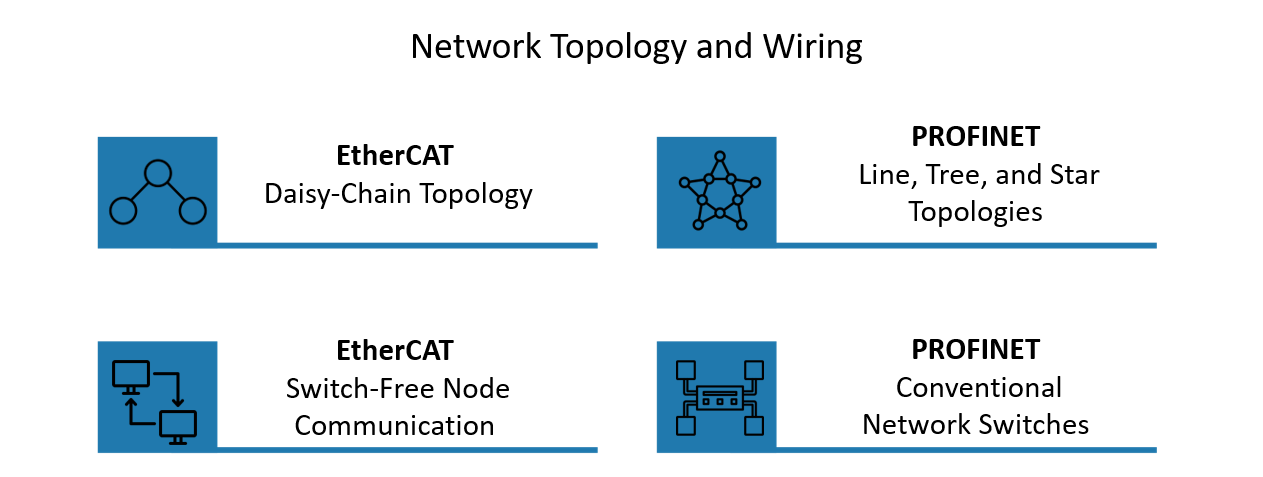
EtherCAT's daisy-chain topology, no switches required at any node, tends to simplify cabling for machines with many closely spaced axes or I/O points, a robot arm or a multi-axis CNC machine, for instance, where wiring each device directly back to a central switch would add real cost and complexity. Profinet's more flexible line, tree, and star topology support, enabled by its use of conventional network infrastructure including standard switches, tends to suit plant-wide automation spanning greater physical distances and more varied device types, where Profinet's IT-network-compatible infrastructure integrates more naturally with a facility's broader networking environment than EtherCAT's more specialized daisy-chain wiring typically does.
EtherCAT Development: What Engineering Teams Actually Need to Get Right
EtherCAT development work centers on master stack selection, open-source and commercial options exist with different real-time OS integration and determinism guarantees, and slave controller implementation, historically requiring dedicated ASICs or FPGAs for the processing-on-the-fly capability, though many modern industrial MCUs now integrate this functionality directly. Getting this right also means validating actual achieved cycle times and jitter under real network load and topology, not just the theoretical minimums the protocol's architecture makes possible, since real-world cable lengths, slave count, and data payload size all affect what cycle time a specific network configuration actually achieves in practice.
Profinet Development: Where the Engineering Effort Concentrates
Profinet development work concentrates on selecting the right combination of RT or IRT capability and conformance class for the application, configuring GSD (General Station Description) files correctly for device interoperability, and for IRT specifically, careful network topology planning since IRT's dedicated time-slot scheduling requires the network's physical topology to be known and configured in advance, a planning step EtherCAT's simpler daisy-chain approach doesn't require to the same degree. This work for applications spanning multiple conformance classes on one network also requires understanding how devices of different classes interoperate and where a network's overall real-time performance is bounded by its least capable participating device class.
Making the Choice: A Practical Framework
For new machine-level designs dominated by high-axis-count motion control, multi-axis robotics, CNC, packaging machinery with many synchronized servo drives, EtherCAT's cycle-time performance and simpler wiring typically make it the stronger default choice. For plant-wide automation architectures that need to span standard IT-style connectivity, conventional factory automation, and selectively, high-performance motion control within the same overall network infrastructure, Profinet's layered RT and IRT structure and broader ecosystem of devices across conformance classes often provides more architectural flexibility. Many facilities in practice run both, EtherCAT within individual high-performance machines and Profinet at the plant-wide integration level, rather than treating the choice as strictly either-or across an entire facility.
Embien's Capabilities
Embien's product engineering services support real-time Ethernet protocol development across both EtherCAT and Profinet, from master and slave stack selection through custom FPGA-based slave controller implementation where off-the-shelf devices don't meet an application's performance or I/O requirements. Our engineering process validates actual cycle time and determinism under real network topology and load, not just theoretical protocol capability.
To discuss real-time Ethernet protocol selection for an industrial automation program, reach out to Embien's engineering team.