
Thermal management in electronics design is a fundamental engineering discipline that engineers consistently underestimate. Research shows one in five engineers identify thermal issues as common causes of expensive late-stage design complications. Products that overheat, malfunction, or fail due to inadequate embedded thermal management solutions transform promising innovations into costly market failures.
This article covers one of the 7 modern sins of electronic product engineering and suggests ways to apply effective embedded thermal management solutions for a successful product realization.
Why thermal issues are often overlooked in electronics design
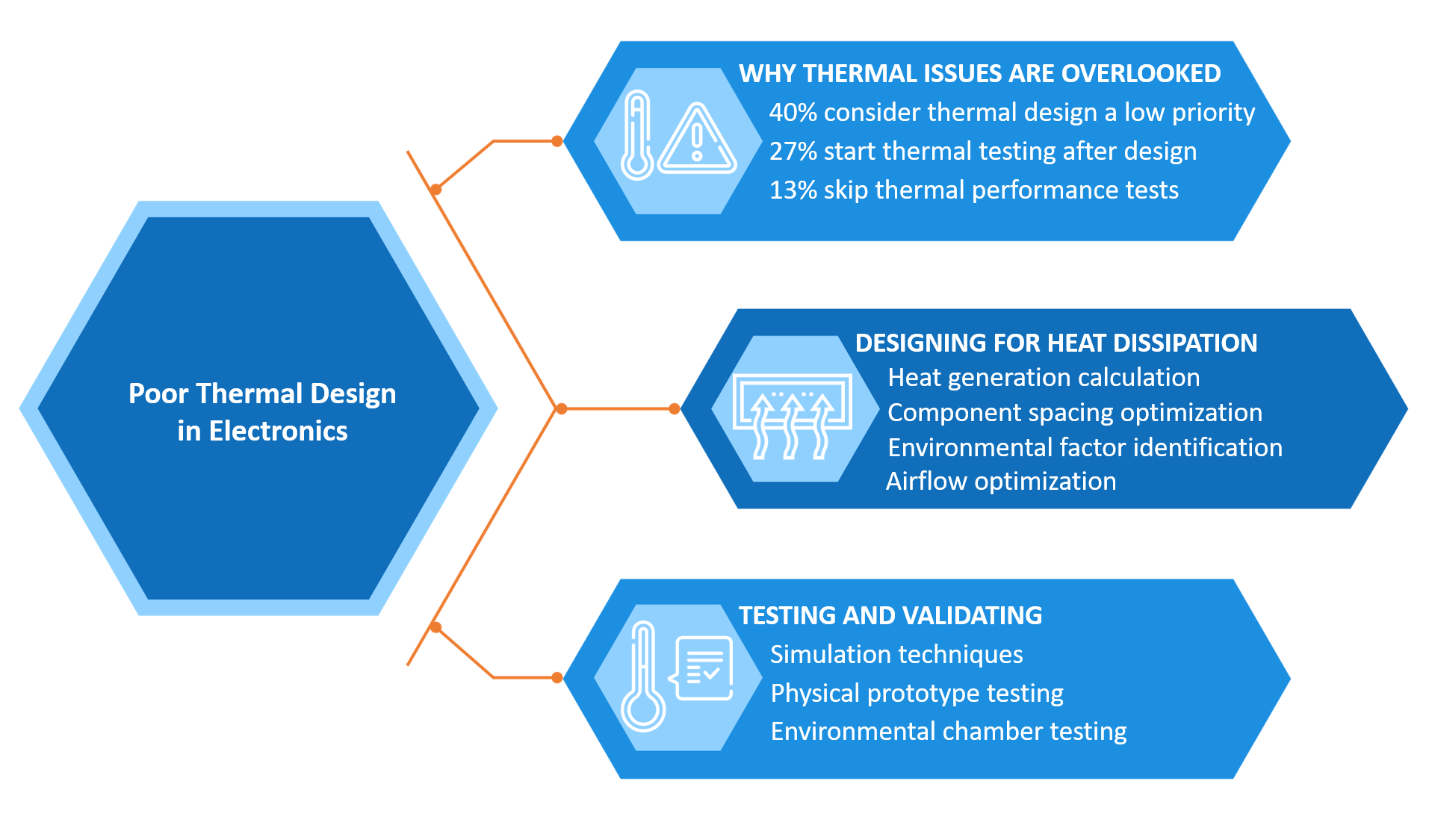
Proper thermal management in electronics design receives inadequate attention despite its direct impact on device performance. Currently, 40% of engineers consider thermal design a low priority during development. This perspective persists while inadequate embedded thermal management solutions directly affect device longevity, reliability, and operational performance.
Data reveals concerning patterns in thermal testing practices. Approximately 75% of designers fail to test thermal operation early enough in the design process. More specifically, 27% wait until design completion before conducting thermal tests, compounding potential problems. Most concerning, 13% of engineers skip thermal performance testing entirely—ignoring the need for electronics thermal failure prevention strategies.
Several misconceptions drive this neglect. Many engineers view thermal simulation for embedded hardware as overly complex and time-consuming—a perspective held by 40% of surveyed professionals. Others incorrectly assume "over-engineering" thermal aspects proves easier than proper optimization. Heat management becomes an afterthought until serious problems emerge.
Designing for heat dissipation with embedded thermal management solutions
Effective embedded thermal management solutions require understanding heat transfer fundamentals.
Consumer electronics primarily rely on convection and conduction for thermal transfer, though radiation becomes significant for products without active cooling or those exposed to direct sunlight. Proper thermal management in electronics design accounts for all three modes.
Successful thermal design follows a systematic approach:
- Heat generation calculation - Determining exact power generation and dissipation establishes the foundation for effective embedded thermal management solutions
- Environmental factor identification - External temperature conditions significantly impact thermal performance and require early consideration
- Component spacing optimization - Adequate spacing enables air circulation, while crowded designs trap heat and reduce cooling effectiveness
- Airflow optimization - Strategic airflow design prevents hotspots and ensures cooling air reaches all components
- Heat sink selection for PCB layout - Heat sinks require correct sizing and configuration for specific thermal loads; accurate heat sink selection for PCB layout is one of the most impactful decisions an engineer makes
Thermal challenges vary significantly across applications. A smart doorbell generating only 3 watts must manage both internal and environmental heat sources. PCB design critically impacts thermal management in electronics design—thick copper layers excel at current carrying but complicate repairs by wicking heat during soldering. Our cross-domain embedded expertise includes dedicated thermal analysis to address these nuances. For hardware-level thermal optimization, see also our Printed Circuit Board Design and fabrication capabilities.
Testing and validating thermal performance
Early thermal validation represents a crucial investment that prevents expensive late-stage problems and potential redesigns. Thermal simulation for embedded hardware should begin during early development with reduced-order models and first-principles calculations.
Mature designs require more sophisticated embedded thermal management solutions validation approaches:
- Thermal simulation for embedded hardware - Thermal simulations provide visual representations of temperature and airflow patterns inside equipment, enabling proactive electronics thermal failure prevention strategies
- Physical prototype testing - Real-world testing of physical components reveals actual thermal behavior and enables necessary adjustments
- Environmental chamber testing - Controlled temperature conditions verify performance across expected operating environments
Thermal testing requires ongoing attention rather than single-event validation. Initial screening tests cost significantly less than complete thermal certification, making early and frequent validation financially sound. This proactive approach to thermal management in electronics design ensures products maintain reliability and safety throughout their operational lifespan.
Conclusion
Addressing thermal considerations early and thoroughly enables product engineers to create devices that perform reliably under challenging conditions. Applying robust electronics thermal failure prevention strategies from the design phase—including proper heat sink selection for PCB layout and thermal simulation for embedded hardware—is the most cost-effective path to reliable products. Our engineers at Embien leverage state-of-art embedded thermal management solutions tools to measure thermal dissipation and design countermeasures suitable for each specific product application. Reach out to our specialized consulting team to help dissipate your design's thermal radiation effectively.