
Introduction
In the earlier blog, we discussed the importance of verification in medical product development ensuring that the product is designed and implemented according to the specifications. As a natural continuation, today we focus on validation, another critical step in the lifecycle of embedded medical systems.
Verification is about “building the product right,” validation is about “building the right product.” For medical devices, this is especially important since their failure can directly affect patient safety. Regulatory standards like IEC 62304, ISO 13485 and ISO 14971 require validation as an essential step before market release.
Today, we will explore what validation means in embedded medical product development, how it differs from verification, the role developers play and the tools that support the process.
Validation vs. Verification
Generally, developers use the terms interchangeably, but there is a difference:
- Verification confirms that the system was implemented correctly according to the specifications and design documents.
- Validation ensures that the device meets the intended use in real-world conditions.
- Verification would check that the sensor interface driver works correctly, and the calibration formula is applied as specified.
- Validation would demonstrate that the device provides accurate readings under clinical usage including varying ambient conditions, user handling, and real patient samples.
For example, in a glucose monitoring device.
Verification is inward-looking, while validation is outward-looking. Both are mandatory, but validation provides the final assurance that the device is fit for purpose.
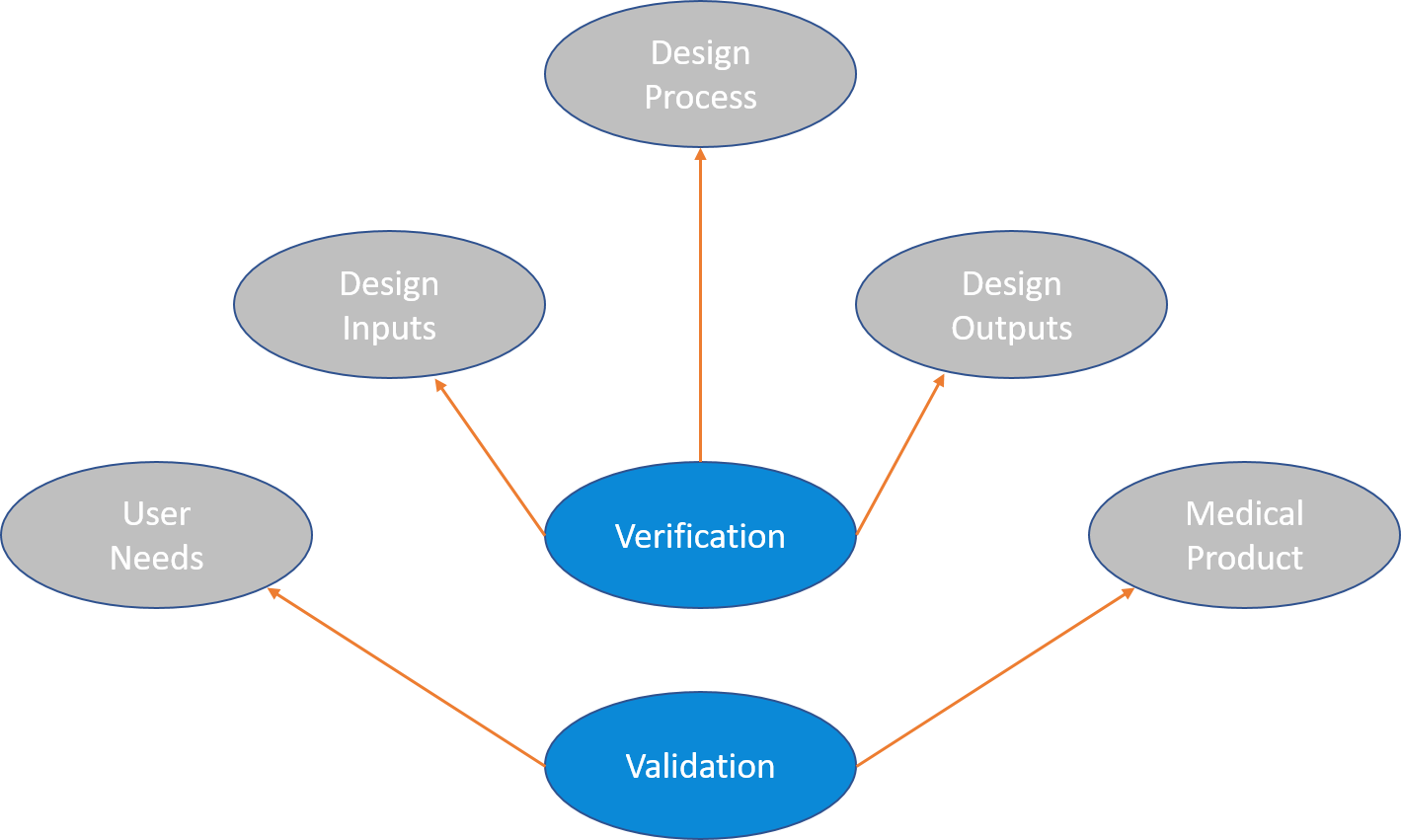
Validation vs. Verification
Key Aspects of Validation for Developers
Validation in embedded medical product development is essential for Healthcare IoT Devices to meet regulatory and safety standards. Embedded product testing and validation help ensure devices are effective and reliable in real-world scenarios. Our product validation services are designed to help companies achieve FDA approval for healthcare products efficiently.Requirement Traceability
In medical product development, each user requirement must be linked to one or more validation test cases. This traceability ensures that nothing is left untested. Tools such as IBM DOORS can help maintain this mapping.
For developers every feature implemented should have a corresponding validation path. For instance, if the requirement specifies that a ventilator must raise an alarm within 2 seconds of oxygen supply failure, validation ensures that this is achieved in real scenarios, not just in simulated conditions.
Validation Environment
Validation must be carried out in conditions as close to real-life usage as possible. Depending on the device, this could involve:
- Simulators and emulators for sensors and patient signals.
- Hardware-in-the-Loop (HIL) systems for end-to-end testing.
- Controlled test labs that can reproduce environmental factors such as temperature, humidity, or electromagnetic noise.
At Embien, we often build custom rigs to simulate the sensor signals using TestBot.
Formal vs. Empirical Validation
Formal Validation uses documented requirements and structured test cases mapped to each requirement. This ensures regulatory compliance and completeness.
Empirical Validation involves practical, real-world usage such as simulated patient data, environmental stress tests, and exploratory testing. It uncovers scenarios not always captured in requirements.
For example, in a diagnostic analyzer, formal validation would confirm accuracy within defined tolerances, while empirical validation might reveal that certain elements fail under higher humidity an insight only discovered through real-world trials.
Tools used:
- Test Management: TestRail, qTest.
- Automated Execution: Jenkins CI pipelines integrated with test benches.
Automation in Embedded product testing and validation
Manual validation is tedious and not scalable. Automated testing helps reduce errors, improve coverage and save time. For Healthcare IoT Devices and embedded product testing and validation, Developers can leverage:
- Continuous Integration (CI) pipelines that trigger validation tests on each new build.
- GUI automation tools such as Squish, TestBot for medical HMIs.
- Mobile automation tools like Appium for companion health apps.
Hardware-in-the-Loop (HIL) Simulators in Validation
HIL simulators bridge the gap between lab conditions and real-world environments. They allow developers to test how the device behaves with simulated physiological signals or clinical scenarios.
For example, during validation of a cardiac monitor, HIL systems can inject synthetic ECG waveforms that simulate arrhythmias, bradycardia, or sensor failures. Developers can observe how the complete system reacts under these controlled but realistic conditions.
Tools used:
- dSPACE HIL systems.
- National Instruments LabVIEW / PXI-based test benches.
- Custom FPGA-based simulators designed by teams like Embien for domain-specific signals.
Risk-Based Validation
Not all features carry the same risk. For instance, a cosmetic UI misalignment is low-risk, whereas an incorrect dosage calculation could be life-threatening. Standards like ISO 14971 emphasize risk-based approaches, which developers must incorporate in their validation activities.
By aligning validation effort with risk, developers ensure that patient safety is always prioritized.
Tools and Frameworks Useful for Developers
From our experience, some of the tools that developers can actively use for validation include:
- Requirement and Test Management: IBM DOORS.
- Automation: Jenkins, GitLab CI, Appium, Robot Framework.
- Traceability and Compliance: TestRail.
- Simulation and HIL: National Instruments LabVIEW, custom HIL setups, eTestBot.
The choice of tool depends on project size, regulatory requirements, and budget. At Embien, we have helped customers select and integrate these tools seamlessly into their workflows.
Conclusion - Validation for Medical Equipments and Healthcare IoT Devices
Validation in embedded medical product development is not just about checking boxes for regulatory approval. It is about ensuring that the device truly serves its intended purpose in the field, under the conditions in which it will be used.
For developers, this means looking beyond specifications and engaging with validation tools, frameworks, and workflows. By doing so, they not only build safer products but also improve their own productivity and confidence in the outcome.
Over the years, Embien has supported several medical device manufacturers in embedding validation into their development lifecycle. Some highlights include:
- Reusable Validation Frameworks – We developed frameworks that allow quick creation of new test cases for sensor-based devices, saving considerable developer effort.
- CI/CD Integration – By embedding validation tests into build pipelines, we enabled faster defect detection and improved developer productivity.
- Multi-Domain Capability – From embedded firmware and Android-based health apps to cloud dashboards, we have validated end-to-end medical ecosystems.
In summary, validation is a critical aspect of embedded medical product development that ensures devices are safe, effective, and compliant. Developers play a key role in this process by leveraging the right tools and approaches to validate their products thoroughly. At Embien, we are committed to helping our clients navigate this complex landscape with expertise and tailored solutions.
By leveraging advanced tools and automation, we streamline the validation process for medical devices. For a comprehensive overview of our engineering and validation expertise, visit our product engineering services page. Automation tools like TestBot can accelerate embedded product testing and validation for Healthcare IoT Devices. Why choose Embien for prototype testing and validation? Our team ensures every device is thoroughly tested and validated for real-world use. We support clients in navigating the complexities of validation in embedded medical product development, enabling successful product launches and regulatory compliance. Our expertise in embedded product testing and validation helps deliver safe, effective, and innovative Healthcare IoT Devices.